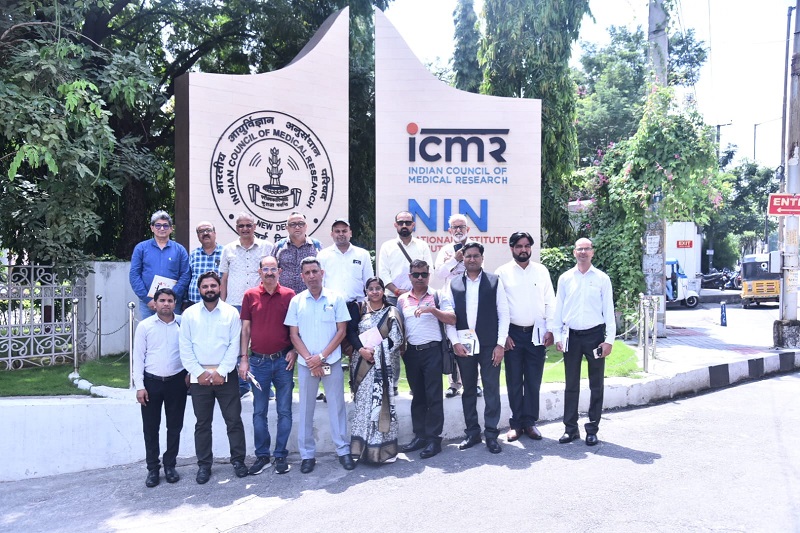
Media Delegation from Uttarakhand Visits ICMR–National Institute of Nutrition, Hyderabad
HYDERABAD, SEPTEMBER 02, 2026: A 15-member media delegation from Uttarakhand visited the ICMR–National Institute of Nutrition (ICMR–NIN) in Hyderabad today as part of the ongoing Hyderabad Press Tour organised by the Press Information Bureau (PIB).
The visit offered journalists practical insights into the institute’s pioneering contributions to nutrition research, public health education, and its role in informing national policies and welfare programmes.
Addressing the delegation, Dr. Bharati Kulkarni, Director, ICMR–NIN, highlighted the institute’s core mandate in generating scientific evidence on food composition, nutrient requirements, and dietary guidance. She explained that the Indian Food Composition Tables (IFCT) provide comprehensive nutritional data—detailing energy, protein, micronutrient, and mineral profiles of indigenous food items—which serve as critical reference material for researchers, the food industry, and public health policymakers.
Dr. Kulkarni also underscored the significance of the Nutrient Requirements for Indians and Recommended Dietary Allowances (RDAs), which define nutritional baselines across various physiological categories and age groups, forming the foundation of India’s statutory nutrition interventions.
Highlighting key tenets of the Dietary Guidelines for Indians (DGIs), Dr. Kulkarni emphasised that healthy dietary habits must be inculcated from infancy. She specifically highlighted the guideline advising zero added sugar intake for children under two years of age.
Addressing the dual burden of malnutrition, Dr. Kulkarni voiced concern over rising rates of overweight and obesity, particularly among children, driven by sedentary lifestyles and the excessive intake of foods high in fat, sugar, and salt (HFSS). Drawing a clear distinction between food security and nutrition security, she remarked that access to food alone does not guarantee nutritional well-being, emphasizing dietary diversity and behavioural change as indispensable pillars of public health.
Dr. Kulkarni also noted ongoing research on indigenous crops and millets from Uttarakhand, including Mandua, Jhangora, Cholai, and Koda, to map their specific nutrient profiles. She added that clinical and analytical studies evaluating the impact of ragi (finger millet) consumption on anemia reduction are currently in progress.
*Technical Sessions on Nutrition Communication*
The delegation attended technical briefing sessions conducted by Dr. Subba Rao M. Gavaravarapu, Scientist–G and Head, Nutrition Information, Communication & Health Education (NICHE) Division, ICMR–NIN.
Dr. Subba Rao addressed the contemporary nutrition paradox, unpacking the coexistence of undernutrition, micronutrient deficiencies, and lifestyle-induced metabolic disorders. He stressed the pivotal role of media professionals in bridging the gap between scientific nutrition data and daily public consumption habits, urging responsible reporting to dispel food fads and promote evidence-based dietary practices.
*Laboratory Visits and Cultural Tour*
The journalists toured advanced laboratory facilities at ICMR–NIN and interacted with researchers to observe ongoing research in food analysis and lipid chemistry.
Later in the day, the delegation visited the Salar Jung Museum as part of the tour’s cultural component, gaining an understanding of Hyderabad’s historic heritage and archival collections.
About the Author