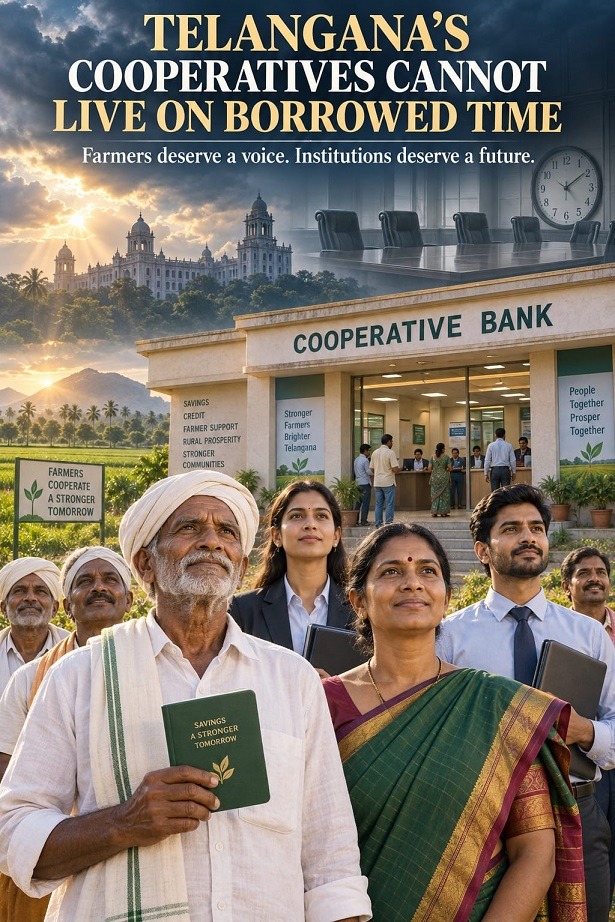
The State must break the silence on a lasting future for farmer-owned institutions
Repeated interim arrangements cannot provide a lasting future for institutions that finance agriculture, protect rural savings and give farmers a voice in their own development
KARIMNAGAR, SEPTEMBER 22, 2026: A farmer cannot postpone sowing until the next government order. A rural enterprise cannot suspend its plans while institutions wait for administrative clarity. Yet the documents concerning Telangana’s cooperative banking system reveal a succession of temporary arrangements, extensions, changes in management and subsequent legal proceedings. They raise a question that deserves a clear public answer: what is the State’s plan for restoring stable, accountable and democratic cooperative governance?
This question reaches far beyond who occupies a chairman’s office. It concerns the institutions through which farmers obtain credit, villages organise economic activity and ordinary members exercise collective ownership. When their governance remains uncertain, the issue belongs at the centre of agricultural policy.
The record does not support a claim that the government has taken no action. Several orders have been issued. What it does support is a demand for something more meaningful than another administrative arrangement: a publicly explained path towards institutional stability, member participation and timely elections.
Temporary Orders Cannot Build a Permanent Future
The sequence of decisions illustrates the problem. Proceedings dated February 22, 2025, appointed the outgoing managing committee members of Karimnagar District Cooperative Central Bank as a person-in-charge committee for six months from February 25, 2025, or until further government orders, whichever came earlier. This was an interim appointment following the completion of their tenure. [1]
The proceedings of August 25, 2025, recorded that the earlier arrangement had expired on August 24. They appointed the outgoing chairman as person-in-charge from August 25 until further government orders, while stating that separate orders would follow regarding other members after scrutiny. Significantly, the proceedings themselves recognised the urgency: a DCCB is a financial institution in which major policy decisions must be taken regularly. [2]
That observation deserves emphasis. The need for functioning governance was acknowledged within the administration’s own record. It therefore cannot be treated as a peripheral concern raised only by those seeking office.
A further change followed through G.O.Rt.No.598, dated December 19, 2025. The government appointed the respective headquarters Collectors and District Magistrates as official persons-in-charge for nine DCCBs. The stated duration was six months, until elections were conducted, or until further government orders, whichever occurred first. The order cited the proposed reorganisation of PACS and DCCBs in relation to new districts and mandals. [3]
Reorganisation Needs a Deadline and Members Deserve Answers
Reorganisation may have a legitimate administrative purpose. Institutions must remain accessible as population, economic activity and administrative boundaries change. But a proposal to reorganise a cooperative network should be accompanied by an explanation of its objectives, financial implications, and consultation process and completion schedule. Members deserve to know how their society’s assets, liabilities, representation and banking relationships would be affected.
Reorganisation needs a timetable. Democratic governance needs a destination.
The subsequent legal developments must be described accurately. In the supplied order dated May 21, 2026, concerning W.P.Nos.16519, 16212 and 16224 of 2026, the Telangana High Court issued an interim direction that G.O.Rt.No.598 should not be given effect to until the next hearing, then listed for June 12, 2026. The Registrar’s memorandum dated June 12 described the suspension as continuing until further orders and instructed the addressed District Cooperative Officers to take immediate implementation action, with copies to the CEOs of all nine DCCBs. [4, 5]
These are distinct documents, and an interim direction is not a final judgment. The materials reviewed do not establish the subsequent judicial position or the present management arrangement in every bank. They do, however, demonstrate why a clear, consolidated public statement is necessary. Members and employees should be able to understand the governing position without reconstructing it from successive orders and memoranda.
The phrase “until further orders” can serve an administrative purpose. It cannot, by itself, communicate a development strategy.
When Governance Waits Rural Opportunity Can Slip Away
For a cooperative institution, uncertainty is not merely a matter of terminology. Management must plan lending, review recoveries, address audit findings, invest in technology and maintain internal controls. Employees need clarity about responsibility and approval powers. Members need a reliable forum in which to raise concerns. Depositors need confidence in the institution’s professionalism and continuity.
The supplied documents do not establish that banking services have stopped or that deposits are unsafe. Such claims would require separate evidence. The concern is that prolonged uncertainty can make necessary decisions harder, weaken accountability and distract institutions from their economic purpose.
A bank may continue its daily transactions while its longer-term plans lose momentum. That possibility should be addressed before it becomes measurable damage.
The Farmer Must Have a Voice in the Institution, the Farmer Owns
At the centre of the cooperative idea is a simple principle: the people who use and own an institution should have a meaningful voice in its direction. PACS connect members with local financial and agricultural services. DCCBs support the district-level cooperative credit structure. Their effectiveness depends on financial discipline, competent management and the confidence of participating societies and members.
Elections therefore deserve serious attention. They provide an opportunity to review performance, question decisions and renew leadership. Repeatedly extending former officeholders and replacing them with officials are both arrangements that require explanation; neither should become a substitute for a credible process of democratic renewal.
This argument does not require defending every elected committee. Poor performance, conflicts of interest and misconduct must be addressed through evidence and the applicable procedures. Member ownership carries responsibilities as well as rights. Strong cooperatives require transparent accounts, effective audits, responsible lending and consequences for wrongdoing.
The task is to combine democratic accountability with professional competence. Elected representatives should understand the needs of their members. Executives should have the expertise and clearly defined authority to manage banking operations. Decisions should be recorded, conflicts disclosed and performance reviewed. These principles should survive changes in political leadership.
Telangana Cannot Afford to Miss the Cooperative Opportunity
The wider national context makes the need for clarity more pressing. A Union government backgrounder published on January 18, 2026, reported that 79,630 PACS had been approved for computerisation and 59,261 were actively using ERP software. It also described model bye-laws enabling more than 25 business activities and broader participation by women and Scheduled Caste and Scheduled Tribe communities. These are dated national figures, but they show the scale and direction of the cooperative development agenda. [6]
Telangana should explain how its governance arrangements will support participation in these opportunities. Computerisation needs trained employees, accurate records and effective supervision. Business expansion needs feasibility studies, investment decisions and accountable management. A society cannot become economically stronger merely because its permitted activities have increased.
Locally viable cooperative projects could include storage, grading, agricultural processing, machinery hiring, dairy services and digital access. Each should respond to a demonstrated need and meet the relevant financial and regulatory requirements. The objective should be better services and sustainable income for members.
Give Women and Youth a Place Where Decisions Are Made
Women and young people must have a meaningful place in that future. Women farmers, self-help group members and rural entrepreneurs should participate in institutional decisions, as well as benefit from services. Educated rural youth can contribute skills in accounting, technology, marketing and enterprise development. A cooperative renewal programme should create practical routes for their participation.
Employees also deserve a voice in reform. They handle the daily work through which policy becomes service. Their experience can help identify operational delays, training needs and weaknesses in internal systems. Consultation with employees, members and affiliated societies would make institutional reform better informed.
Break the Silence with a Roadmap the Public Can Measure
The immediate response should begin with public clarity. The State should publish an institution-wise statement of the applicable governance arrangements, identify the authorities responsible for decisions and explain how continuity of essential operations is being maintained.
It should then present a credible election roadmap, consistent with applicable law and judicial directions. Where reorganisation remains necessary, the government should disclose the work completed, the issues outstanding and the expected milestones. If a timetable cannot yet be finalised, members deserve specific reasons and a date for the next public update.
A parallel development programme should set measurable priorities for financial strength, audit compliance, digital capability, staff training and member services. Progress should be reported regularly. The government’s performance should be judged by the stability and usefulness of the institutions it helps sustain.
The central question is not answered by counting the orders issued. It is answered when cooperative members can see who is responsible, how decisions are made and when they will exercise their voice.
Rural Development Cannot Remain Until Further Orders
Telangana’s rural economy needs institutions capable of thinking beyond the next extension. Its farmers deserve a cooperative system with a clear mandate and a dependable future.
The government must turn a succession of temporary arrangements into a credible plan for cooperative renewal. Rural development cannot remain “until further orders.”
Source Notes
[1] Supplied 01.pdf: Rc.No.1297/2025/DCCB, dated February 22, 2025. This compilation also contains copies of later documents listed below.
[2] Supplied 02.pdf: Rc.No.1297/2025/DCCB, dated August 25, 2025.
[3] Supplied 03.pdf: G.O.Rt.No.598, Agriculture and Cooperation (Coop.II) Department, dated December 19, 2025, with annexure.
[4] Supplied 04.pdf: Telangana High Court interim order dated May 21, 2026, in W.P.Nos.16519, 16212 and 16224 of 2026.
[5] Supplied 05.pdf: Rc.No.1297/2025/CR-2, dated June 12, 2026, concerning implementation of the High Court order.
[6] Press Information Bureau, International Year of Cooperatives 2025, published January 18, 2026. National figures reflect that publication date.
About the Author