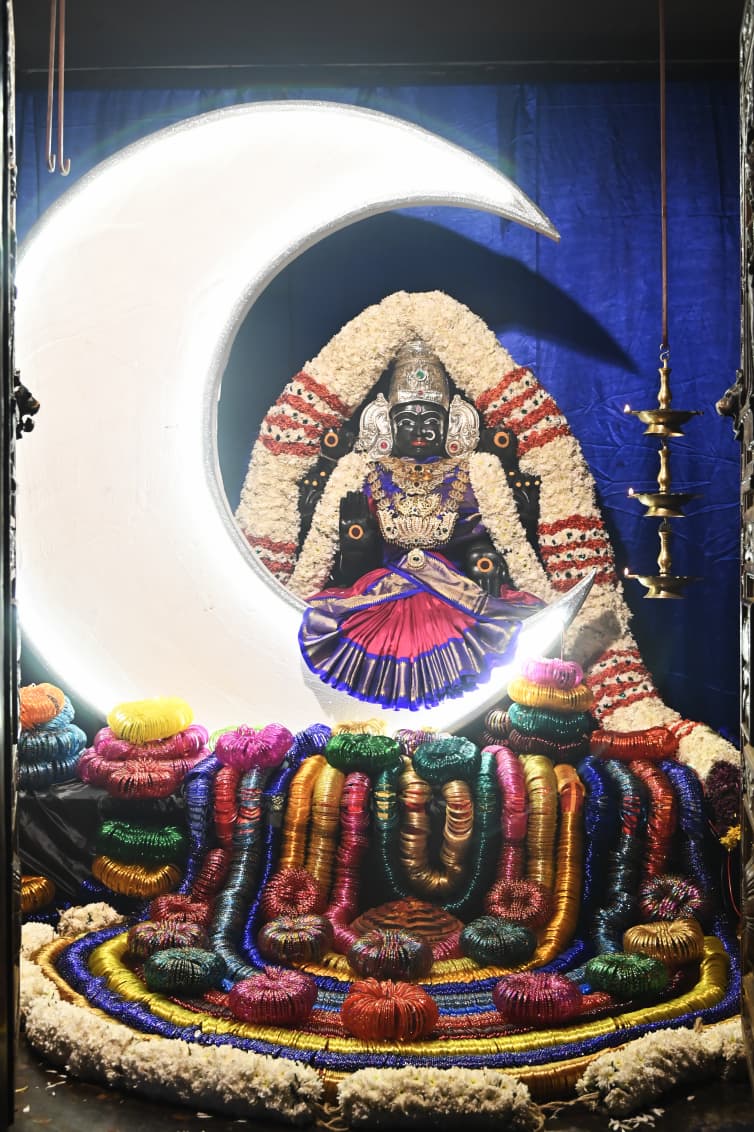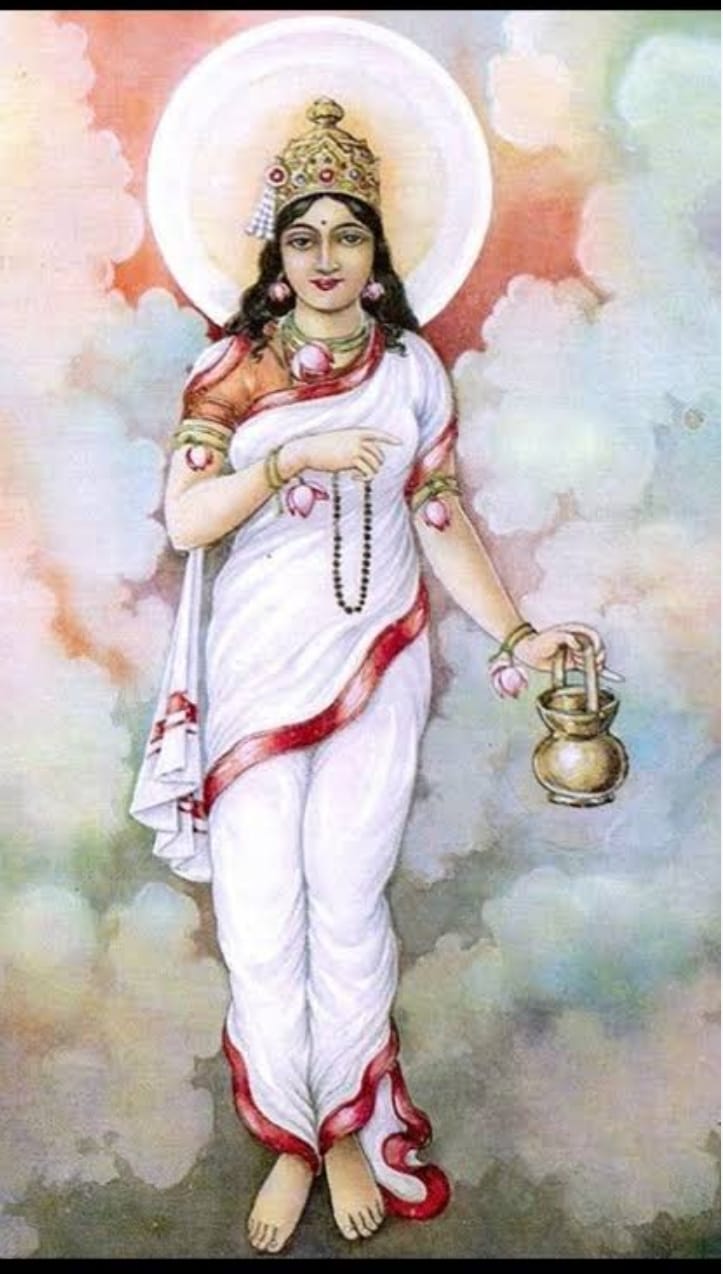
From Sati to Parvati… From love to penance… From determination to fulfilment…
To understand the divine play of Adi Parashakti, it is not enough to look only at the forms She has assumed. We must also perceive the philosophy hidden behind those forms. For the story of the Divine Mother is not merely meant to be heard… it is also meant to help us understand ourselves.
According to the Puranas, Goddess Sati, who had married Lord Shiva in her previous birth, relinquished her body in the sacred fire of yoga after being unable to bear the humiliation inflicted upon Shiva during the yajna performed by her father, Daksha. Subsequently, the Divine Mother was reborn as Goddess Parvati, the daughter of Himavan and Menadevi.
As Sati, She had chosen Lord Shiva as Her husband. As Parvati, She resolved once again to attain the very same Lord Shiva. Sati and Parvati — different forms, different births. Yet, the divine love underlying these forms remained the same.
Here, a question arises. If Adi Parashakti is the Supreme Divine Power, why did She undertake penance? When Her very will is the source of creation, why did She need to perform sadhana?
Perhaps, discovering the answer to this question is the first step towards understanding the deeper essence of Brahmacharini.
- Brahmacharini — The Power That Remained Steadfast in Her Resolve
Parvati resolved to attain Lord Shiva as Her husband. However, Shiva was the embodiment of renunciation. Immersed in meditation, He remained absorbed in penance, transcending the external world.
Although Parvati’s parents attempted to change Her decision, She did not abandon Her resolve. She knew Her goal. She also understood the intensity of the discipline required to attain it.
Therefore, She chose the path of penance. Similar situations arise in our lives, too. When we choose a goal, those around us may consider it impossible. Circumstances may not favour us. Sometimes, we may even begin to doubt our own decisions.

Yet every determination encounters a test before it reaches fulfilment. Is that test meant to make us abandon our goal? Or is it meant to prepare us to become worthy of attaining it?
The story of Parvati reveals the second perspective.
True determination does not mean choosing a path without obstacles. It means cultivating the strength to overcome those obstacles with wisdom, even when they arise.
- Tapas — From Desire to One-Pointed Focus
According to the Puranic accounts, Goddess Parvati performed intense penance for thousands of years.
Initially, She subsisted on a simple diet. Later, She consumed only leaves. Eventually, She gave up even leaves and continued Her penance.
Because She renounced even leaves during Her austerities, Parvati became renowned by the name Aparna.
This should not be viewed merely as a story about giving up food. Behind it lies a spiritual message concerning penance, mastery over the senses, and one-pointed concentration.
The mind wanders among countless desires. We may aspire to achieve a goal while remaining attached to habits that work against it. We may wish to practise discipline while simultaneously giving in to distractions that divert our attention.
Tapas means recognising this restlessness within ourselves and directing our energy towards a single purpose.
Through Her penance, the Divine Mother demonstrated complete concentration on Her goal.
Her tapas also invites us to pause and ask ourselves:
What is it that we truly seek?
How prepared are we to work towards that goal?
What stands in the way of our goal — our circumstances or the restlessness within us?
Determination gives direction to desire. Sadhana gives strength to determination. Discipline sustains that sadhana.
This is the essence of Brahmacharini.
- Kamadeva’s Flower Arrow — Desire Before Renunciation
During this time, an asura named Tarakasura began tormenting the gods. He had obtained a boon from Brahma that he could be killed only by a son of Lord Shiva.
The gods believed that only the marriage of Shiva and Parvati, followed by the birth of their son, could make the destruction of Tarakasura possible.
Therefore, they sought the help of Kamadeva, the god of love and desire.
Kamadeva shot his flower arrow at Shiva, who was immersed in meditation. Angered by this interruption, Shiva opened His third eye, reducing Kamadeva to ashes.
This episode reminds us of Shiva’s renunciation, Kamadeva’s power of desire, and the inward focus required for spiritual practice.
Desire can motivate a person to move forward. The same desire can also make the mind restless.
But spiritual practice teaches us an important distinction: having a desire is one thing; becoming a slave to that desire is another.
Parvati did not allow Her goal to remain merely a desire. She transformed it into tapas.
When desire is guided by determination, it becomes a goal. When determination is strengthened by sadhana, the pursuit of that goal becomes a spiritual journey.
- Prakandasura — The Power That Could Not Be Disturbed from Her Penance
Some Puranic accounts also describe the episode of an asura named Prakandasura.
According to this account, when Parvati was in the final stage of Her penance, Prakandasura attacked Her with an army of millions of asuras.
Seeing the Divine Mother in danger, Goddess Lakshmi and Goddess Saraswati came forward to help Her. During the battle, the water from the kamandalu beside Parvati is said to have flowed forth like a great flood, sweeping away the asura army. Subsequently, flames emanating from the Mother’s eyes reduced Prakandasura to ashes.
This episode allows us to contemplate two complementary aspects of the Divine Mother.
One is the ascetic who practises in silence, turning inward with unwavering concentration.
The other is the boundless power that confronts unrighteousness when the need arises.
Both these qualities are necessary within us, too.
We must know when to remain silent. We must know when to turn inward and focus our minds. At the same time, we must also recognise when to stand courageously in defence of our dharma.
True spirituality does not make us weak. It cultivates discernment, courage, and inner stability within us.
- Shiva’s Test — Seeing the Essence Beyond the Form
Parvati’s intense penance attracted the attention of Lord Shiva. Nevertheless, according to the Puranic accounts, Shiva once approached Her in the guise of a brahmachari to test Her resolve.
He spoke of Shiva’s renunciant nature, His unusual appearance, His dwelling in cremation grounds, and His adornment with serpents. He questioned why She wished to marry someone with such unconventional characteristics and suggested that She abandon Her decision.
But Parvati remained undisturbed.
Shiva’s external appearance was not what mattered to Her. What mattered was the Supreme Principle embodied in Him.
Some accounts also describe Shiva testing Her knowledge and spiritual maturity by asking questions. Finally, recognising Her unwavering devotion and determination, Shiva revealed His true form and consented to marry Her.
Here, we encounter another spiritual message.
We cannot fully understand something merely by looking at its external appearance. Wisdom is necessary to perceive the principle underlying it.
The same truth applies to devotion. If we see the Divine Mother only as a form, we perceive the image of the deity. But when we seek to experience the consciousness, power, and divine principle underlying that form, worship becomes a process of self-reflection.
Parvati did not seek Shiva merely as an individual; She recognised the Supreme Principle within Him.
This is the deeper significance of Her sadhana.
- Why Did Adi Parashakti Perform Penance in Human Form?
This is one of the most important questions at the heart of Brahmacharini’s philosophy.
Why did Adi Parashakti, the source of all creation, take birth in human form and undertake intense penance through a human body?
From a spiritual perspective, this divine narrative can be understood as a profound teaching.
Through Her sadhana, the Divine Mother reminds us of the inner power that exists within every human being.
An immense power lies within us, too. However, our fears, doubts, restlessness, and discouragement may prevent us from recognising it.
The form of Brahmacharini inspires us by showing that human beings can undertake even the most demanding disciplines and dedicate themselves wholeheartedly to their goals through consistent effort and self-discipline.
However, sadhana does not mean causing suffering to ourselves. It means caring for our body and mind with wisdom while cultivating the discipline necessary to pursue our goals.
The true message of the Mother’s penance does not lie merely in the intensity of the hardships She endured. It lies in Her unwavering commitment to Her resolve.
Adi Parashakti teaches us to recognise the power within us, steady the mind, choose our goals in accordance with dharma, and practise consistently towards their fulfilment.
- Brahmacharini — The Power That Awakens Within Us
Every person has a goal in life.
A student may aspire to excel in education. A spiritual seeker may long for spiritual experience. Another person may aim to support their family or fulfil their responsibilities with sincerity.
Our goals may differ, but certain qualities are essential for achieving them.
Determination. Patience. Discipline. Self-confidence. Consistent practice.
Remaining committed to a decision through difficult circumstances, moving forward without being overcome by fear, and continuing to make efforts when faced with challenges are among the profound lessons Goddess Brahmacharini offers us.
However, determination does not mean stubbornness. Our goals should be righteous. Correcting our approach according to circumstances while preserving our values is also part of the path of sadhana.
The story of the Divine Mother invites us to ask ourselves:
How committed are we truly to our goals?
When the mind becomes restless, can we bring it back to our purpose?
When difficulties arise, can we continue to trust ourselves?
Are we making an effort to recognise the power within us?
Seeking answers to these questions is an important step in our inner journey.
8 From Tapas to the Inner Journey
It is not merely about learning the stories of the Divine Mother. It is about journeying alongside Her by understanding the philosophy hidden within those stories and applying it to our lives.
The story of Sati reminds us of devotion and dedication.
The story of Parvati reminds us of determination.
The name Aparna reminds us of unwavering commitment to penance.
The form of Brahmacharini reminds us of discipline, self-restraint, and consistent spiritual practice.
In all these forms, it is the principle of Adi Parashakti that we seek to contemplate.
Worshipping the Divine Mother is not merely about offering prayers to a deity outside ourselves. It is also an effort to awaken the consciousness, discernment, courage, and love within us.
Recognising our weaknesses and striving to overcome them, steadying the mind, and fulfilling our responsibilities with dedication can all become forms of sadhana in our everyday lives.
Goddess Brahmacharini reminds us of a profound truth:
The path to the Divine begins within us. Determination is the first step on that path. Sadhana is the journey. Self-knowledge is its light.
Conclusion — The Mother Is the Resolve; the Mother Is the Sadhana
As Sati, the Divine Mother chose Lord Shiva as Her husband. Reborn as Parvati, She undertook intense penance to attain that very same Lord Shiva.
What we witness in this divine narrative is not merely a marriage. It is a profound journey shaped by determination, spiritual discipline, patience, and unwavering commitment.
The story of Adi Parashakti performing tapas in human form conveys a powerful message: we must recognise the strength that already exists within us.
When difficulties arise, let us not lose heart. When doubts emerge, let us reflect with wisdom. Let us continue moving forward with dedication towards the righteous goals we seek to achieve.
For the Divine Mother is not merely a deity whom we worship externally. Her principle can also be contemplated in the courage, determination, love, and consciousness within us.
Let us remember Her. Let us seek to understand Her philosophy. Let us practise Her teachings in our lives.
Ultimately, there is one profound truth to discover on this spiritual journey:
The resolve that awakens the power within us is the Mother. The inspiration that sustains our sadhana is the Mother. The source of the wisdom that illuminates our inner being is none other than Adi Parashakti.
Om Devi Brahmacharinyai Namah.
About the Author