The PACS and DCCBs should no longer be seen as old rural credit institutions, but as the people-owned economic machinery of rural India
For a small farmer, PACS is not merely an office. It is a place where he can seek credit, support, inputs, advice and dignity.
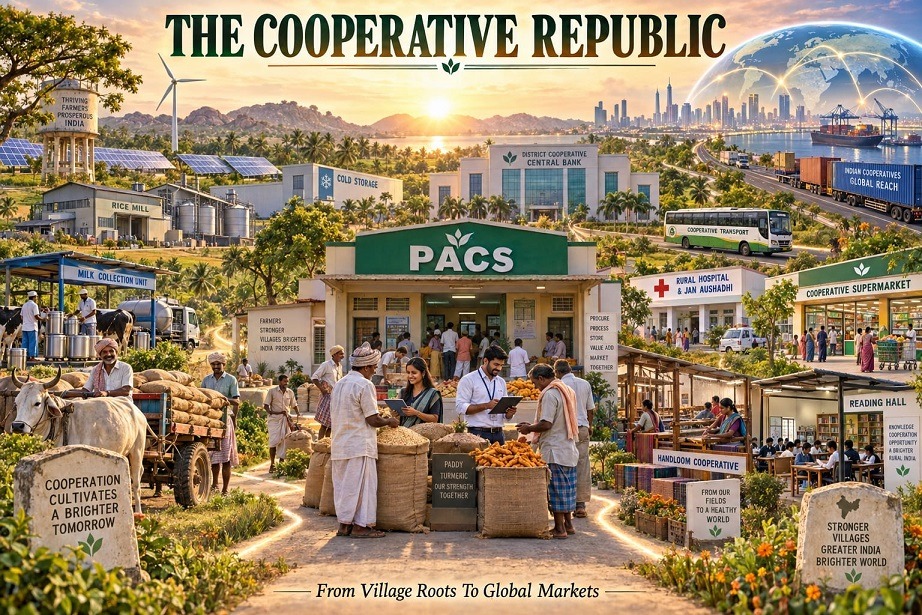
PACS have diversified their business activities to meet all the requirements of the farmers in the villages such as lending loans for crops, selling seeds, fertilizers, operating warehouses, solar power plants, rice mills, seed processing units and more
Editorial Article
KARIMNAGAR, SEPTEMBER 16, 2026: This article explains why PACS and DCCBs should be seen not merely as old rural credit institutions, but as people-owned platforms capable of transforming agriculture, local business, education, health, transport, industry and exports. It uses simple examples so that ordinary readers, students, farmers, employees, elected representatives and policy makers can understand the strength of cooperation.
What A Future PACS Can Do
| Area | Simple Meaning | Village Benefit |
| Agriculture | Crop loans, seeds, fertilisers, machinery, storage and processing | Better farming and better prices |
| Markets | Grading, packing, branding, supermarkets and online sales | Farmers become partners in value |
| Transport | Cooperative buses, vans and produce transport where legally permitted | Students, farmers and workers get mobility |
| Health | Jan Aushadhi Kendras, clinics, diagnostics and cooperative hospitals | Affordable health support |
| Education | Reading halls, libraries, education loans and foreign study support | Rural youth get opportunity |
| Industry | Rice mills, garment units, dairy, poultry, water plants and handloom clusters | Jobs and local enterprise |
| Infrastructure | Road works, storage yards, function halls, sports courts and swimming pools where permitted | Community assets and youth development |
| Energy | Solar and wind power projects | Long term income and green growth |
| Exports | Rice, turmeric, millets, milk products, garments and handloom goods | Village products reach the world |
The Simple Meaning Of Cooperation
A cooperative is a simple but powerful idea. It means ordinary people come together, pool their trust, use their money carefully, share responsibility and build their own future.
If one farmer wants to build a cold storage, he may not be able to do it. If one weaver wants to reach national markets, it is difficult. If one unemployed graduate wants to start an industry, it may be impossible. But when people come together through a cooperative, what is impossible for one person becomes possible for an entire community.
That is why Primary Agricultural Cooperative Societies and District Cooperative Central Banks must no longer be seen as old rural credit institutions. They must be seen as the people owned economic machinery of rural India.
PACS: The First Financial Door Of The Village
Before commercial banks and private banks entered villages, PACS were already standing beside farmers. A PACS knows the farmer, the land, the season, the crop and the family difficulty. It is not a distant institution. It is a village institution.
A private bank may see an account number. A cooperative sees a member. That is the difference.
For a small farmer, PACS is not merely an office. It is a place where he can seek credit, support, inputs, advice and dignity.
DCCB: The Backbone Of Rural Credit
If PACS is the village level institution, the District Cooperative Central Bank is the district level backbone. DCCB supports PACS with finance, banking services, monitoring, refinance linkages and institutional strength.
A strong DCCB can make hundreds of PACS strong. A weak DCCB can weaken the entire rural credit chain. Therefore, DCCBs should not remain only crop loan banks. They must become district development banks.
The Forgotten Glory And The Reason For Decline
For decades, cooperatives were the real rural banks of India. They served farmers, tenants, milk producers, weavers, small traders, artisans and village households when modern banking was not easily available.
They were not just lending institutions. They were schools of thrift, discipline, collective responsibility and leadership. Many rural leaders first learned public life through PACS, DCCBs, marketing societies and cooperative bodies.
After the 1980s, many cooperative institutions slowly weakened. Political interference, poor recovery, delayed audits, weak governance, lack of professional management, technology gaps and increasing competition from commercial banks damaged the system. The idea of cooperation did not fail. The system was weakened.
The Vaidyanathan Lesson
The decline of cooperative credit was recognised at the national level. The Vaidyanathan Committee was appointed to examine revival of the Short Term Cooperative Credit Structure.
Its broad message was clear. Cooperatives must be democratically elected, financially revived, professionally managed and institutionally accountable.
The revival support that followed was not charity. It was a national recognition that rural credit cannot be left only to private profit or market forces. If rural India must grow, cooperative credit must grow.
Amit Shah And The New Ministry Of Cooperation Moment
A major national turning point came with the creation of the Union Ministry of Cooperation. Under Union Home and Cooperation Minister Amit Shah, PACS computerisation, business diversification and creation of new PACS have entered national policy discussion.
The Government of India approved computerisation of about 63000 functional PACS with a total budget outlay of Rs 2516 crore, including a Government of India share of Rs 1528 crore. The official objective is to improve efficiency, transparency and accountability and to help PACS diversify into multiple services. The project is expected to benefit nearly 13 crore farmers, most of them small and marginal farmers.
The official release also states that PACS are the lowest tier of the three tier Short Term Cooperative Credit Structure and account for 41 percent of Kisan Credit Card loans given by all entities in the country, with 95 percent of those PACS linked KCC loans going to small and marginal farmers.
Amit Shah has also spoken of creating two lakh new PACS by 2029 and connecting PACS with 22 different business activities to improve financial viability. This is the correct direction. But one warning must be remembered. Computerisation alone will not save cooperatives. A computer in a weak institution only digitises weakness. Technology must be joined with honesty, recovery discipline, democratic elections and professional governance.
PACS Must No Longer Be Only Loan Counters
The old PACS gave crop loans. The future PACS must give complete rural economic support.
A modern PACS can provide crop loans, seeds, fertilisers, pesticides, farm machinery, tractors, harvesters, warehouses, cold storages, grading centres, rice mills, dal mills, oil mills, milk collection centres, dairy units, poultry units, mutton and chicken marts, purified drinking water plants, petrol bunks, supermarkets, cooperative retail stores, garment units, handloom support centres, solar power units, wind power projects, Jan Aushadhi Kendras, rural clinics and cooperative hospitals.
It can also support public transport in rural areas, wherever law and government permissions allow. A cooperative bus or van service can connect villages to schools, colleges, hospitals, markets and railway stations. It can help students, farmers, workers, women and elderly people travel safely and affordably.
Roads Sports Libraries And Public Facilities
A PACS can also participate in local infrastructure works subject to legal permissions, technical standards and government guidelines. Village approach roads, internal roads, storage yards, market platforms, community assets and maintenance works can be taken up through cooperative models where the law permits.
A cooperative can build sports courts, playgrounds, indoor halls and swimming pools. A village that can build a function hall for marriages can also build a sports court for youth. A society that earns income from business can invest in health, sports and discipline.
A cooperative can build reading halls and libraries for unemployed youth preparing for competitive examinations. In towns and mandal headquarters, thousands of young people struggle for a quiet place to study. A PACS or DCCB supported cooperative library can become a temple of employment. If one village produces ten government employees, ten bank employees, ten teachers or ten entrepreneurs because of such a reading hall, that society has done more than banking. It has changed families.
Education Health And Youth Opportunity
A cooperative can support poor but talented rural youth to study abroad through education loans, scholarship funds, member guarantees and counselling support. A farmer child should not lose a global opportunity only because the family has no financial backing. A people owned bank must stand behind people owned dreams.
A cooperative can run a Jan Aushadhi Kendra and provide affordable medicines. It can run a small diagnostic centre with proper approvals. It can create health awareness camps. It can support insurance enrolment. It can connect rural families to affordable healthcare.
A cooperative can run function halls. In villages, marriages and family functions often push poor families into debt. A cooperative function hall can provide decent facilities at reasonable rates. The income can come back to the society. The benefit can go back to members.
Rural Industry Exports And Value Addition
A cooperative can enter garment industries. Rural women, youth and self help groups can be trained in stitching, uniforms, school dresses, hospital linen, workwear and handloom based fashion. DCCBs can finance garment clusters. PACS can organise workers. Marketing societies can sell products. Exports can follow.
A cooperative can strengthen weavers by supplying yarn, dyes and designs, providing working capital, creating online catalogues, participating in exhibitions and exporting handloom products. Then the weaver does not remain a helpless worker waiting for middlemen. He becomes part of a global rural enterprise.
A cooperative can transform milk into a brand, paddy into packaged rice, turmeric into export grade powder, chillies into branded spice, millets into health products, vegetables into processed foods, cotton into garments and rural skill into global value. This is the difference between production and prosperity.
Simple Examples Anyone Can Understand
Example one is paddy. Today, a farmer grows paddy and sells it quickly because he needs money. Many times, he does not get a good price. In a cooperative model, PACS gives the crop loan, supplies seed, arranges machinery, stores paddy, mills it into rice, packs it under a cooperative brand and sells it in supermarkets and online. The farmer receives a better share of the final value.
Example two is milk. A woman producing ten litres of milk a day may sell it at a low price. But if 500 families join through a cooperative, the society can collect milk, test quality, chill it, package it and produce curd, ghee, butter, paneer and sweets. Milk becomes a rural business.
Example three is transport. If students, farmers and workers struggle to reach colleges, hospitals and markets, a cooperative transport service can solve a daily village problem and create employment at the same time.
Example four is education. A cooperative reading hall with clean desks, lights, internet and newspapers can help rural youth prepare for jobs. A society that helps one youth get employment helps an entire family rise.
Why Cooperatives Are Stronger Than Corporates In Rural India
A corporate company can build a supply chain. But a cooperative can build a people economy.
A corporate comes to the village to buy and sell. A cooperative belongs to the village itself. A corporate first answers to its shareholders. A cooperative first answers to its members.
That is why cooperatives can become India strongest rural economic model if they are honestly governed and professionally managed.
Role Of Central Government
The Central Government must continue to give policy support, financial support, digital infrastructure and legal clarity. It must help PACS diversify into lawful and viable businesses.
It must support cooperative exports, food processing, renewable energy, healthcare, rural transport, retail marketing, warehousing, education support, Jan Aushadhi Kendras, garment industries and rural infrastructure models.
PACS computerisation is a good beginning. The next stage must be PACS enterprise development. The Ministry of Cooperation must become the national engine for this transformation.
Role Of State Governments
State Governments must conduct cooperative elections on time. They must protect cooperative autonomy. They must strengthen audit systems. They must train elected members. They must prevent unnecessary political interference.
A cooperative without elections is a body without a heartbeat. A cooperative without autonomy is a vehicle without fuel.
State Governments must remember that PACS and DCCBs are not temporary administrative bodies. They are member owned democratic institutions.
Role Of RBI And NABARD
RBI must protect depositors and ensure prudential discipline. Capital adequacy, risk management, fraud prevention, cyber security and governance must be strong.
NABARD must provide refinance, supervision, training, business planning and rural innovation support. It should become the knowledge partner of the next cooperative revolution.
Regulation must not create fear. Regulation must create strength. Good DCCBs should be encouraged to expand carefully into new rural businesses.
Role Of Employees
Employees are the real face of cooperatives. The branch manager, supervisor, accountant, field officer, PACS secretary and recovery staff decide whether the public trusts the system.
Every correct loan strengthens the bank. Every recovered rupee protects the member. Every clean record builds confidence. Every respectful conversation with a farmer creates goodwill. Every audit compliance protects the institution.
Employees are not merely staff. They are the field soldiers of rural finance.
Why Educated Youth Must Enter Cooperative Leadership
Educated youth must not think politics begins only with MLA or MP elections. Public life can begin from PACS.
A young graduate who understands agriculture, banking, law, accounting, technology, logistics, digital marketing and business can transform a PACS. He can create online sales. She can build farmer brands. They can introduce transparent records, digital payments, cooperative transport, reading halls, Jan Aushadhi Kendras, garment units and profitable rural services.
Cooperative elections are not small elections. They are rural political schools. The next great leader may not come from a television debate. He may come from a PACS, a milk society, a weavers cooperative, a DCCB board or a village marketing society.
Why Experts Are Needed In Committees
Democracy gives legitimacy. Expertise gives direction.
A DCCB Board handles public deposits, crop loans, business finance, government schemes and farmer livelihoods. Such decisions cannot be taken only with emotion. They need knowledge.
Therefore, key committees must include experts in banking, agriculture, law, audit, technology, risk management, marketing, exports, renewable energy, health administration, transport and rural business. Elected leaders must represent the people. Experts must guide the institution. Together, they can protect both democracy and money.
How Cooperatives Can Strengthen India Economy And Rupee
A strong rupee does not come only from speeches. It comes from production, exports, savings and confidence.
If cooperatives help farmers process and export rice, turmeric, millets, pulses, cotton products, pickles, jaggery, spices, milk products, garments and handloom goods, India earns more value.
If villages produce more, import less and export more, the national economy becomes stronger. If rural savings grow, banks become stronger. If local enterprise expands, employment grows. If cooperative businesses grow, wealth remains in villages.
The Second Cooperative Movement
The first cooperative movement gave rural India access to credit. The second cooperative movement must give rural India ownership, markets, technology, health, education, transport, industry, dignity and global reach.
PACS must dream beyond loans. DCCBs must think beyond survival. Governments must protect autonomy. RBI and NABARD must guide with wisdom. Employees must rise with responsibility. Members must demand transparency. Experts must join governance. Educated youth must step forward.
If this happens, cooperatives will not merely return to old glory. They will create a new glory.
Conclusion
The future of India may not be written only in corporate boardrooms. It may be written in PACS meetings, DCCB boardrooms, farmer warehouses, milk chilling centres, handloom clusters, garment units, reading halls, sports courts, solar farms, cooperative supermarkets, rural transport networks, Jan Aushadhi Kendras and export desks run by village born institutions.
The world is waiting for a model that combines democracy, finance, production and justice.
India already has that model.
It is called cooperation.
Public Sources Referred
- Press Information Bureau Ministry of Cooperation 29 June 2022: Cabinet approval for computerisation of about 63000 PACS with total outlay of Rs 2516 crore and Government of India share of Rs 1528 crore; expected benefit to nearly 13 crore farmers.
- Ministry of Cooperation public communications: National focus on PACS computerisation, transparency, common accounting and business diversification.
- Times of India report 19 May 2025: Amit Shah statement on two lakh new PACS by 2029 and linking PACS with 22 business activities for financial viability.
- Vaidyanathan Committee reform framework: National recognition that the Short Term Cooperative Credit Structure required financial revival, democratic functioning, professional management and accountability.
About the Author