Two-Day State-Level Workshop at SRR Government Arts & Science College Receives an Overwhelming Response
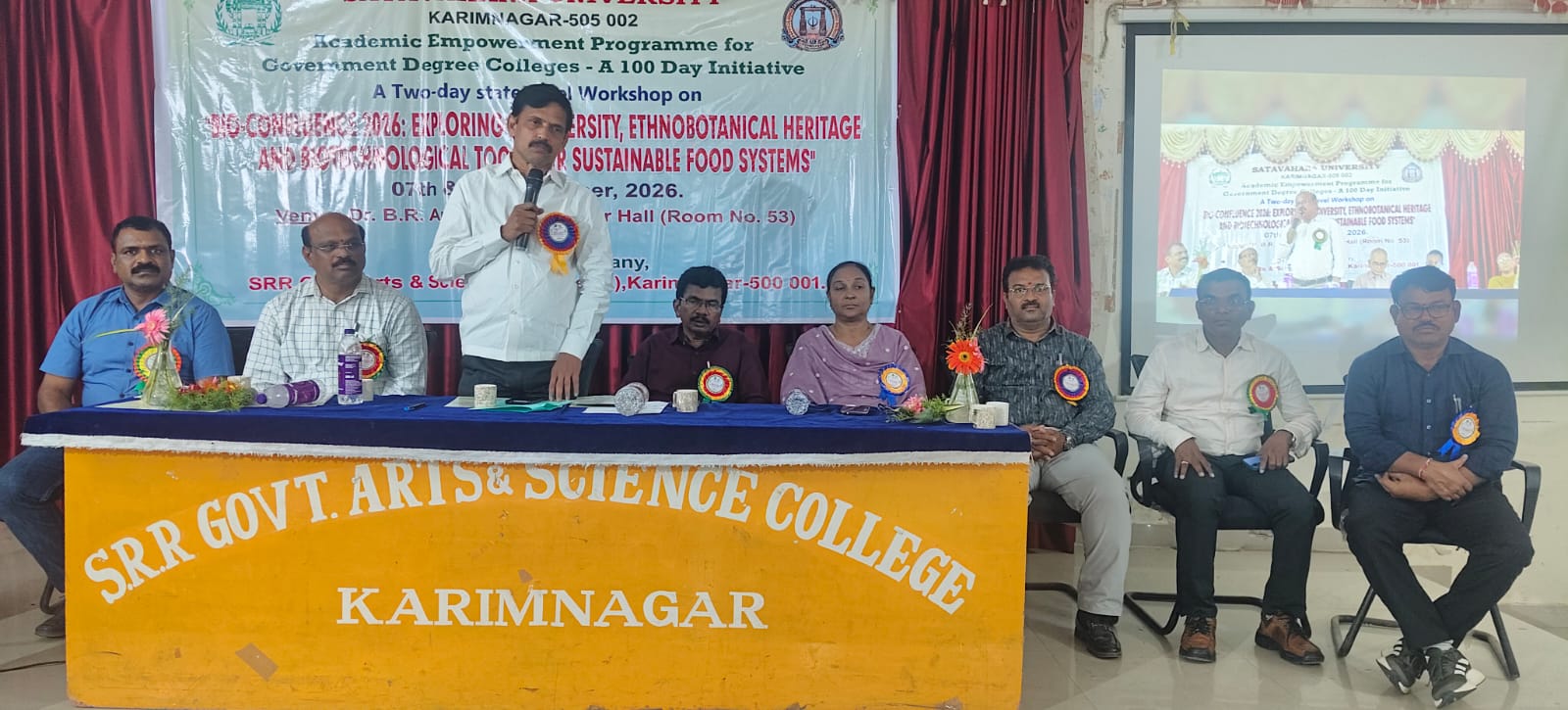
KARIMNAGAR, OCTOBER 08, 2026: The two-day state-level workshop “Bio-Confluence–2026: Exploring Biodiversity, Ethnobotanical Heritage and Biotechnological Tools for Sustainable Food Systems”, organised by the Department of Botany, SRR Government Arts & Science College (Autonomous), Karimnagar, on October 7 and 8, concluded successfully on Thursday with an overwhelming response from students and faculty.
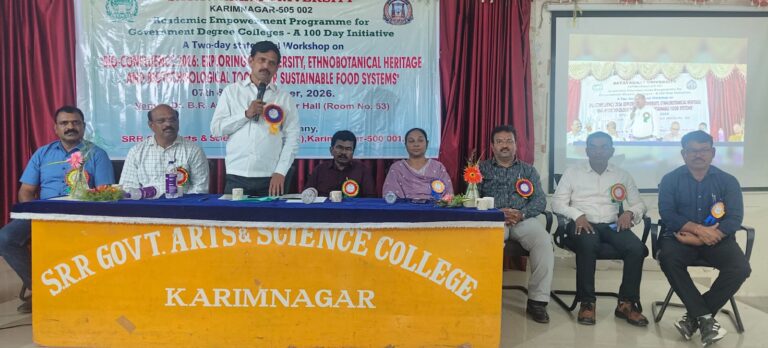
The valedictory programme was held at the Dr. B.R. Ambedkar Seminar Hall of the college. N.V. Sri Ranga Prasad, Head, Department of Business Management, Satavahana University and Coordinator, Academic Empowerment Programme for Government Degree Colleges, attended the programme as the Chief Guest.
Speaking on the occasion, Mr Ranga Prasad stated that state-level workshops of this nature play an important role in developing students’ skills, research orientation and awareness of contemporary scientific developments. He appreciated the efforts of the Department of Botany in providing students with practical knowledge on biodiversity conservation and sustainable development.
Vice-Principal and Academic Coordinator Sri T. Rajayya participated in the programme and certificates were distributed to the students and faculty who participated in the workshop.
Biodiversity Conservation Essential for Sustainable Development
Surender Reddy, State General Secretary, TGCGTA, stated that biodiversity is essential not only for maintaining ecological balance but also for human well-being, agriculture, food security and sustainable development. He emphasised the need to conserve local plant resources and integrate traditional plant knowledge with modern scientific and technological approaches. He called upon students to take an active role in protecting biodiversity for future generations.
Need for an Integrated Approach to Biodiversity Conservation
Prof. Tirukovela Srinivas, Head, Department of Botany and Controller of Examinations, and Convener of the workshop, stated that biodiversity conservation is not limited to protecting plants and animals alone, but also involves the integrated conservation of genetic diversity, species diversity and ecosystems.
He highlighted the importance of integrating ethnobotanical knowledge, local plant resources, sustainable agriculture and modern biotechnology for the development of sustainable food systems. He encouraged students to actively participate in environmental conservation initiatives.
Creating Environmental Responsibility among Students
Padala Thirupathi, Organising Secretary of the workshop and Assistant Professor of Botany, stated that the primary objective of the workshop was to create awareness among students and faculty about the interrelationship between biodiversity conservation, ethnobotanical heritage and sustainable food systems.
He said that special emphasis was placed on the conservation of local plant species, documentation of traditional botanical knowledge, sustainable utilisation of natural resources and development of environmental responsibility among students.
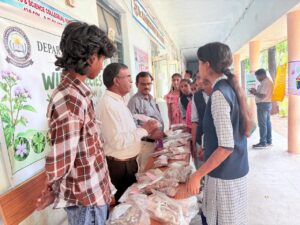
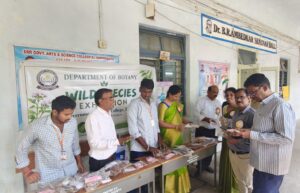
Special Exhibition on Ethnobotanical and Medicinal Products
Madhu of Government Degree College, Echoda, participated as a resource person and provided valuable insights into biodiversity, ethnobotany, medicinal plants and sustainable food systems.
As part of the workshop, he organised a special exhibition showcasing various ethnobotanical and medicinal plant-based products. He explained their traditional uses, medicinal significance, preparation methods and relevance to health and well-being. The exhibition provided students with practical exposure to medicinal plants, traditional botanical knowledge and the importance of conserving ethnobotanical resources.
Workshop Receives Overwhelming Response
During the two-day workshop, sessions, awareness programmes and demonstrations were conducted on biodiversity conservation, ethnobotany, traditional botanical knowledge, medicinal plants, sustainable food systems, conservation of natural resources and modern biotechnology.
IQAC Coordinator Harjyoth Kaur and Staff Club Secretary M. Srinivas Reddy, along with faculty members, staff and students, participated in the programme. Participation certificates were distributed to the students and faculty members.
The organisers expressed their sincere gratitude to the Chief Guest, distinguished guests, Satavahana University for its financial support, faculty members, staff and students for their valuable cooperation in making Bio-Confluence–2026 a grand success.
Faculty members including Radhakrishna, Taher Hussain, Kala Jyothi, Satish. Ande Bunga Thirupathi, Thajuddin, Roopa Rani, Latha, Veena and Mounika participated in the programme.
About the Author