
From Vaidyanathan reforms to administrative overreach, a silent reversal now threatens rural cooperative banking
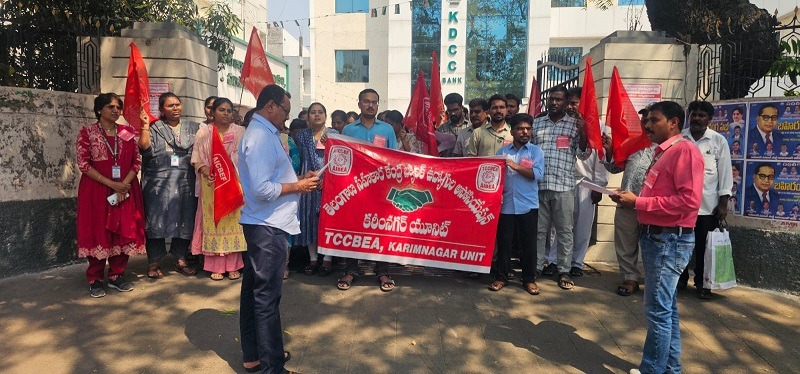
KARIMNAGAR, APRIL 17, 2026: The District Cooperative Central Banks (DCCBs) are not merely financial institutions. They are the living arteries of India’s rural economy. From financing crop cycles to meeting emergency household needs, from supporting women’s self-help groups to sustaining rural markets, from enabling small traders to delivering last-mile financial inclusion—DCCBs anchor the grassroots economy in ways few other institutions can.
It is precisely this relevance that makes recent developments deeply alarming. A pattern is now clearly visible: administrative overreach, financial pressure, retrospective recovery decisions, and growing intervention in matters that were once the domain of autonomous cooperative institutions. Together, these developments raise a fundamental question:
Is the cooperative system being strengthened—or is its autonomy being quietly eroded?
Not Just Recovery—A Breakdown of Trust
At the centre of the current controversy lies the move to recover incentive and ex gratia payments already disbursed to DCCB employees. These payments Were approved by competent Boards. Were processed through due procedure. Were paid and taxed.
The attempt to recover them retrospectively now creates a double financial burden, as employees have already borne tax liability on these amounts.
But the issue is not merely financial.
👉 It is about legality, institutional autonomy, administrative fairness, and employee dignity.
Employees who spent years in the field—driving recoveries, containing NPAs, mobilising deposits, and rebuilding institutions—are now being told that what was granted yesterday may be withdrawn today.
A system that rewards performance and later disowns that reward does not strengthen discipline—it destroys credibility.
A System Once Rescued from Collapse
To understand the gravity of the present, one must revisit the past.
In the 1990s, India’s cooperative credit system was in deep crisis. Political interference, weak governance, financial indiscipline, and structural distortions—especially the common cadre system—had pushed DCCBs to the brink of collapse.
At that critical juncture, visionary leadership intervened.
Under Chief Ministership of Dr Y. S. Rajasekhara Reddy, one of the first States in the country: Accepted the Vaidyanathan Committee recommendations. Entered into a Memorandum of Understanding (MoU) with the Government of India. Effectively utilised revival funds. Undertook legal reforms within the Cooperative framework. This was not routine governance. It was a system-saving intervention.
The objective was clear:
👉 DCCBs should never again fall into structural collapse
The Core Reform Principle: Autonomy with Accountability
The Vaidyanathan framework rested on three pillars:
Autonomy – Institutions must take independent decisions
Accountability – Boards must own outcomes
Professionalisation – HR systems must align with banking realities
A critical reform step was the abolition of the common cadre system.
Why the Cadre System Was Removed
The earlier cadre system had created a fundamental flaw:
Boards were accountable
But had no control over staff
👉 Responsibility without authority.
This resulted in:
Weak performance accountability
Misaligned staffing
Political and administrative interference
Institutional inefficiency
The reform conclusion was unequivocal:
👉 Human resource control must lie with the cooperative institution itself
Subsequent expert frameworks reinforced this:
👉 Decentralisation is essential for survival of cooperative banks
From Losses to Growth: Proof that Reforms Worked
These reforms delivered results.
District Cooperative Banks that were once struggling began moving towards profitability. NPAs were controlled. Operational discipline improved. Public trust was restored.
Banks across districts—including Karimnagar, Khammam, Nalgonda, Warangal, and even previously distressed regions like Nizamabad—demonstrated that with autonomy and accountability, cooperative institutions can thrive.
Leadership as Proof: Mr Konduru Ravinder Rao Model
The success of this transformation was not accidental—it was also shaped by leadership that respected institutions.
Konduru Ravinder Rao stands as a defining example.
Emerging from a remote background in Gambhiraopet, he rose not only to national prominence but earned recognition at international cooperative forums. Yet, his true contribution lay not in personal stature, but in institutional strengthening.
His guiding principle was unwavering:
“Individuals are temporary; institutions are permanent.”
He consistently emphasised:
The system must always come before individuals
No authority is above institutional integrity
Any action harmful to the system must be opposed—without hesitation
Under such leadership:
District bank autonomy was protected
Board decisions were respected
Coordination existed without coercion
Performance was encouraged—not penalised
The outcome was transformative.
A district bank that once operated with just 57 employees grew into an institution supporting hundreds of livelihoods. That growth was not driven by control—but by empowerment.
Equally significant is what did not happen during that period:
No pattern of harassment of DCCBs
No retrospective questioning of incentives
No erosion of Board authority
Instead, there was trust—between institutions, employees, and communities.
The Present Shift: From Cooperation to Control
It is this contrast that sharpens present concerns.
The role of a State Cooperative Apex Bank is to:
Support
Coordinate
Strengthen
Not to dominate.
However, emerging patterns suggest:
High-cost lending pressures
Direct appropriation of DCCB funds
Compliance-driven financial strain
Interference in Board-approved decisions
👉 This is not cooperation—it is control.
The Legal Question That Cannot Be Ignored
This issue is not merely administrative—it is fundamentally legal.
Are High-Level Committees statutory bodies?
Can they override Cooperative Acts?
Can they nullify Board decisions?
Where does oversight end and overreach begin?
If advisory bodies begin functioning as binding authorities,
👉 statutory governance is effectively bypassed
A Silent Return to the Past
What is unfolding is not an isolated event—it is a pattern.
Today: Incentives
Tomorrow: Staffing
Then: Promotions
Next: Policy decisions
👉 Gradual erosion of autonomy
👉 Eventual return to centralised control (cadre-like system)
This is precisely what earlier reforms sought to eliminate.
The Human Cost
Cooperative banking is built on trust:
Between employee and farmer
Between institution and community
If that trust breaks:
Motivation declines
Recovery weakens
Rural credit suffers
A demoralised workforce cannot sustain a cooperative system.
Why This Requires Immediate Policy Attention
This is no longer a local administrative issue.
It raises national questions of:
Cooperative federalism
Statutory authority
Institutional autonomy
What Must Be Done
Withdraw retrospective recovery of incentives/ex gratia
Clearly define the limits of High-Level Committees
Protect Board autonomy under Cooperative law
Restore balance between Apex and District institutions
Reaffirm decentralisation principles of reforms
The Final Question
Do such High-Level Committees exist across all States?
And where they do, do they exercise such powers?
This question demands clarity.
Conclusion: A Moment for Course Correction
If corrective action is not taken now, history will record a harsh truth:
👉 The cooperative system was not weakened by external forces—
but by internal distortions left uncorrected.
This is not just a policy issue.
This is a test of India’s commitment to cooperative federalism.
Final Appeal
The cooperative system has already shown what works.
👉 It thrives under autonomy
👉 It grows under trust
👉 It sustains under decentralisation
It declines under control.
The choice is clear.
Protect the system—or risk losing it.
About the Author