Emergency response team proposed for Alipiri footpath
A wildlife monitoring cell is to be set up at the Laxminarasimha Swamy temple
TIRUMALA, JULY 18, 2026: In the larger interests of the pedestrian pilgrims, the TTD Additional Executive Officer Sri Ch. Venkayya Chowdary suggested that the TTD and District Forest officials accord top priority to the safety of devotees trekking to Tirumala via the Alipiri footpath, with a special focus on protection from wild animals.
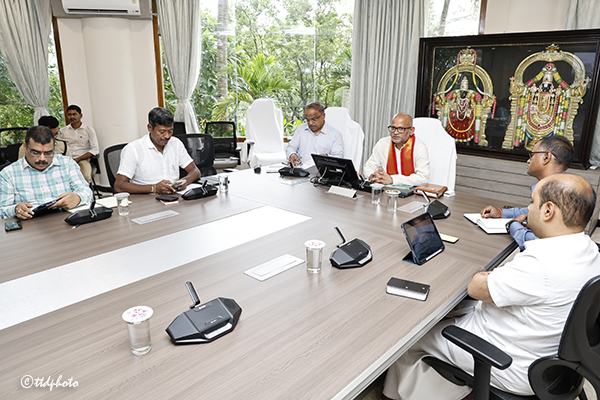
A review meeting was held with the TTD and Forest officials at the Sudharma Conference Hall in Tirumala on Saturday by the Additional EO. Some excerpts from the meeting:
Emergency Response Team and surveillance: A specialised Emergency Response team to be formed comprising a veterinary doctor, forest staff and other trained personnel, equipped with necessary devices, vehicles and communication systems for immediate response to wildlife-related incidents, so that it can reach any incident site within 5 to 10 minutes. Continuous surveillance is to be maintained along the stretches with leopard movement and roaming leopards; if any are captured in cages, relocated to distant, protected forest areas.
Restrictions and monitoring along footpath routes:
To study the feasibility of allowing pilgrim entry on the Srivari Mettu and Alipiri footpath routes only up to 6 p.m., in alignment with prevailing safety protocols on account of leopard movement. A review of shops located along the footpath and their impact on wildlife movement and pilgrim safety be pursued, with suitable regulatory measures wherever required.
Wildlife Monitoring Cell and Data Analysis:
A dedicated Wildlife Monitoring Cell will be established near Sri Lakshmi Narasimha Swamy (LNS) Temple to systematically record, review and analyse digital data as per the approved Standard Operating Procedures (SOPs). The Cell will be supported with adequate infrastructure, modern technology and trained manpower to handle real-time monitoring, incident logging and trend analysis of wildlife movement and related incidents. Detailed Data Analysis of wildlife incidents and trends over the last few years, including movement patterns of wild animals in and around Tirumala and assessment of the wildlife population to be regularly recorded.
Risk parameters, waste management and safety measures:
Risk parameters linked to wildlife–human interactions have been identified, and mitigation measures, including zoning, signage and controlled access in sensitive locations, have been discussed. Strengthening of waste-management practices in forest areas, particularly around the footpath and LNS Temple, was emphasised to prevent food waste and other attractants that draw wild animals closer to pilgrim routes.
Interdepartmental coordination:
To ensure effective monitoring and rapid response, the need for better coordination among all concerned departments, including TTD Forest Wing, State Forest Department, Vigilance, Health and Security, is stressed.
Earlier, TTD Deputy Conservator of Forest Sri Phanikumar Naidu gave a detailed PowerPoint presentation on areas where leopard movement has been recorded over the past two years, performance of trap cameras and solar-powered cameras, and ongoing mitigation efforts.
The meeting was attended by Chief Conservator of Forests Sri Srinivas Reddy, DFO Sri Saibaba, TTD Chief Engineer Sri Satyanarayana, Deputy EO (Health) Sri Somnurayana, VGO Sri Surendra and other senior officials from TTD and the Forest Departments.
About the Author