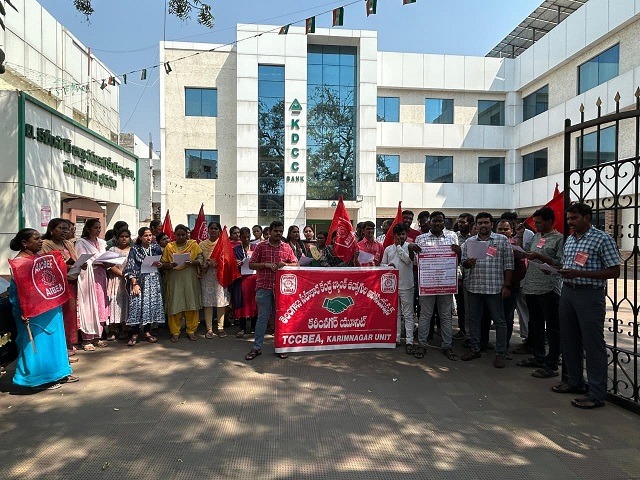
Members of Telangana Cooperative Central Bank Employees Association are agitating against the recovery of incentives and bonus given to staff
KARIMNAGAR, APRIL 19, 2026: A controversy over employee incentives and ex-gratia payments in Telangana’s cooperative banking sector has now evolved into something much larger than a dispute over compensation. It has become a searching test of legality, institutional consistency, democratic governance, and the future of cooperative autonomy in India.
At the heart of the matter lies a troubling question: Why have certain authorities declared long-standing decisions invalid only after elected boards completed their tenure?
If these payments were truly unlawful, improper, or beyond institutional authority, why was there prolonged silence when democratically elected governing bodies were in office? Why did objections emerge only after those boards ceased to function? Was it caution? Institutional hesitation? Or an inability to confront elected management directly?
These questions deserve answers—not for rhetoric, but for public accountability. The Real Issue Is Not Incentives. This controversy is not fundamentally about incentives or ex-gratia. It is about whether statutory institutions created under cooperative law retain meaningful powers, or whether those powers exist only until external authorities decide otherwise.
Across several District Cooperative Central Banks (DCCBs), employee benefits were reportedly granted through internal processes, board approvals, and institutional resolutions. Many of these decisions existed openly for years. If they were visible, recorded, audited, and implemented, then the sudden claim of invalidity raises a serious governance concern.
Can an action remain acceptable while boards are in office, but become objectionable only after they leave? That is not merely a legal inconsistency. It risks appearing as selective governance. The Spirit of Reform Was Autonomy, Not Dependency.
Prof. A. Vaidyanathan Committee reforms sought to rescue cooperative credit institutions from over-centralisation, political interference, and administrative dominance.
Its central recommendations were unmistakable: Strengthen elected boards, professionalise management, reduce excessive state interference, create accountability with autonomy, reward efficiency and performance, and restore member control. The cooperative bank was never meant to function as a branch office of bureaucracy.
If profitable institutions cannot recognise employee contribution through lawful internal decisions, then the reform promise stands hollowed out.
What the Law Intended
TS Cooperative Societies Act, 1964 recognises cooperative institutions as member-owned, democratically governed, and statutorily regulated bodies. That structure matters. It means authority flows through: members, general body resolutions, elected boards, by-laws, statutory supervision within legal limits.
It does not mean every internal decision can be casually displaced by post-facto administrative displeasure.
So the obvious question follows:
If external bodies can nullify board resolutions at will, why hold elections at all? If elected boards cannot govern, then democratic governance becomes ceremonial.
Who Owns a DCCB?
This is perhaps the most fundamental question of all.
District Cooperative Central Banks are not privately owned corporations. They are cooperative institutions whose ownership and legitimacy derive from their members.
Their ultimate sovereign forum is the General Body—the Mahasabha of members. If resolutions passed by members and boards are treated as worthless after the event, what remains of cooperative ownership?
Are member decisions mere formalities? Are annual meetings symbolic exercises? Are governance structures only decorative? If that is so, then cooperative identity itself is diminished.
A Deeper Contradiction: One Rule for Some, Another for Others?
Telangana State Cooperative Apex Bank itself draws institutional legitimacy from member district banks.
If resolutions of district banks are suddenly suspect, then a larger question emerges:
How are similar governance mechanisms accepted in one tier of the cooperative structure while dismissed in another?
If board and general body decisions are valid at the apex level, on what principled basis are comparable decisions questioned at the district level?
If legality applies differently depending on institutional tier, influence, or timing, then what is at stake is not regulation—but equality before governance.
This inconsistency warrants independent examination. When Trust Is Damaged, Who Will Be Accountable? There is another issue that cannot be ignored.
If High Level Committee (HLC), NABARD, Registrar of Cooperative Societies and Telangana State Cooperative Apex Bank together create an atmosphere of instability, uncertainty, and retrospective intervention, they risk damaging public confidence in the cooperative system itself.
Depositors, borrowers, members, and rural communities depend on trust.
If repeated actions create the perception that cooperative institutions are internally weakened, administratively controlled, and perpetually uncertain, then loss of confidence may follow. If confidence erodes, business weakens. If business weakens, losses may arise.
Then a larger public question must be asked:
Who bears responsibility if these actions push cooperative institutions toward distrust, decline, or financial stress?
Accountability cannot be demanded only from employees and boards. It must also apply to those whose decisions destabilise institutions.
The Limits of Oversight Bodies
High Level Committee (HLC) may advise, coordinate, and review. NABARD may guide development and refinancing discipline. Registrar of Cooperative Societies may supervise statutory compliance.
All are important institutions. But importance is not the same as unlimited power. An advisory committee is not a legislature.
A regulator is not a substitute board. A financing apex body is not owner of every autonomous member institution.
Oversight cannot become absorption. Incentives and Institutional Performance
Mitra Committee-style reform thinking recognised that incentives can improve productivity, discipline, and measurable performance.
Amalorpavanathan-type assessments stressed that modern cooperative banking requires motivated manpower, retention systems, and professional HR practices.
In that context, incentive systems are not inherently suspect. They may represent managerial tools in competitive banking environments.
To condemn them retrospectively, without transparent standards, is poor governance.
Due Process Is the Minimum Standard. If any payment was unlawful, the path is clear: identify the violated legal provision, examine the board’s authority, set aside the relevant resolution lawfully, issue notices, hear affected parties, assess tax and financial implications and apply standards consistently across institutions
Without this, recovery drives may appear less like rule of law and more like rule by direction.
Why Timing Matters
Timing determines credibility. If objections arise only after elected boards demit office, public perception naturally asks: Were authorities hesitant earlier? Was confrontation avoided while boards were strong? Is retrospective enforcement easier than timely governance? Institutions cannot demand trust while operating through selective wakefulness.
The Cost of Demoralisation
Cooperative banks depend on employees who mobilise deposits, recover rural credit, reduce NPAs, manage branch operations, and sustain member trust.
Rewarding them in one cycle and penalising them later sends a dangerous message:
Initiative carries risk.
Performance invites reversal.
Recognition is temporary.
Uncertainty is permanent.
That is how morale declines and institutions weaken.
A Better Path Forward
Instead of blunt directives, authorities should choose principled reform:
Independent legal review of disputed payments
Uniform standards across all cooperative tiers
Consultation with member institutions
Prospective policy clarity instead of retrospective punishment
Respect for board autonomy within law
Transparent inquiry into inconsistent treatment across institutions
The Larger Democratic Question
Cooperatives are not merely financial entities. They are democratic economic institutions.
If member decisions can be ignored, board powers neutralised, and autonomy narrowed after elections end, then the injury is not only to employees or directors.
It is to democracy within the cooperative movement.
The present dispute concerns incentives.
The deeper question concerns sovereignty:
Will cooperative institutions be governed by law and member mandate—or by selective administrative awakening?
About the Author