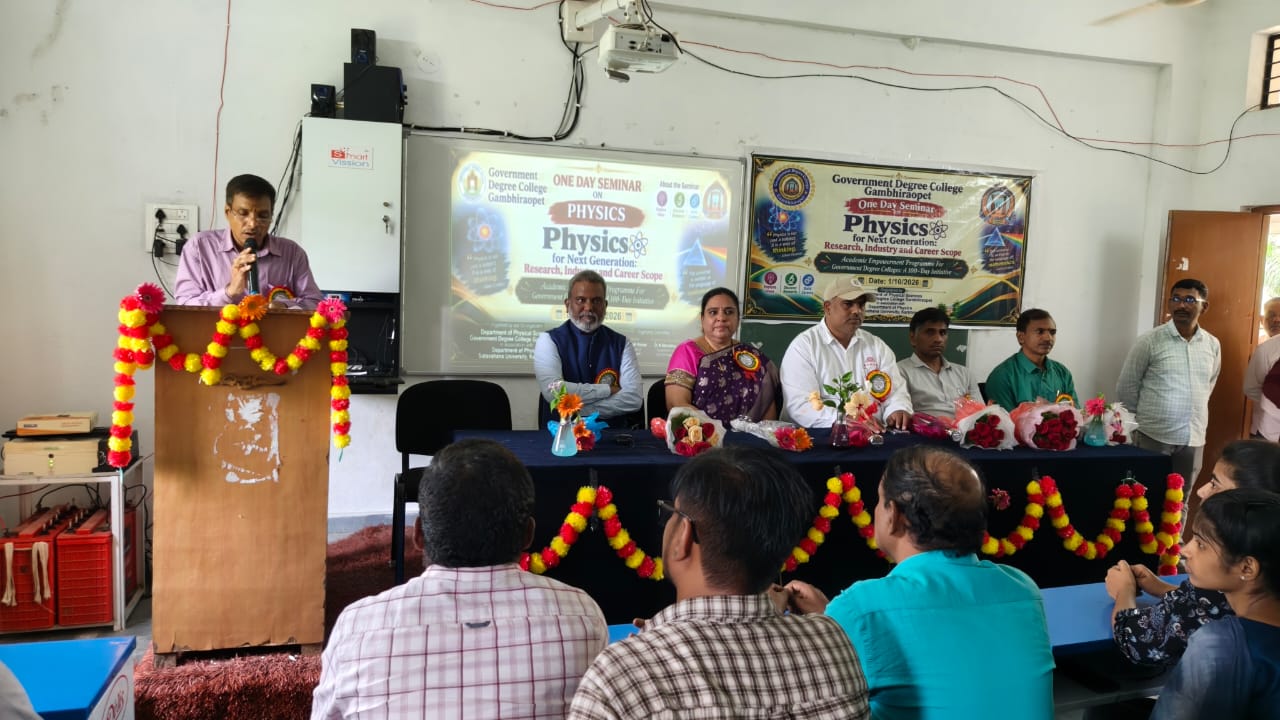
RAJANNA-SIRCILLA, OCTOBER 01, 2026: A One-Day Seminar on “Physics for the Next Generation: Research, Industry and Career Scope” was organised on Thursday (October 01, 2026) at the Government Degree and PG College, Gambhiraopet, under the auspices of the Department of Physical Sciences, Satavahana University, as part of the 100-Day Programme.
As part of the seminar, N. Mohan Babu, Department of Physics, Telangana University, delivered a lecture on “Recent Breakthroughs in Science and Technology.” D. Suresh Kumar, Programme Convener and Chairman, Board of Studies in Physics, Satavahana University, delivered a lecture on “Nanotechnology.”
S Ramakanth, Head, Department of Physics, Satavahana University, delivered a lecture on “Waves and Their Quantum Properties.” G. Ramesh Reddy, Assistant Professor of Physics, delivered a lecture on “Career Awareness and Guidance for Undergraduate Students.”
Speaking on the occasion, the Principal, Prof. V Vijaya Lakshmi, stated that B.Sc. Physical Sciences students should develop a strong understanding of Physics, as the subject plays an important role in understanding nature, technological advancements, and the development of the economic world around us.
The resource persons appreciated the students for their active participation and poster presentations on topics such as Physics in Everyday Life, Rocket Motion, Waves, the Raman Effect, Properties of Light, and other aspects of Physics.
Later, the Principal and faculty members felicitated the resource persons with shawls as a mark of respect and appreciation.
Special appreciation was expressed to N. Adivishnu, Assistant Professor of Physics, for successfully organising and conducting the programme.
The programme was attended by M. Prabhakar, Vice-Principal; Y. Anjaneeyulu, IQAC Coordinator; J. Sravan Kumar, TASK Coordinator; P. Dharmapuri, NSS Programme Officer; K. V. Bikshamaiah; Manohar; Srinivas; Sucharan; Krishna Prasad; Mahesh; M. Deepika; E. Bhargavi; Shankaraiah; Vijaya, along with other faculty members and students.
The active participation of the faculty and students contributed to the successful conduct of the seminar.
About the Author