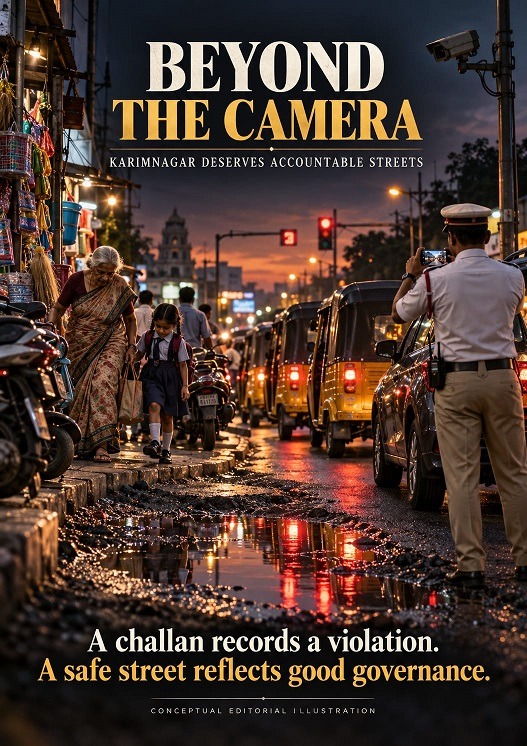
Traffic enforcement earns public trust when penalties are matched by safe roads, accessible footpaths and transparent administration.
KARIMNAGAR, OCTOBER 24, 2026: A traffic camera can record a violation; it cannot repair a pothole, reclaim a pavement or guide an ambulance through congestion. Karimnagar’s authorities must confront the widening gap between photographing road users and managing the roads they use. When enforcement is conspicuous, but public service appears absent, citizens understandably ask whether traffic administration is protecting lives or merely collecting penalties.
That concern has a documented local context. Telangana Today reported in September 2024 that traders and mechanics were occupying Karimnagar’s footpaths, forcing pedestrians onto carriageways. It also described clearance drives whose effects faded as encroachments returned. A local report in April 2026 renewed complaints about obstructed pavements, unauthorised auto stands and an excessive emphasis on photographing violations. These reports warrant scrutiny and an official response. [1, 2]
The first requirement is disclosure. How many auto stands operate within Karimnagar’s municipal limits? Which have written permission, and which authority issued it? How many occupy government land, municipal property, road margins or privately owned premises? What capacity, operating conditions and pedestrian safeguards apply? A painted signboard cannot substitute for documented authorisation. The city needs a publicly accessible, mapped register distinguishing authorised stands from disputed or unauthorised locations.
Autorickshaws provide essential mobility and livelihoods. Drivers need properly located waiting areas, passenger boarding bays and predictable rules. Allowing vehicles to cluster around busy junctions, however, transfers the cost of administrative indecision to everyone else. A November 2024 report recorded a police coordination meeting addressing unauthorised stands, encroachments, parking and crossings. Authorities should now disclose what those directions achieved, location by location. [3]
Pedestrian access deserves equal urgency. The corporation should publish the total length of footpaths, the portion continuously usable and the stretches obstructed by merchandise, parked vehicles, structures or damaged surfaces. Accessibility must include wheelchair users, older people and children. Clearance should follow transparent procedures, with appropriate vending arrangements and safeguards for livelihoods. Repeatedly removing small vendors while overlooking larger commercial obstructions would undermine confidence in the entire exercise.
Road maintenance requires the same public accounting. In January 2025, The New Indian Express reported on a Karimnagar resident filling potholes himself; the then mayor attributed maintenance of the main roads to the Roads and Buildings department. This illustrates why responsibility must be identified clearly. Residents should see a road register naming the maintaining agency, defect reports, repair deadlines, expenditure and contractor obligations. [4]
Parking policy must also withstand scrutiny. Every paid facility should display its authorisation, approved tariff, operating hours and complaint contact, and issue receipts. Charges should reflect a transparent policy supported by practical alternatives. Authorities should explain where motorists may legally park before relying heavily on penalties for obstruction. Commercial establishments must also be examined for compliance with their approved parking arrangements.
None of this excuses dangerous driving. Helmets, seat belts, speed limits and safe crossings remain essential. Cameras can support consistent enforcement, provided evidence is accurate and appeals are accessible. Constables must also remain visibly engaged in junction management, emergency assistance and preventing obstruction. Performance should be judged by fewer injuries, safer walking and improved traffic flow, alongside fair enforcement.
Publicly funded institutions owe respectful treatment to every resident, including those who pay no income tax. Karimnagar needs a joint monthly accountability report from police, municipal and road authorities, followed by public review. Citizens must obey traffic rules; government must fulfil its responsibilities with comparable seriousness. The strongest evidence of successful policing is a street people can use safely and confidently. That is the standard against which every camera and every department should be judged.
Sources
- Telangana Today, 14 September 2024. Footpaths encroached by traders causing problem to pedestrians in Karimnagar town. Read source
- Hindudayashankar, 2 April 2026. Report on e-challans and road encroachments. Read source
- Hindudayashankar, 27 November 2024. CP stresses coordination among all departments for traffic regulation and removal of encroachments. Read source
- The New Indian Express, 19 January 2025. Taking the road with fewer potholes. Read source
About the Author