A Karimnagar Blueprint For Viksit Bharat Through PAC, DCCBs, Women Empowerment SHG Groups and a People-Owned Cooperative Economy
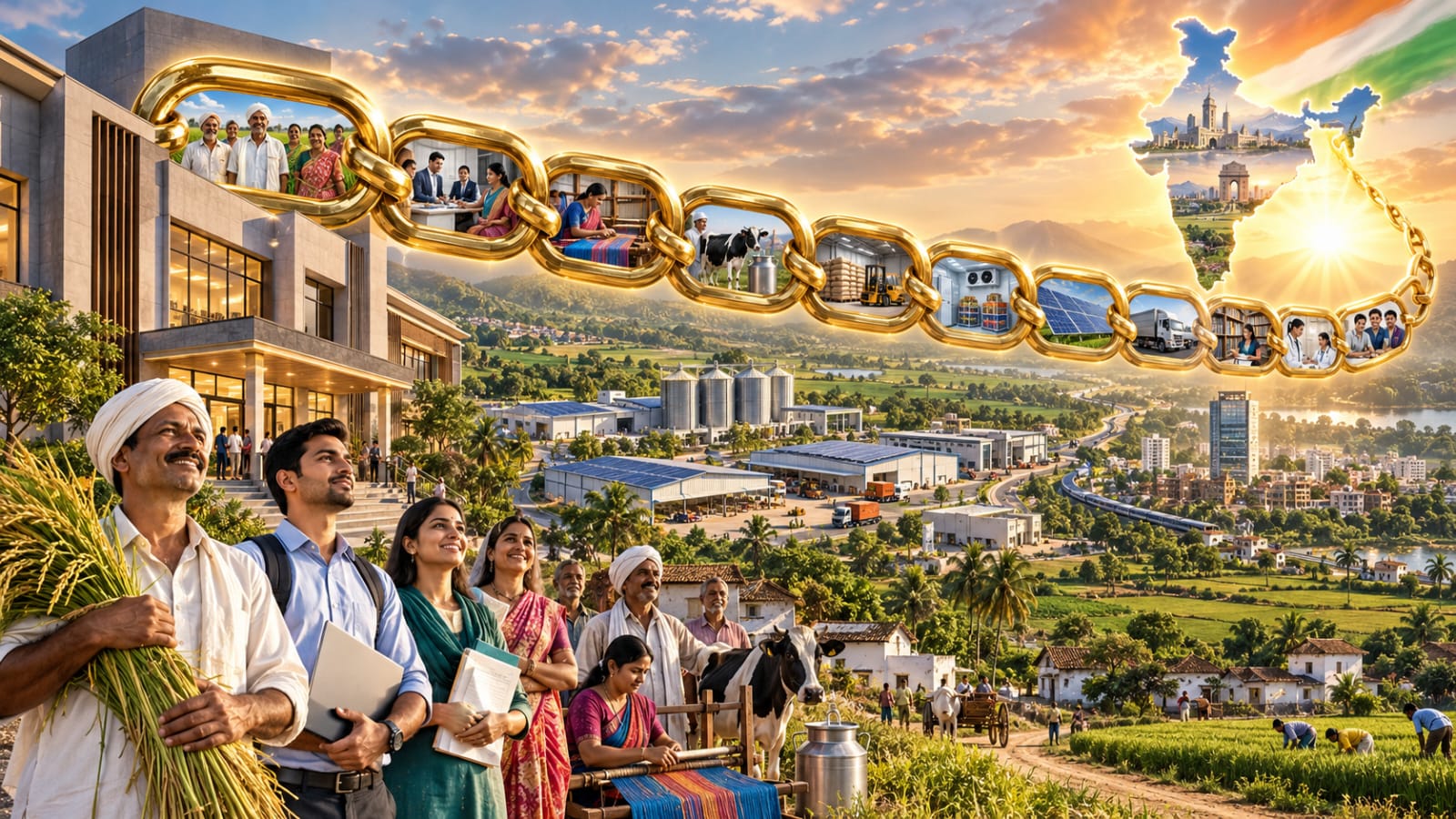
The golden chain symbolises the cooperative connection between farmers, women, SHG groups, PACS, DCCBs, dairy, warehousing, solar energy, transport, healthcare, youth and public institutions.
KARIMNAGAR, SEPTEMBER 17, 2026: India is searching for a development model that can create farmer prosperity, rural employment, youth leadership, local industry, affordable public services, value addition, exports and balanced growth. The answer may not lie only in foreign models, capital, institutional boardrooms or urban technology platforms. One of the strongest answers is already present in our villages, mandals, towns and districts, which is called ‘Cooperation’.
A cooperative is not a small rural office. It is not merely a crop loan counter. It is not an outdated institution. It is not a weak alternative to other banking and development institutions. A cooperative is a democratic form of economic participation. Other institutional models have their own place in the economy. But the cooperative model has a special democratic character because it belongs to its members: farmers, weavers, milk producers, sheep breeders, artisans, labourers, women, youth, depositors and ordinary households.
In this people owned model, women should not be treated as beneficiaries at the end of the chain. They should be placed at the centre of planning, credit, enterprise, governance and ownership. Women farmers, women dairy members, women artisans, women depositors, women employees, women elected representatives and Self Help Group members are not a side subject. They are among the strongest social capital of rural India.
If India wants Viksit Bharat, it should stop treating cooperatives as minor institutions. It can reimagine PACS, DCCBs and other cooperative societies as the foundation of a people owned economy.
The Scale India Has Not Fully Imagined
This is not a sentimental argument. The data itself is powerful.
As per the Ministry of Cooperation’s National Cooperative Database, India had 8,53,430 cooperative societies as on July 15, 2026. Out of these, 6.63 lakh are functional, 1.41 lakh are non-functional, and 49,177 are under liquidation. The same official data records 1,06,126 PACS, 1,58,216 dairy cooperatives, 47,182 labour cooperatives, 19,433 handloom textile and weavers cooperatives, 16,916 livestock and poultry cooperatives, 10,162 marketing cooperatives, 5,223 handicraft cooperatives, 4,175 transport cooperatives, 20,809 agro-processing or industrial cooperatives, 26,329 women welfare cooperatives, and 280 sugar mill cooperatives.
Another Ministry of Cooperation statement says the National Cooperative Database provides single point access to information on over 8.5 lakh cooperatives across 30 economic sectors, having nearly 30 crore members.
This means India already has the skeleton of a national cooperative economy. The network exists. The members exist. The village roots exist. The trust exists. What is missing is integration, finance, technology, professional management and national imagination.
Telangana And Karimnagar Can Become The Pilot
Telangana has 60,680 cooperative societies as per the National Cooperative Database. NAFSCOB data shows Telangana has 9 DCCBs, while India had 351 DCCBs as on March 31, 2020.
In united Karimnagar district, there are 131 Primary Agricultural Cooperative Societies, along with many handloom societies, powerloom weavers societies, sheep breeders societies, labour contract societies, milk societies and other cooperative institutions. If these institutions are connected into one district chain, Karimnagar can become India’s first serious pilot for a new cooperative development model.
This model may be called:
Karimnagar Cooperative Integrated Development Mission
Its principle should be simple:
One district. One DCCB. Many PACS. Many functional societies. Shared assets. Professional management. Member ownership. Public benefit.
This is where KDCCB can stand at the centre, not merely as a lending institution, but as the financial nerve centre of a district cooperative economy.
The Peddapalli Beginning
This vision is not completely theoretical. In united Karimnagar district, particularly in the newly carved out Peddapalli district, the first signs of such a model are already visible.
In Peddapalli district, five solar projects are ready for inauguration. Among them, two solar plants have synchronized with the power grid. Large warehouse construction works have also been initiated. These are not small developments. They show that cooperative institutions can move beyond traditional credit and begin building long-term productive assets.
The developments in Peddapalli also deserve a careful acknowledgement. The constructive support and encouragement associated with Peddapalli MLA Ch Vijayaramana Rao, the Telangana Government, the Peddapalli District Collector Koya Sree Harsha and the district government officers have created a positive environment for cooperative institutions to explore development assets through lawful coordination among public representatives, administration, DCCB, PACS and members.
The role of the Collector and district administration is important in such public-purpose initiatives. Wherever permissions, guidance, convergence and institutional coordination are provided strictly in accordance with law and policy, cooperative development can become more orderly, transparent and people oriented.
The cooperative fraternity, including TEAM KDCCB, PACS staff, governing body members, cooperative employees and member institutions, may respectfully acknowledge the positive support extended by the Peddapalli MLA, the Telangana Government, the Peddapalli District Collector and the government officers of Peddapalli district, subject to official records, lawful permissions and applicable policy frameworks.
This may be one of the models India can examine: cooperative institutions, district administration, elected public representatives, DCCB finance, PACS participation, NABARD support, women members, SHG groups and government policy working together within lawful and transparent limits.
Subject to competent approvals, institutional policy and prudential safeguards, TEAM KDCCB can play a constructive role in coordination, finance and cooperative development support. If this energy is organised into a clear and lawful pilot, Peddapalli and Karimnagar can demonstrate how cooperation may move from loan books to development assets.
The Cooperative Chain Economy
The real strength of cooperation is not in one society working alone. Its power lies in connection.
- A village PACS can finance and collect farm produce.
- A milk society can collect and process milk.
- A sheep breeders society can organise livestock products.
- A handloom or powerloom society can produce textiles and garments.
- A labour contract society can provide trained manpower for construction, loading, transport, warehousing and maintenance.
- A marketing society can handle branding and sales.
- KDCCB can provide finance, monitoring, professional discipline and institutional coordination.
This chain can move products and services from village to mandal, mandal to town, town to district, district to State, State to other States, and India to the world.
This is not ordinary development. This is self-driven cooperative development.
Some supply chains may concentrate value at the top. A well-governed cooperative chain can distribute value more widely among members.
Other business models often ask, “Where is the margin?”
A cooperative model should also ask, “How many members can rise?”
From Karimnagar To Telangana To India
If one united district like Karimnagar can connect 131 PACS and several functional societies into one district cooperative chain, Telangana can connect its 9 DCCBs, PACS and thousands of societies into a State Cooperative Economic Grid.
Each district need not produce everything. Each district can specialise.
Karimnagar can build warehouses, solar projects, rice, dairy, handloom, transport and cooperative retail. Nizamabad can strengthen turmeric and agro-processing. Warangal can focus on textiles, cotton and handloom. Khammam can build chilli, horticulture and forest produce chains. Other districts can build dairy, livestock, millets, energy, transport, retail, fishery and artisan networks.
When district chains are connected, Telangana can become a cooperative economic grid. When State grids are connected, India can build a National Cooperative Economic Network.
This is the missing national imagination.
Women Priority Women Empowerment And SHG Groups
No cooperative development model can be complete without women priority. Rural women already manage household savings, dairy activity, food processing, small trade, tailoring, livestock, children education and family health. When these women are organised through SHG groups and linked with PACS and DCCBs, the cooperative chain becomes deeper, more disciplined and more inclusive.
SHG groups can become the strongest village-level enterprise partners of PACS. They can manage food processing units, millet products, turmeric powder, pickles, papads, snacks, dairy products, tailoring units, school uniforms, handloom finishing, packaging, rural supermarkets, Jan Aushadhi counters, canteens, purified water units, sanitation services, digital service centres and doorstep collection services.
Women empowerment should therefore be built into the cooperative model as a policy priority. Every viable PACS cluster can identify women-led enterprises, provide credit linkage through DCCB, ensure training, maintain transparent accounts, create market access and give SHG products space in cooperative supermarkets and local brands.
A district cooperative grid should not merely count how many loans were issued to women. It should also ask how many women became entrepreneurs, how many SHG groups became suppliers, how many families received stable income, how many girls continued education, and how many villages gained dignified women-led economic activity.
Women priority is not charity. It is economic wisdom. SHG groups bring repayment discipline, social trust, local knowledge and collective responsibility. When women rise, the village economy becomes more stable. When SHG groups enter the cooperative chain, development becomes visible inside every household.
Role Of NABARD And Development Finance Institutions
If NABARD or other development finance institutions extend low-cost refinance or special development credit to eligible cooperative banks and institutions, subject to applicable guidelines, prudential safeguards, professional appraisal, strict monitoring and transparent utilisation, cooperative infrastructure can grow at a scale individual societies cannot achieve.
DCCBs can use such funds to finance PACS clusters and cooperative projects. A single PACS may not be able to build a large warehouse, cold storage, solar plant, rice mill, dal mill or processing unit. But 5 to 10 PACS together, supported by DCCB finance, NABARD refinance, government land and professional management, can build assets that serve generations.
NABARD and other development finance institutions can also serve as knowledge partners for the next phase of cooperative development.
Role Of State Government And Competent Authorities
Land is often the biggest barrier to rural infrastructure. If the State Government can allot suitable government lands wherever legally permissible, transparently and for public-purpose cooperative projects, a new era can begin.
Large warehouses, cold storages, solar plants, wind power projects, rice mills, dal mills, dairy units, fuel storage points, study halls, libraries, function halls, stadiums, cooperative supermarkets and rural service centres can be built.
State Governments and competent authorities may strengthen the cooperative sector by conducting cooperative elections on time, protecting cooperative autonomy, strengthening audit departments, supporting training, preventing unnecessary interference and permitting lawful business diversification wherever policy allows.
Regular elections and cooperative autonomy are essential for institutional credibility and member confidence.
PACS As Village Economic Hubs
The PACS of the future cannot remain only a crop loan counter. It should become a village economic hub.
It can provide crop loans, seeds, fertilisers, pesticides, farm machinery, tractors, harvesters, storage, grading, processing, transport, market linkage, digital payments and member services.
It can also become the natural platform for women SHG groups by giving them space for production, storage, packaging, billing, digital payments, marketing and local sales. PACS and SHGs together can convert household skill into formal rural enterprise.
It can support rice mills, dal mills, oil mills, milk collection centres, dairy units, fish ponds, mutton and chicken marts, purified water units, petrol bunks, fuel storage facilities, daily needs supermarkets, khadi stores, garment units, Jan Aushadhi Kendras, health centres, function halls, study rooms, libraries, sports courts, stadiums, public transport and taxi services.
This is how a PACS can move from lending to wider village development, wherever permitted by law, bye-laws, regulation and competent approvals.
A PACS need not ask only, “How many loans were issued?”
It should also ask, “How many lives were improved?”
DCCB As District Development Bank
A DCCB can become the financial brain of the district cooperative economy, subject to regulatory discipline and institutional capacity.
It should create a Cooperative Business Incubation Cell with banking officers, agriculture experts, chartered accountants, legal advisers, technology professionals, marketing experts, export consultants and experienced cooperative practitioners.
This cell should prepare project reports, examine viability, design credit products, monitor cash flows, guide societies, ensure proper accounts, connect markets and protect the bank from reckless lending.
In the new model, a DCCB need not merely lend. It can also enable development through responsible finance.
A DCCB need not ask only, “How much refinance was received?”
It should also ask, “How much district wealth was created?”
Five Income Streams For Every PACS
Every PACS should gradually develop at least five income streams.
- Credit service income.
- Input supply income.
- Storage and processing income.
- Transport and logistics income.
- Retail, branding or service income.
Depending on local conditions, additional income can come from solar power, wind power, machinery rental, water plants, dairy, poultry, fish ponds, function halls, libraries, supermarkets, khadi stores, garment units, Jan Aushadhi Kendras and health services.
A PACS depending only on loan interest is fragile. A PACS with multiple income streams becomes resilient.
Large Warehouses And Cold Storages
The farmer loses when he is forced to sell immediately after harvest. Large warehouses and cold storages can change this.
If PACS clusters build warehouses and cold storages, farmers can store produce, avoid distress sales, wait for better prices, grade produce, enter processing and sell through cooperativebrands.
Storage is not just a building. It is bargaining power.
The warehouse works already initiated in the Karimnagar cooperative region can become the first step towards a district storage grid.
Solar And Wind Power Cooperatives
Solar and wind power can become long-term cooperative income sources.
In Peddapalli district, five solar projects are nearing inauguration. This is a powerful beginning. If PACS clusters can own solar plants, societies can generate non-credit income. DCCB can finance carefully. Technical agencies can install and maintain. Government can support land and permissions. NABARD can provide refinance and guidance.
From crop credit to clean energy, cooperation can move into the future.
Processing And Value Addition
Farmers should not remain only producers. They should become owners of value.
Paddy should become cooperative branded rice. Pulses should move through dal mills. Oilseeds should move through oil mills. Milk should become curd, ghee, butter, paneer and sweets. Turmeric should become graded powder. Cotton should become garments. Vegetables should become processed food. Fish ponds should become organised fish marketing. Sheep breeders should enter meat, wool and allied products.
The producer should own more of the value chain.
Handlooms Powerlooms And Hand Skills
India cannot become truly developed by ignoring hand skills.
Weavers, powerloom workers, potters, carpenters, metal workers, bamboo workers, rural artists, khadi workers and artisans carry generations of knowledge. Their work is not backward. It is heritage economy.
Cooperatives can provide working capital, raw material, design support, common facility centres, branding, packaging, online catalogues, exhibitions, cooperative showrooms and export access.
If handloom and powerloom societies are connected with PACS, DCCB, garment units, khadi stores and cooperative supermarkets, artisans will not remain dependent on middlemen. They can become producers, brand owners and market participants.
When hand skills are respected, income improves, culture survives and youth regain pride in traditional occupations.
Labour Contract Societies As Development Force
Labour contract societies are often ignored in large policy discussions. But they can become a major development force.
They can provide manpower for warehouse construction, loading and unloading, transport support, maintenance works, local infrastructure, cooperative factories, market yards, cleaning, security and service operations.
If properly trained and linked with DCCB-financed cooperative projects, labour societies can provide continuous employment and reduce migration.
Milk Societies And Dairy Enterprise
Milk societies should not stop at collection. They can become value-added dairy enterprises.
Milk can become curd, ghee, paneer, butter, sweets and packaged products. Women members and SHG groups can play a major role in milk collection, testing, billing, value addition, packaging, sale counters and household-level dairy discipline. Dairy creates daily cash flow, unlike seasonal agriculture. A strong dairy cooperative chain led by women can stabilise rural income.
Sheep Breeders And Livestock Cooperatives
Sheep breeders societies can support meat, wool, manure, livestock health, insurance and organised marketing. Instead of distress sale through middlemen, livestock producers can move into organised value chains.
If livestock and poultry cooperatives are connected with cold storage, transport, retail marts and supermarkets, member income can improve substantially.
Fish Ponds And Fisheries
Fish ponds and fisheries cooperatives can become another important rural income stream. Cooperative fish production, cold storage, ice plants, transport and retail fish marts can help members receive better prices. Fisheries can also create youth employment in production, transport, processing and retail.
Supermarkets Khadi Stores And Local Brands
Cooperative supermarkets can sell local rice, pulses, turmeric, vegetables, milk products, fish, meat, garments, handloom cloth, khadi products, daily needs and purified water.
This connects rural production to urban consumption. Consumers get genuine products. Producers get better value. Society earns income. Wealth stays in the district.
Cooperative khadi stores and garment outlets can connect rural skill with urban demand.
People Transport And Taxi Facilities
Transport is development.
Students need to reach colleges. Patients need hospitals. Farmers need markets. Workers need towns. Women need safe mobility.
PACS clusters can support public transport and taxi facilities wherever law permits. Cooperative buses, vans and taxi services can connect villages to mandal centres, district headquarters, hospitals, schools, colleges, railway stations and markets.
This creates service, safety and employment.
Study Rooms Libraries And Human Capital
A cooperative movement that ignores education will miss the future.
PACS and DCCBs can create reading halls, libraries, digital learning centres and career guidance centres. If a cooperative study hall helps rural youth become teachers, bank employees, police officers, nurses, engineers, entrepreneurs or public servants, the society has changed not one person but one family.
This is social banking at its best.
Health Jan Aushadhi And Cooperative Hospitals
Rural families often fall into debt because of health expenses. Cooperatives can support Jan Aushadhi Kendras, pharmacies, diagnostic centres, health camps, insurance facilitation and cooperative hospitals wherever legally and professionally viable.
Affordable healthcare through cooperatives can reduce rural debt and build trust.
Function Halls Stadiums And Community Assets
A function hall can reduce marriage expenses. A sports court can build discipline. A stadium can support rural talent. A swimming pool can support health, training and safety. A library can create employment.
These are not luxuries. They are community assets. If built through cooperatives and managed transparently, they can generate income while serving society.
Fuel Storage And Sensitive Businesses
Fuel storage plants, petrol bunks and related services can support farmers, transport, machinery and rural enterprise. Such projects require strict legal compliance, safety standards and professional management.
Sensitive or socially debated business sectors, wherever legally permissible, should be approached only with caution. Public interest, applicable law, social impact, competent approvals and member consent should guide every decision. Revenue should never override social responsibility.
Reviving Closed Companies
India has many closed and sick industries. Telangana has emotionally important examples such as Nizam Sugar Factory. Such factories are not merely closed buildings. They represent lost jobs, lost farmer confidence and lost district wealth.
Not every closed unit can be revived. But every major closed unit can be studied.
If raw material, market demand, legal position, land, machinery, finance and professional management are favourable, cooperative revival can be explored. Farmers, PACS, DCCB, government, technical experts and professional managers can come together.
A closed factory can become a cooperative industrial asset.
Professional Governance Is Non Negotiable
This future cannot be built with weak governance.
Democracy gives legitimacy. Expertise gives direction.
DCCB boards and cooperative committees should be supported by professionals in banking, agriculture, audit, law, technology, risk management, marketing, exports, renewable energy, healthcare, transport and rural business, in accordance with applicable laws, bye-laws and regulatory norms.
As a policy suggestion, at least 50 percent of key advisory and management committees may have expert participation. Elected leaders should represent members. Experts may guide technical decisions. Employees should implement with discipline. Members should demand accountability.
A cooperative that is emotionally strong but professionally weak will fail. A cooperative that is professional but not democratic will lose its soul. The future needs both.
Employees As Field Soldiers Of Rural Finance
Employees are the daily face of the cooperative system.
Every correct loan protects the bank. Every recovered rupee protects member money. Every clean record builds confidence. Every respectful conversation with a farmer creates goodwill. Every audit compliance protects the institution.
Employees need not see themselves as staff of an old system. They can be field-level builders of rural finance and rural development.
Youth Must Lead
Educated youth should enter cooperative leadership.
Educated young women should be consciously encouraged to enter PACS committees, SHG federations, dairy societies, weaver societies, digital service centres and cooperative business units. A cooperative future without women leadership will be incomplete.
A graduate who understands banking, commerce, law, agriculture, technology, logistics, accounting or digital marketing can transform a PACS. They can introduce member databases, QR payments, transparent minutes, stock systems, digital catalogues, market alerts, online sales and cooperative branding.
Cooperative elections are not minor polls. They are rural political schools.
Before becoming MLAs, MPs or ministers, young leaders should learn public money, recovery, audit, member trust and institutional responsibility.
The next great rural leader may come from a PACS, a milk society, a weaver society, a labour society or a DCCB board.
What Other Banks Must Understand
Those who underestimate cooperatives may need to rethink their assessment.
Other banks have capital, technology, speed and systems. Cooperatives have a different strength: grassroots trust. They know the village, the member, the land, the crop, the family and the local reputation.
No app can fully replace social knowledge.
If cooperatives modernise, other banks and institutions may view them not as weak institutions, but as powerful last-mile economic networks.
What National Policy Makers May Consider
Union Cooperation Minister Amit Shah has stated that the three-tier structure of PACS, District Cooperative Banks and State Cooperative Banks plays a vital role in the progress of farmers and villages. He has also stated that the government aims to open district cooperative banks in 80 percent of districts in the next five years.
This vision can now move from institutional expansion to economic integration.
India need not stop at computerising PACS. It can transform PACS. It need not stop at creating new societies. It can connect societies. It need not stop at giving loans. It can build cooperative value chains. It need not stop at rural credit. It can create rural wealth.
The national vision of Viksit Bharat and Sahakar se Samriddhi can find a practical district-level illustration in regions such as Karimnagar, subject to policy support, institutional discipline and lawful implementation.
Expected Changes
Farmers will get better prices through storage, processing and branding. Weavers and artisans will receive working capital, design support and markets. Milk producers will move into value-added dairy. Sheep breeders will enter organised livestock products. Labour societies will receive regular work. Youth will get jobs in logistics, accounts, digital marketing, transport and management. Women can become cooperative entrepreneurs. SHG groups can become suppliers, service providers, retailers, processors and local brand builders. Villages will get transport, libraries, health services and community assets. DCCBs will gain business relevance and deposit growth. PACS can become profitable service hubs. District products can become State and national brands. Closed assets may find new life. Cooperation can become a development movement again.
The Moral Argument
India cannot become truly developed if villages remain only producers and cities capture all value. Development should not mean that the farmer grows, the trader earns, the company brands and the village watches.
Development should mean that the producer also owns value.
Cooperation tells the farmer: you are not alone. It tells the artisan: your skill has value. It tells the woman: your savings, labour and leadership can build the village economy. It tells the SHG group: your unity can become enterprise. It tells the youth: your village can be your platform. It tells the depositor: your money can build your district. It tells the nation: growth need not be owned only by a few.
Conclusion Karimnagar Can Show India
The cooperative movement does not need sympathy. It needs imagination, lawful planning and professional discipline.
It does not need to be protected as a relic. It can be rebuilt as a modern people-owned economy, within the framework of law and regulation.
What is missing is integration, finance, technology, professional management and national imagination.
The future of India will not be written only in institutional boardrooms, government secretariats or technology parks. It can also be written in PACS meetings, DCCB boardrooms, farmer warehouses, cold storages, solar plants, handloom clusters, garment units, milk societies, sheep breeders societies, labour societies, study halls, sports stadiums, supermarkets, transport networks, fuel facilities, Jan Aushadhi Kendras and export desks born in villages.
- Telangana can show it.
- Karimnagar can pilot it.
- Peddapalli can prove it.
- KDCCB can finance it.
- PACS can carry it.
- Societies can connect it.
- Youth can lead it.
Women can strengthen it.
SHG groups can deepen it.
- Members can own it.
- District administration can enable it.
- TEAM KDCCB can stand ready.
It is called cooperation.
Publication Note: This article is a public policy opinion and development suggestion. It is not an official sanction, approval, commitment or legal declaration by any authority, institution or individual. All projects mentioned are subject to applicable laws, bye-laws, regulatory guidelines, competent approvals, feasibility, audit, public interest and institutional decision-making.
About the Author