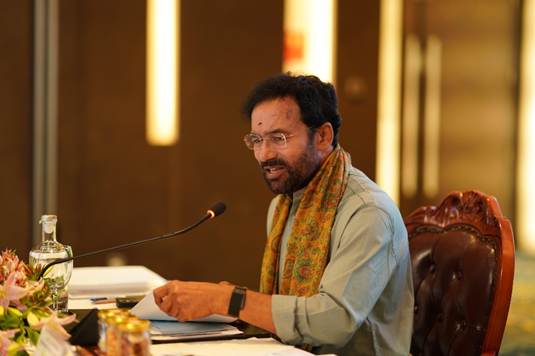
The Minister Chaired High-Level Review Meetings of GSI, NIRM & IBM in Bengaluru, Seeks Blessings of Gurudev Sri Sri Ravi Shankar
HYDERABAD, MAY 25, 2026: Union Minister for Coal & Mines G. Kishan Reddy on Monday directed all mining and exploration agencies under the Ministry to fast-track pending projects and adopt a mission-mode approach to strengthen India’s mineral security and strategic growth objectives.
“All organisations must fast-track pending projects and ensure that technology, transparency and efficiency become the foundation of every institutional process. The people of India and the Government of India expect speed, accountability and visible outcomes from every agency working in this sector,” the Minister said while chairing a series of high-level review meetings in Bengaluru with senior officials of the Geological Survey of India (GSI), National Institute of Rock Mechanics (NIRM), Indian Bureau of Mines (IBM) and the Remote Sensing & Aerial Survey (RSAS) division.
The meetings focused on accelerating mineral exploration, strengthening scientific and technological capabilities, promoting sustainable mining practices and aligning institutional efforts with the national vision of Viksit Bharat 2047.
During the review, the Minister assessed ongoing projects, technological advancements and exploration activities being undertaken across the country, particularly in the field of critical and strategic minerals, including Rare Earth Elements (REE), Lithium, Nickel, Cobalt, Tungsten, Vanadium and Platinum Group Elements (PGE). The organisations presented detailed updates on resource augmentation, mineral targeting, scientific surveys, mine sustainability, geospatial technologies and advanced exploration systems being implemented to strengthen India’s mineral security and strategic growth objectives.
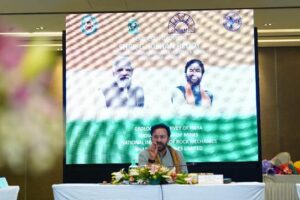
Addressing the officials, Shri G. Kishan Reddy stated:
“Under the leadership and vision of Hon’ble Prime Minister Shri Narendra Modi Ji, India is moving decisively towards becoming a self-reliant and globally competitive economy. The mining and exploration sector has a critical role in securing India’s future growth, industrial expansion and strategic mineral security.”
He further directed all organisations to work in a coordinated mission-mode approach with clearly defined timelines, measurable outcomes and greater accountability.
The Minister also emphasised the importance of advanced technologies, data integration and scientific innovation in strengthening India’s exploration ecosystem.
“The future of mineral exploration lies in technology-driven systems including AI, remote sensing, integrated geoscience analytics and advanced exploration methodologies. Our institutions must lead this transformation to make India future-ready and resource-secure,” he said.
The Geological Survey of India highlighted major exploration outcomes across Karnataka and Goa, including the identification of gold, copper, PGE, nickel and cobalt-bearing zones, along with significant augmentation of mineral resources following reforms introduced under the MMDR Amendment Act, 2015. GSI also outlined its five-year roadmap involving large-scale thematic mapping, AI/ML-enabled mineral targeting and advanced-stage exploration projects covering nearly 48,000 sq. km.
The National Institute of Rock Mechanics showcased its contributions towards nationally significant infrastructure and mining safety projects including hydropower, metro rail, tunnel engineering, seismic monitoring and controlled blasting near sensitive infrastructure. The institute also presented its capabilities in rock mechanics, engineering geology, micro seismic monitoring and geotechnical solutions supporting strategic national development projects.
The Indian Bureau of Mines reviewed progress in sustainable mining practices, operationalisation of auctioned mineral blocks, scientific mine closure, mineral beneficiation and environmental safeguards. IBM also presented findings related to critical mineral enrichment and recovery potential from existing mining ecosystems under the National Critical Mineral Mission.
The RSAS division presented the progress achieved under the National Aerogeophysical Mapping Programme (NAGMP), including airborne geophysical surveys, hyperspectral remote sensing and AI/ML-driven mineral prospectively mapping. The review highlighted that more than 6.5 lakh sq. km. has already been covered under the programme, generating over 200 exploration projects using aero-geophysical datasets.
As part of the Bengaluru visit, Hon’ble Minister Shri G. Kishan Reddy also visited the Art of Living Foundation International Centre and interacted with members of the Art of Living family. The Minister visited the Gurukul and Exhibition Centre and appreciated the institution’s efforts towards value-based education, spiritual awareness and social transformation rooted in India’s cultural heritage.
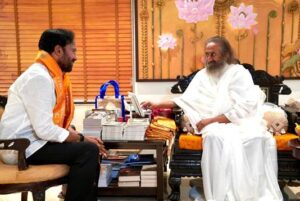
The Minister also had the privilege of interacting with Sri Sri Ravi Shankar and sought his blessings.
Reflecting on the visit, Shri G. Kishan Reddy said:
“India’s development journey towards Viksit Bharat 2047 must be guided not only by economic progress and technological advancement, but also by spiritual consciousness, cultural values and a spirit of collective service towards society.”
The visit concluded with a renewed emphasis on nation-building through scientific progress, sustainable development, cultural values and institutional excellence in alignment with the vision of Viksit Bharat 2047.
About the Author