Questions now confront Telangana’s cooperative governance structure
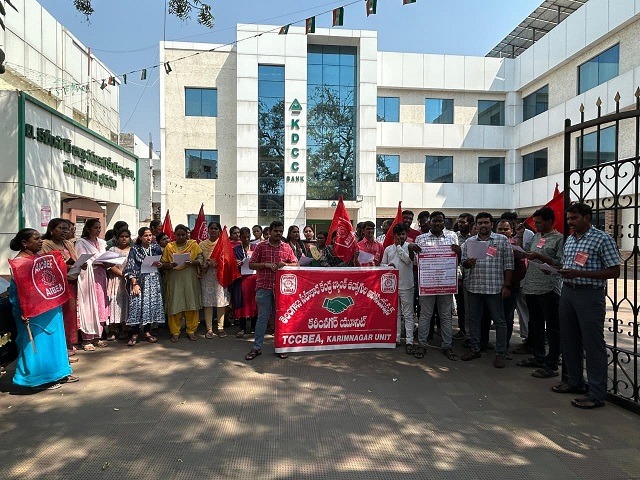
Telangana Cooperative Central Bank Employees Association agitations opposing the recovery of incentives, ex gratia, and bonus etc enters sixth day
KARIMNAGAR, APRIL 20, 2026: If lawfully sanctioned incentives are under scrutiny, should not supervisory failures, executive appointments, and institutional accountability face equal scrutiny too?
A healthy cooperative banking system depends on one foundational principle: accountability must be even-handed. It cannot be severe toward employees and silent toward supervisory lapses. It cannot be retrospective for workers and permissive for those who held power. It cannot be loud on incentives yet muted on losses, fraud risks, governance failures, or questionable appointments.
That is why a set of uncomfortable but necessary questions now confronts Telangana’s cooperative governance structure.
Across the state, district cooperative central bank employees who received incentives or ex gratia through approved institutional processes reportedly face scrutiny, pressure, and recovery proceedings. But parallel questions remain unanswered about losses in at least one district bank, supervisory failure, executive responsibility, and the larger governance architecture.
These are not anti-institution questions. They are pro-accountability questions.
The First Question: Who Is Responsible for the Losses? If a district cooperative bank has suffered financial losses, the first task of any serious governance framework is to identify responsibility accurately.
Was it caused by: Weak credit appraisal? Political lending pressure? Poor recovery systems? Internal control failures? Fraud or collusion? Management negligence? Supervisory silence? Delayed intervention?
Until those answers are established, pursuing peripheral issues while core institutional losses remain unresolved risks appearing selective.
What Did Annual Inspections Discover?
The District cooperative central banks do not operate without scrutiny. Under the legal and regulatory framework, inspections, audits, and supervisory reviews are expected periodically. That naturally leads to a critical question: If serious financial problems existed, why did annual inspections fail to bring them out in time? Were warning signals missed? Were observations diluted? Were findings not acted upon? and were reports ignored after submission?
If inspections happened but problems remained hidden, the issue is not merely with one district bank. It is with the quality of oversight itself.
If There Was Concealment, Who Is Answerable?
If material irregularities were known but not escalated, that is grave. If they were not known despite repeated inspections, that too is grave.
Either way, accountability cannot stop at the district gate. Any system that asks employees to repay benefits must also ask: Who certified compliance? Who reviewed balance sheets? Who monitored deviations? Who signed the inspection reports? Who failed to trigger corrective action? Why Enquire Only After Public Exposure?
If concerns surfaced publicly nearly a year ago, why has visible accountability for supervisory officers remained limited?
Why do enquiries often begin only after issues become public controversies?
A governance culture that reacts only after exposure, rather than preventing damage through timely vigilance, is not reform—it is delay management.
Accountability of Inspecting Officers Matters Too
If inspecting officers missed or overlooked serious issues, were departmental actions initiated?
Were reports reopened?
Were internal responsibilities fixed?
Were inspection systems upgraded?
Without examining the accountability of those tasked to inspect, enforcement appears incomplete.
The CEO Appointment Question
Another important issue concerns the appointments of Chief Executive Officers in district cooperative banks.
If eligible serving officers exist within district banks, why are retired officers sometimes appointed under the banner of “fit and proper criteria”?
The principle of fit and proper was meant to ensure competence, integrity, and professionalism—not to become a shield against transparent talent pipelines.
This raises legitimate questions:
Were serving eligible officers considered fairly?
Was succession planning ignored?
Is retirement now an advantage over service merit?
Are the same service rules applied uniformly?
Are CEOs Bound by Equal Standards?
Employees across cooperative banks operate under service rules, age limits, disciplinary codes, transfers, and performance obligations.
Then the public is entitled to ask:
Do CEOs face equally clear standards of accountability?
If a regular employee commits misconduct, procedures exist.
If a CEO presides over large losses, control failures, or fraud exposure, what is the consequence?
If a top apex-level executive commits serious misconduct, what is the mechanism?
Transparent systems answer these questions in advance—not after a crisis.
Fraud Cannot Be a Theoretical Issue
In any financial institution, fraud risk is real. That is why governance standards must be strictest at the top.
If crores of rupees are lost through fraud, negligence, or collusion, responsibility must extend to: Operational actors, Supervisory chain, Management leadership, Board oversight, where applicable. Institutions fail when only the lowest rung is visible.
The Retirement Contradiction
Governments prescribe retirement ages for public and banking service structures to create certainty, renewal, and progression.
If employees retire at structured ages, yet retired individuals continue returning to key executive posts while younger, qualified internal officers wait, frustration is inevitable.
This is not a question of age. It is a question of governance philosophy.
Are institutions nurturing leadership pipelines—or recycling control?
Incentives vs Institutional Priorities
There is a larger irony here.
Employees who helped banks earn profits, mobilise deposits, reduce NPAs, or improve service are scrutinized over incentives.
Meanwhile, questions over losses, failed oversight, delayed action, and appointment logic remain inadequately addressed.
That inversion of priorities can damage morale across the cooperative system.
What Reform Should Actually Look Like
A serious reform agenda for Telangana’s cooperative banking sector would include: Transparent forensic review of loss-making banks. Public accountability for failed inspections. Merit-based CEO appointments, Fixed standards for executive responsibility. Strong internal audit systems. Protection for honest employees. Performance-linked incentives within law and Timely elections and board accountability.
Final Question
If employees are being asked to answer for benefits they lawfully received, then should not those who failed to prevent losses, detect irregularities, or justify appointments answer first?
Because credibility in governance rests on one timeless rule:
The higher the authority, the higher the accountability.
About the Author