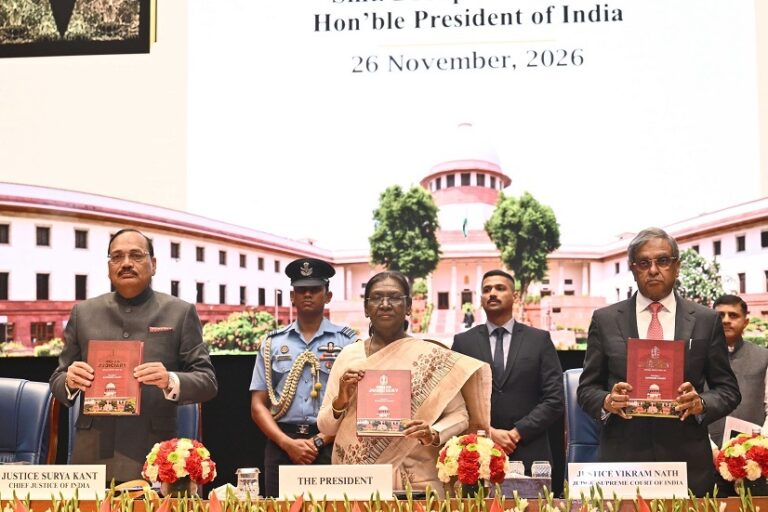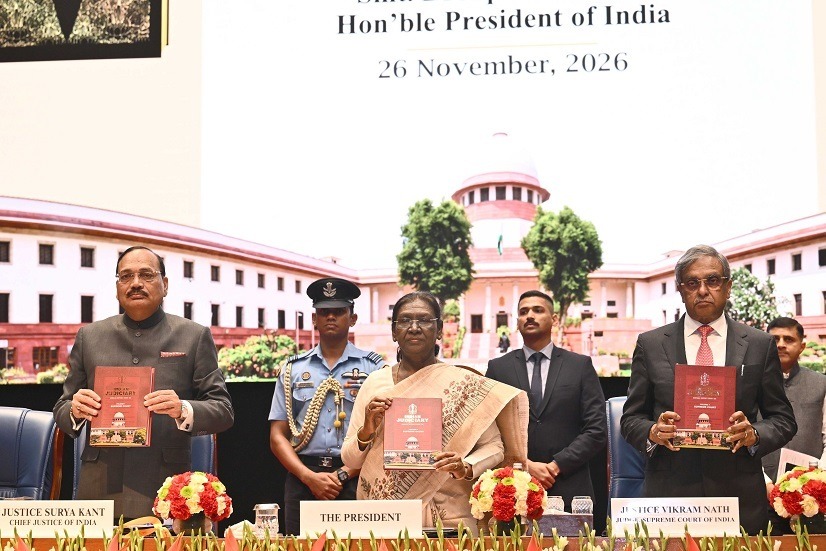
President of India graces the Constitution Day celebrations organised by the Supreme Court of India
Timely Delivery of Justice is an essential component of the very concept of Justice: Murmu
Greater emphasis on inclusivity and merit will further strengthen our judiciary: President
NEW DELHI, NOVEMBER 26, 2026: The President of India, Smt Droupadi Murmu, graced the Constitution Day Celebrations, being organised by the Supreme Court of India, in New Delhi today (November 26, 2026).

Speaking on the occasion, the President extended her greetings to the fellow citizens on Constitution Day. She said that on November 26, 1949, the people of India adopted their Constitution. In 2015, on the auspicious occasion of the 125th birth anniversary of the principal architect of our Constitution, Dr. Babasaheb Bhimrao Ambedkar, it was decided to observe ‘Constitution Day’ annually on this date. It is a day to pay respectful tribute to the great architect of the Constitution and to the ideals enshrined within it.
The President said that the Supreme Court, High Courts, and the district and lower courts have made an invaluable contribution to the glorious journey of our Republic. Over the past decades, there have been unimaginable changes across many spheres of life. In particular, the influence of technology and media has become increasingly pervasive and profound. While adapting its role to changing circumstances and expectations, the judiciary has upheld and strengthened the fundamental ideals of justice. From time to time, the Indian judiciary has placed special emphasis on judicial accountability, thereby bringing to execution the ideals envisioned by the framers of the Constitution. The synergy between judicial independence and judicial accountability lends strength to the role of the judiciary.
The President said that the timely delivery of justice is an essential component of the very concept of justice. To ensure that justice is accessible in a timely manner, the judiciary is undertaking various initiatives such as simplifying procedures, leveraging technology, and establishing special courts. She noted that despite these efforts, the massive backlog of pending cases remains a significant challenge for our justice delivery system. She expressed confidence that this challenge will be addressed through the concerted efforts being made at every level of the judiciary.
The President said that not everyone possesses the resources required to access the High Courts or the Supreme Court. Our Constitution mandates the provision of justice on the basis of equal opportunity, which includes the facilitation of free legal aid. The objective of this mandate is to ensure that no citizen is denied the opportunity to seek justice due to economic constraints or any other form of hardship. The President emphasized that the true progress of a nation lies in ensuring that every citizen has an equal opportunity to thrive and succeed. She underscored the importance of providing every child with equal access to quality education. It is also crucial to focus on the quality and reliability of legal representation available to the poor and marginalized sections of society. In this context, the District, State, and National Legal Services Authorities must intensify their efforts to ensure that justice reaches these vulnerable and disadvantaged groups.
The President said that empathy and ethics should be given as much importance as the study of laws in legal education in our country. She urged the leading lights in the lawyers’ community to present inspiring examples for young lawyers. She said that the young lawyers should see that excellence can be blended with empathy, and competence with compassion.
The President said that larger and more active participation of women in the Bench and Bar will help make our society more fair, just, equitable and inclusive. She highlighted that a woman’s perspective can add to inclusion, diversity and balance to judicial decision-making. She underlined the need to encourage greater participation by women as judges and lawyers. Greater emphasis on inclusivity and merit will further strengthen our judiciary.
The President noted that the Supreme Court has taken steps to promote access to justice by prioritising cases relating to specially abled persons, acid attack victims, senior citizens aged above 80 years and persons below the poverty line. She appreciated the steps taken for more effective case management and listing, promoting digital transformation, and encouraging amicable resolution of disputes. She expressed confidence that our judicial fraternity will continue to uphold the idealism with which the members of the Constituent Assembly framed the provisions on the judiciary.
About the Author