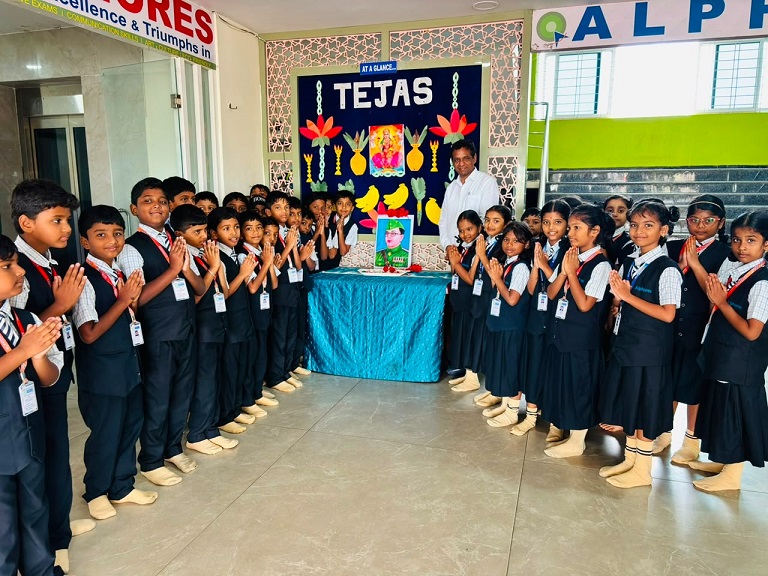
KARIMNAGAR, AUGUST 18, 2026: Students of Alphores e-techno school, Kothapalli, in Karimnagar town, paid rich tributes to Freedom Fighter and Azad Hind Fauj leader Netaji Subhash Chandra Bose on his reported death anniversary on Tuesday.
Alphores Educational Institutions Chairman V. Narender Reddy and students paid floral tributes to Netaji’s portrait. Through his speech, Mr Narender Reddy enlightened the students about the thoughts on the life of Subhas Chandra Bose. He inspired the students to adopt and follow the path paved by him.
Subhas Chandra Bose was popularly known as Netaji. The term means “Respected Leader” and became closely associated with his leadership of the Indian independence struggle. Mr Bose cleared the Indian Civil Services examination in 1920. He withdrew his candidacy in 1921 because he wanted to participate directly in India’s freedom movement.
Netaji Subhas Chandra Bose made important contributions through political mobilisation, international diplomacy, military organisation and his demand for complete independence from British rule.
Bose supported unqualified Swaraj. He opposed proposals favouring dominion status and advocated complete freedom from British rule. He joined the Indian National Congress and became president in 1938.
He was re-elected in 1939 after defeating Pattabhi Sitaramayya, Gandhi’s preferred candidate. He participated in the Non-Cooperation Movement and the Salt Satyagraha of 1930.
As Congress president in 1938, Bose established a national planning committee. It promoted broad industrialisation as part of his vision for independent India. He opposed the suspension of the Civil Disobedience Movement and the Gandhi-Irwin Pact in 1931.
Later, he resigned as Congress president because of ideological differences with Mahatma Gandhi and other leaders. He founded the Forward Bloc to consolidate left-wing political forces.
Bose assumed leadership of the Indian National Army in 1943. The INA was also known as the Azad Hind Fauj and included Indian prisoners of war and civilians from Southeast Asia. On 21 October 1943, Bose announced the formation of the provisional independent Indian government. He used the INA as an armed force to pursue Indian independence.
The INA advanced with Japanese forces towards India. It reached the Imphal and Kohima region in 1944 but was eventually defeated and forced to retreat after lacking adequate air support.
About the Author