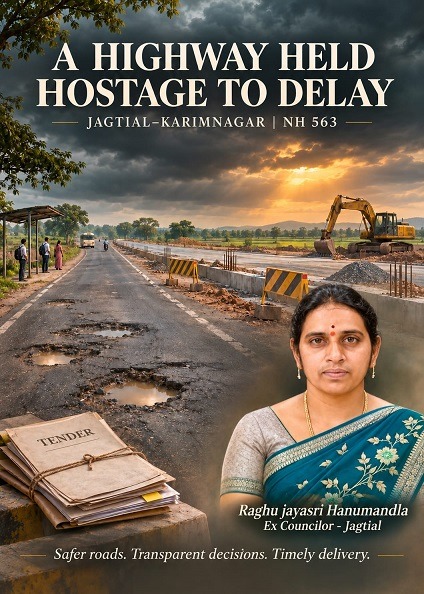
The Jagtial–Karimnagar road project needs transparent procurement, immediate safety measures and a binding timetable for delivery.
Authored Article by former Municipal Councillor Hanumandla Jayashree
JAGTIAL, NOVEMBER 14, 2026: A highway is a public commitment to safer journeys, stronger markets and better access to essential services. When its development remains trapped in repeated tendering, the consequences extend beyond paperwork. Citizens bear the burden through uncertain travel, higher costs and prolonged exposure to unsafe conditions. The proposed four-laning of the Jagtial–Karimnagar section of National Highway 563 demands urgent administrative attention.

Years of promises
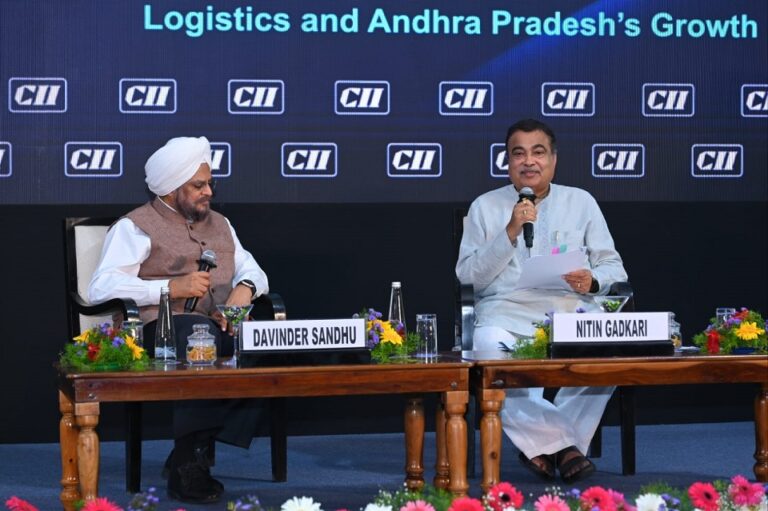
The supplied newspaper reports describe a tender process stretching back to 2022, marked by cancellations, restructuring and extensions. Former municipal councillor Hanumandla Jayashree’s representation to Union Road Transport and Highways Minister Nitin Gadkari brings together concerns over procurement, road safety, compensation and the project’s financing model.
These concerns warrant a documented response. Allegations of negligence require examination; they should neither be accepted without evidence nor dismissed without explanation. Authorities must publish a consolidated chronology identifying what changed, why decisions were taken and which obstacles remain unresolved.
Deadlines without delivery
Official records confirm that the 58.866-kilometre project’s July 2026 tender underwent successive deadline extensions. The original August 27 submission deadline moved to September 30, October 29 and November 26, with bid opening scheduled for November 27, 2026.
Extensions can address legitimate commercial or technical concerns. Repeated postponements, however, demand scrutiny of project preparation, bidder participation and contractual conditions. The public deserves to know whether delays arise from financing difficulties, land availability, unrealistic assumptions or other constraints.
A focused review should examine the cancellations and revisions, identify avoidable failures and recommend corrective action within a fixed period. Its findings should be disclosed.
A financing model that works
NHAI’s April 2025 project list recorded the corridor under the Hybrid Annuity Model. The Union Cabinet’s June 2026 approval subsequently specified Build–Operate–Transfer (Toll). The change is therefore documented, while the supplied reports seek reconsideration of HAM.
The appropriate model must emerge from a realistic assessment of traffic, financing, land readiness and risk allocation. Changing the model without addressing underlying weaknesses would merely restart the cycle.
The authorities should explain the commercial rationale for their choice and demonstrate how it protects public finances while attracting credible bidders. Persistent weak participation should trigger reassessment, accompanied by a clear decision deadline.
Safety cannot wait
The reports describe potholes, hazardous travel conditions and recurring accidents. They do not establish a verified casualty total or prove that particular deaths resulted from project delays. Police and highway authorities should publish reliable crash data and identify locations requiring urgent intervention.
Meanwhile, maintenance must proceed independently of the widening contract. Surface repairs, drainage, road markings, lighting at critical locations and safer junctions are immediate responsibilities.
The future highway must also accommodate pedestrians, two-wheelers, public transport users and neighbouring villages. Safe crossings, appropriate service roads and carefully designed access points should form part of its delivery.
Fairness for affected families
Land acquisition cannot be managed through uncertainty. The reports raise compensation concerns but provide inconsistent indications of payment progress. Authorities should publish village-wise information on awards, payments, outstanding claims and possession.
Affected farmers and property owners need accessible grievance mechanisms and definite timelines for resolving pending matters. Compensation concerns livelihoods and household security; it is central to project readiness.
NHAI, Telangana’s administration and district officials must coordinate these obligations through a shared schedule, with named officers responsible for implementation.
Accountability beyond announcements
The Union government has acknowledged congestion along the corridor and projected a travel-time reduction of about 45 minutes after completion. Those benefits depend on execution.
Elected representatives, local bodies, farmers’ organisations and transport associations should collectively seek a public implementation plan. It must distinguish tender publication, contract award, financial closure, commencement and physical completion, with measurable milestones and regular disclosures.
Ministerial intervention should produce decisions that survive beyond the announcement. Every further extension must explain the obstacle, the remedy and the accountable authority.
The Jagtial–Karimnagar corridor deserves transparent procurement, timely compensation, immediate repairs and sustained construction oversight. Public confidence will return when administrative commitments become visible progress.
A tender records an intention. A safe, completed highway fulfils a public obligation.
About the Author