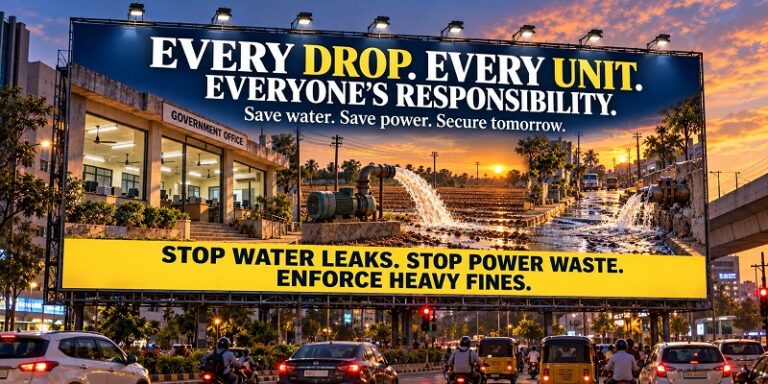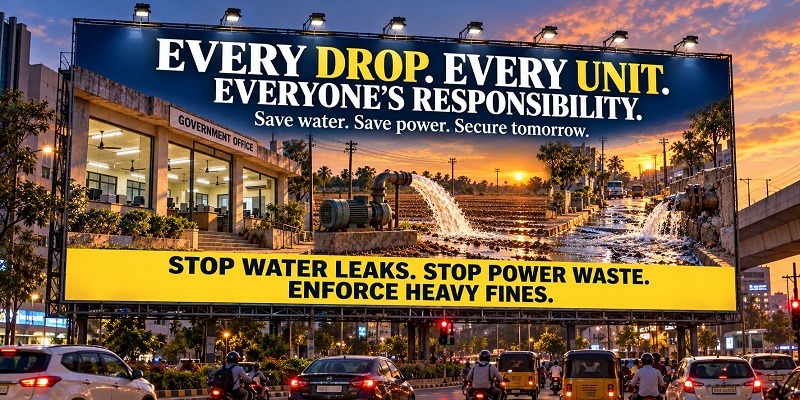
Water and electricity conservation must become a daily practice in public institutions and private lives.
AUTHORED ARTICLE
KARIMNAGAR, OCTOBER 26, 2026: An overflowing water tank and an air-conditioner running in an empty office reveal the same failure: resources are consumed without anyone accepting responsibility. Governments appeal to citizens to conserve water and electricity. Such appeals acquire credibility when public institutions demonstrate the discipline they expect from households.
An October 18 report on www.hindudayashankar.com described municipal water overflowing at Karimnagar’s Integrated District Offices Complex and identified pipeline leakages elsewhere in the town. These reported conditions warrant inspection and a public explanation of corrective action. The present status must be verified; publication of a complaint cannot, by itself, establish whether the problem continues. [1]
The concern should extend to electricity. Public buildings should be inspected for unnecessary lighting, fans operating in vacant rooms, excessive cooling and pumps running beyond operational requirements. These are matters for systematic verification, rather than sweeping allegations against every office. What is needed is a routine that detects waste before a citizen or journalist has to expose it.
Water and electricity are closely connected. Collecting, treating and pumping water require energy. A leaking pipeline therefore wastes both treated water and part of the electricity used to deliver it. Preventing overflow and maintaining pumps can help conserve both resources. Administrations should manage these services together wherever their operations overlap.
Every government office, school, hospital and municipal facility should designate an officer responsible for monitoring resource use. Daily checks should cover taps, tanks, pumps, lighting and cooling equipment. Essential services, medical equipment, security systems and necessary ventilation must remain protected. Conservation requires informed decisions about actual needs.
Practical measures are readily available. Buildings can use daylight where suitable, replace inefficient equipment when economically justified, maintain electrical installations and install reliable tank-level controls. The Bureau of Energy Efficiency promotes air-conditioning at 24°C as an energy-saving practice. Appropriate settings should account for occupancy, comfort and the requirements of the space. [2]
Measurement must follow these measures. Institutions should review monthly water and electricity consumption against occupancy, working hours and seasonal conditions. A hospital cannot fairly be compared with a small administrative office. Nor should an arbitrary savings target encourage staff to compromise public services. The objective is to eliminate avoidable consumption while maintaining service quality.
Municipalities and electricity utilities should also provide accessible complaint channels. Reports of leaking mains, overflowing public tanks or streetlights burning unnecessarily during daylight should receive reference numbers and response deadlines. Closure should follow verification. Repeated failures should trigger a review of equipment, maintenance arrangements and supervisory responsibility.
Citizens have an equally practical role. Repairing household leaks, switching off unused appliances and operating pumps responsibly are everyday civic duties. Businesses, function halls, educational institutions and places of worship should examine their consumption too. Paying a bill does not remove the wider responsibility to avoid waste.
Local journalism can sustain this effort through documented reporting and follow-up. Authorities should respond with inspection findings and repair records. Public scrutiny becomes useful when it leads to measurable improvement.
Conservation must continue beyond campaigns and ceremonial pledges. A functioning valve, a repaired pipe and an unnecessary light switched off are small actions with cumulative value. Telangana’s resource security will be strengthened when saving water and electricity becomes an ordinary habit—supported by accountable institutions and practised by every citizen.
Sources
[1] Hindudayashankar, 18 October 2026. Wastage of water goes unchecked at the newly inaugurated IDOC Collectorate complex in Karimnagar town.
[2] Bureau of Energy Efficiency, Ministry of Power. Space Cooling Raise It By 1 Degree 24 Degrees.
https://beeindia.gov.in/show_content.php?lang=1&level=2&lid=488&ls_id=431
About the Author