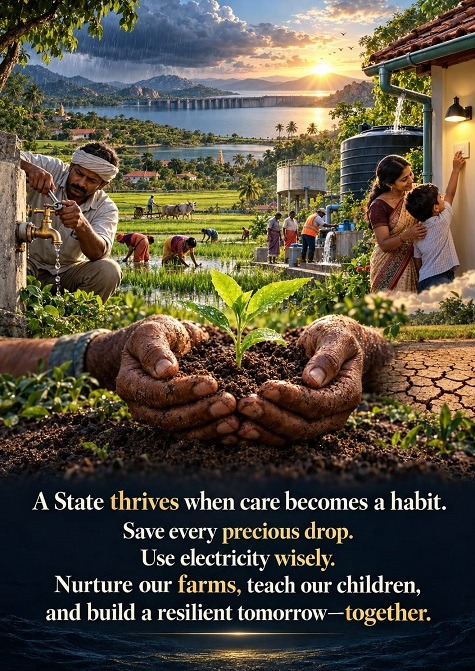
Authored Editorial
A State’s future is shaped not only in government offices but also in the ordinary decisions of its citizens. A leaking tap left unattended, a light burning in an empty room, or rainwater allowed to escape without consideration may appear insignificant. Collectively, however, such habits reveal how we value the resources on which our lives depend. Conservation begins when public concern becomes personal responsibility.
It is legitimate to question governments about water supply, electricity services and preparedness for scarcity. Public institutions must remain answerable for their decisions, expenditure and performance. Yet accountability cannot become an excuse for individual indifference. Citizens should demand effective governance while examining their own conduct. Asking what the government is doing gains greater moral force when accompanied by another question: what are we doing?
The belief that paying a bill confers an unrestricted right to consume deserves reconsideration. Payment settles a financial obligation; it does not make a shared resource inexhaustible. Water and electricity serve households, farms, schools, hospitals and livelihoods. Responsible use recognises these connections. The guiding principle should be straightforward: use what is necessary, avoid what is wasteful, and respect what others also need.
Water conservation carries a particularly intimate connection with food. Behind the meal on a household table stands a farmer whose work depends on access to water. To waste it casually is to overlook the labour and uncertainty behind that meal. Protecting water is therefore more than household thrift. It expresses solidarity with agricultural communities and concern for the security of future generations.
Such concern must find practical expression. Repair leaking taps promptly. Avoid leaving water running during routine tasks. Maintain storage systems and prevent overflow. Where suitable, collect rooftop rainwater through properly designed and maintained arrangements. Rainfall should prompt more than temporary celebration: it should encourage preparation. Conserving water while it is available is wiser than discovering its worth when supplies become uncertain.
The same discipline applies to electricity. Switching off unnecessary lights, fans and appliances should become an ordinary habit in homes, offices and public buildings. Conservation need not mean discomfort or the denial of essential services. It means distinguishing useful consumption from avoidable waste. A simple action, repeated consistently by many people, can establish a culture in which efficiency is expected and carelessness questioned.
Children learn that culture by watching adults. Instructions about saving resources mean little when a household ignores dripping taps or leaves empty rooms illuminated. Parents and teachers can make conservation visible through everyday practice. A child encouraged to close a tap learns more than a household rule: the child learns that personal choices carry consequences beyond the individual. That understanding is a valuable inheritance.
Governments, meanwhile, must support public effort through dependable services, timely maintenance, clear communication and credible conservation measures. Citizen participation should strengthen institutional responsibility, never replace it. Nor should conservation be presented as a guarantee against drought. Its value lies in reducing avoidable pressure and improving preparedness. A resilient State requires both capable institutions and people willing to act.
Love for one’s State is most persuasive when expressed through care. It lives in the repaired tap, the harvested rain and the unnecessary light switched off. One household’s contribution may be modest; a shared commitment can be substantial. Let us question responsibly, conserve consistently and lead by example. The future we seek deserves the resources we can protect today.
About the Author