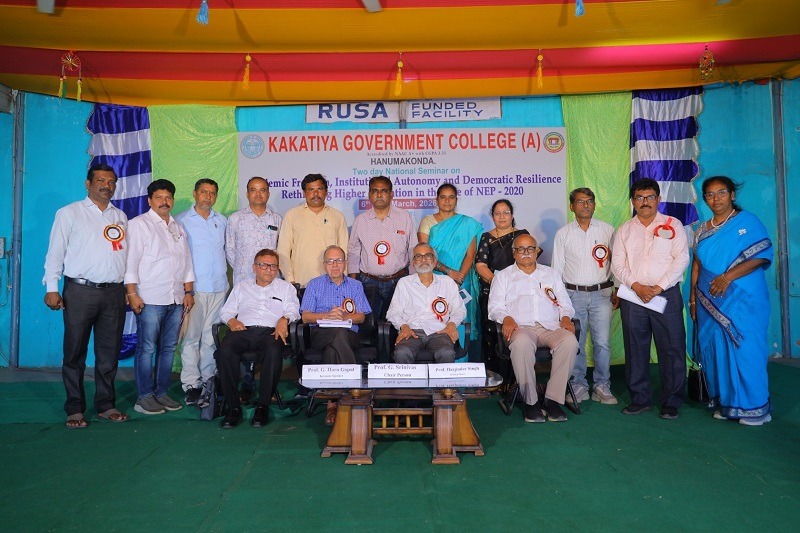
Two-day national seminar on ‘Academic freedom, institutional autonomy and democratic resilience’ conducted at Kakatiya Govt Degree College
HANAMKONDA, MARCH 12, 2026: A two-day national seminar on “Academic Freedom, Institutional Autonomy, and Democratic Resilience: Rethinking Higher Education in the Age of NEP 2020” was successfully organised on March 6–7, 2026, by the Faculty Forum of Kakatiya Government College (Autonomous), Hanamkonda, Telangana.
The seminar began without ceremonial formalities. The inaugural session began with a collective reading of the Preamble to the Constitution of India, symbolically linking the seminar’s deliberations to constitutional values. Instead of shawls or formal felicitations, the invited speakers received a UNESCO publication on academic freedom. The event was designed not merely as a sequence of lectures but as a collective process of reflection and dialogue.
During the inaugural session, a draft document titled “Hanamkonda Declaration on Academic Freedom and Institutional Autonomy” was placed before the participants for discussion. Rather than a pre-determined resolution, it was intended as a discussion paper inviting deliberation. Based on the discussions held during the seminar, the final version of the declaration was consolidated and released in the valedictory session.
The declaration reaffirmed that institutions of higher education are an integral part of democratic life and that academic freedom is essential for the pursuit of truth, critical thinking, and public debate. It also emphasised that the constitutional values of justice, liberty, equality, and fraternity should guide the ethical purpose of education. The draft explained that academic freedom includes the freedom to teach and learn without fear, conduct research according to scholarly standards, publish and disseminate knowledge, and participate in reasoned academic debates. At the same time, it noted that academic freedom must be accompanied by ethical responsibility and academic discipline, and only under such conditions can universities fulfil their intellectual and social responsibilities.
The invited speakers addressed the growing digital and commercial trends in education, the changing regulatory framework after NEP 2020, and the broader challenges faced by universities. Discussions focused on the philosophical and institutional foundations of academic freedom.
The keynote address was delivered by noted political scientist and General Secretary of the Telangana Save Education Committee, Professor G. Haragopal, on the theme “Autonomy of Universities: Emerging Crisis in Higher Education.” In his lecture, he analysed the increasing challenges to academic freedom in India. He noted that certain provisions of the National Education Policy 2020 had raised concerns in some states regarding their implications for federalism and the governance of educational institutions. He also observed that in recent years there has been a growing restriction on academic freedom and institutional autonomy, and that the democratic environment within universities is being weakened. He emphasised that academic freedom is essential for the process of knowledge creation and argued that universities must remain spaces that encourage critical thinking and intellectual dissent. Recalling the historical example of Socrates being punished by the state for questioning established beliefs, he highlighted the importance of protecting education from political interference.
Professor Harjinder Singh Lalltu from the International Institute of Information Technology, Hyderabad, spoke on “Digitalisation and Commercialisation: Education for Whom?” He pointed out that public investment in education is declining and argued that while digital technologies are expanding, they are also generating new forms of inequality.
Professor K. Srinivasulu, former Dean of Social Sciences at Osmania University, analysed “The State of Higher Education in India and NEP 2020” from a historical perspective. He remarked that the neo-liberal economic framework has increasingly transformed education into a commodity.
Professor Arun Kumar, General Secretary of the All India Federation of University and College Teachers’ Organisations (AIFUCTO), discussed the impact of higher education reforms on academic autonomy.
On the second day of the seminar, Professor Burra Ramesh from the Regional Institute of Education, Mysuru, delivered a lecture titled “Teacher Autonomy: For and From.” He explained the distinction between institutional autonomy and the autonomy of individual teachers, emphasising that teachers play a crucial role in exercising academic freedom within the classroom. He noted that teachers face multiple constraints not only from external authorities but also from internal institutional structures, social norms, and personal beliefs. Therefore, he argued, teachers must cultivate ethical responsibility, intellectual independence, and professional commitment in order to exercise their autonomy effectively.
This was followed by a panel discussion on “Teacher Organisations, Academic Freedom, and Institutional Autonomy.” The panelists expressed concern about growing market-oriented trends and increasingly centralised decision-making processes in higher education. They emphasised that unity and collective action among teacher organisations are necessary to safeguard the democratic character of universities.
The seminar received 72 research papers from scholars across various institutions. These papers were presented across six technical sessions over the two days. The presentations addressed themes such as academic freedom, NEP 2020, challenges faced by autonomous colleges, education in the digital age, and the future direction of educational policies.
In the valedictory session, chaired by Professor G. Srinivas, Professor K. Lakshminarayana, Organising Secretary of the Telangana Save Education Committee, attended as the chief guest. He expressed concern that the National Education Policy encourages privatisation and may undermine the academic freedom of teachers and institutions, potentially deepening existing inequalities.
During the session, the final version of the “Hanamkonda Declaration on Academic Freedom and Institutional Autonomy” was unanimously adopted by the delegates.
The two-day national seminar thus provided a meaningful platform for teachers, scholars, policymakers, and students to engage in substantive discussions on the critical challenges facing higher education. It reaffirmed the importance of academic freedom, institutional autonomy, democratic governance, and increased public investment in education. Participants underscored the need for universities to remain spaces that foster free dialogue, intellectual diversity, and critical thinking.