From the power of creation to motherhood… From determination to the celebration of victory… From a mother’s compassion to the grace of the Divine Mother of the Universe…
The compassion that responds when we call out, “Amma”…
The heart that rejoices upon witnessing the success of her child…
The love that feels her child’s suffering as her own…
Where did all these qualities originate?
Who is the source of motherly love?
Who is the source of that selfless love in a mother’s heart that sacrifices her own comforts for the sake of her child?
The compassion, patience, and protective instinct that we see in every mother across the world—are these merely human emotions? Or is there a divine power behind them?
As we seek answers to these questions on our spiritual journey, the divine form we must behold on the fifth day of Navaratri is Sri Skandamata.
She is not merely the mother of Kumaraswamy. She is the embodiment of motherhood manifested by Adi Parashakti, the primordial power who is the source of all creation.
When Shakti manifests as motherhood, She becomes love. When love transforms into responsibility, it manifests as the power of protection. That protective power becomes the path towards the establishment of Dharma.
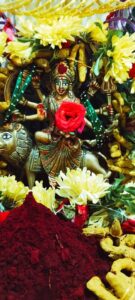
This is the extraordinary spiritual truth revealed through the form of Skandamata.
Adi Parashakti — The Source of All Creation
The Supreme Divine Power assumes different forms through Her divine play, teaching us a unique truth of life through each manifestation.
She is Adi Parashakti. She is Prakriti. She is consciousness. She is the source of creation. The spiritual understanding that all living beings emerge from Her is central to the Shakta tradition.
She is the One we beheld as Shailaputri. She is the One we worshipped as Brahmacharini. She is the One we understood as Chandraghanta, the power prepared to protect Dharma. She is the One we beheld as Kushmanda, the divine energy that is the source of the creation of the universe.
Now, that same Adi Parashakti reveals another extraordinary dimension of Herself to us.
That is motherhood.
The primordial power that created the universe, when manifested as motherly love within that very universe, is worshipped as Skandamata.
The Birth of Skanda — The Divine Manifestation for the Protection of Dharma
According to the Puranas, Tarakasura, empowered by the boon he had received, tormented the gods and sages, obstructing the path of Dharma.
Because of the boon that he could be killed only by a son of Lord Shiva, it became necessary for a son of Shiva and Parvati to be born to destroy him.
Against the backdrop of the prayers of the gods and divine will, the birth of Kumaraswamy is described in various Puranas.
According to a popular Puranic account, Lord Agni carried the divine radiance of Lord Shiva and subsequently conveyed it through the River Ganga to the reeds of Sharavana, where the divine child manifested. When the six Krittikas nurtured the child, he became renowned as Kartikeya. He is also known by the names Shanmukha, because he appeared with six faces; Devasenapati, because he became the commander of the celestial army; and Skanda.
In due course, Skanda grew into a mighty warrior and assumed leadership of the celestial army. He fought Tarakasura, destroyed him, and protected the gods.
In this story, we witness, on the one hand, a great warrior who incarnated to protect Dharma. On the other hand, we also recognise the divine motherhood that stood behind that mighty warrior.
To see her child grow into the protector of the worlds…
To see him establish Dharma…
To see him conquer evil forces…
What greater joy can there be for a mother than witnessing her child’s victory?
Here, we experience another extraordinary dimension of Skandamata’s divine form.
Even the power that protects the worlds finds a divine refuge in a mother’s love.
Skandamata — The Divine Mother Who Rejoiced in Her Son’s Victory
The form of Skandamata that we behold on the fifth day of Navaratri is an extraordinary symbol of motherly love.
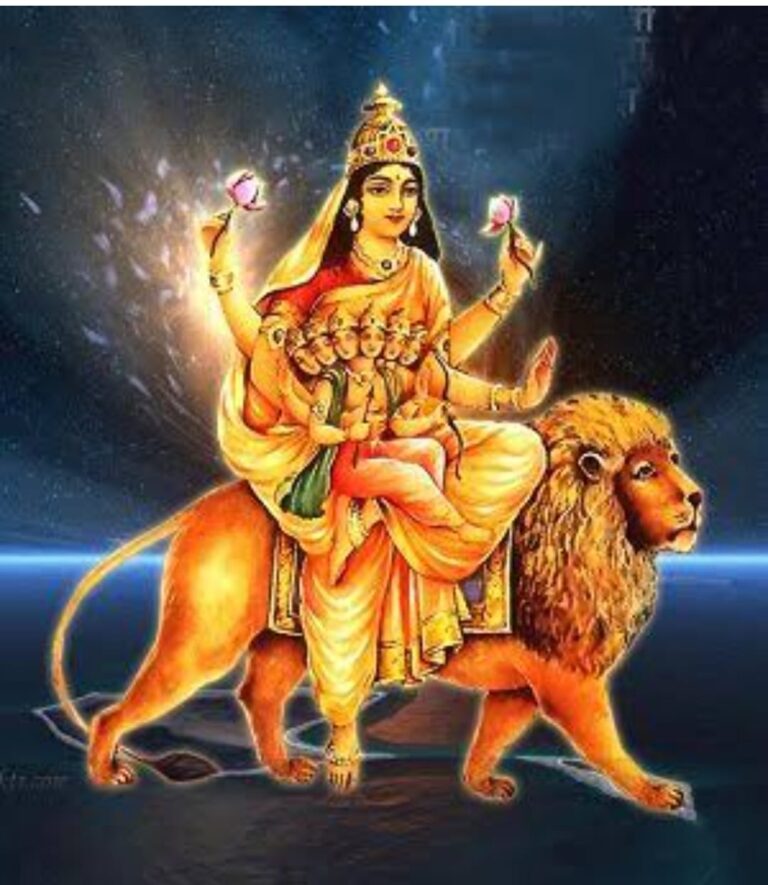
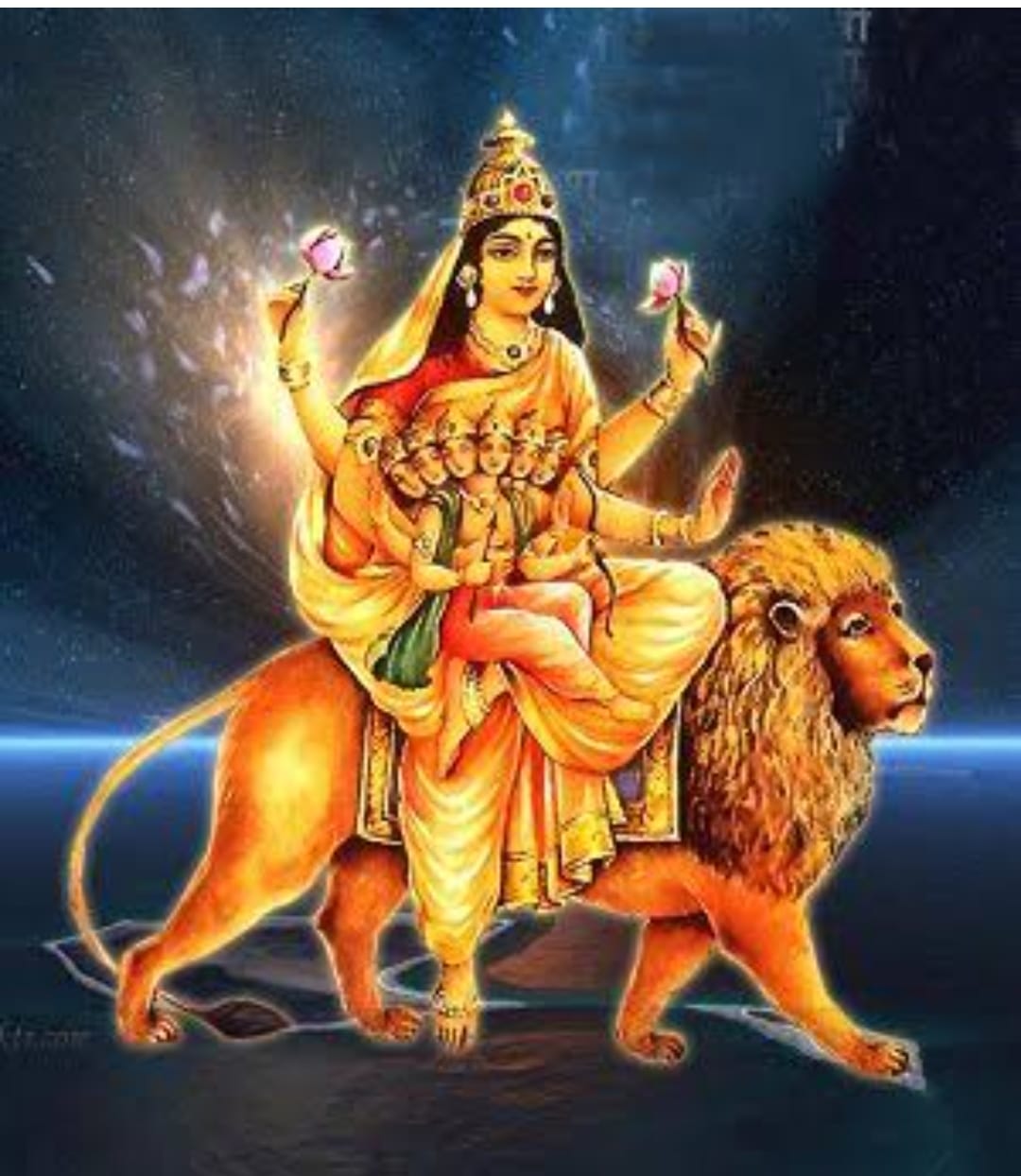
Baby Skanda rests in Her lap. She is depicted as a mother who lovingly holds Her son, carries lotuses in Her hands, and bestows fearlessness upon Her devotees.
On one side, She is Adi Parashakti, who created the universe. On the other, She is the mother who lovingly cradles Her child.
Is there any difference between these two?
The infinite power that creates the universe, expressing love for Her child, is also a part of Her divine play.
Kumaraswamy’s destruction of Tarakasura represents the victory of Dharma. The form of Skandamata reminds us of the motherhood that stood behind that victory.
When we look at Baby Skanda resting in the lap of the Divine Mother, we are reminded of the way a mother loves her child.
When her child is young, she supports his first steps. When he grows up, she rejoices in his achievements. When he faces difficulties, she gives him courage.
However, the motherhood of the Divine Mother of the Universe is not limited to one child.
From the spiritual perspective that She is the mother of all living beings, the compassion of Skandamata is universal.
Just as She lovingly cradles Her own child, She is the Divine Mother who compassionately protects all devotees who seek refuge in Her.
The source of motherly love itself is that Divine Mother of the Universe!
Here, a question touches our hearts.
What is the source of a mother’s love in this world?
Where does the sacrifice of setting aside her own comforts for her child originate?
Why does a mother’s heart ache when she sees her child suffering?
Why does a mother consider her child’s success as her own victory?
When danger threatens her child, how is a mother able to demonstrate courage beyond what she thought possible?
When we contemplate these feelings from a spiritual perspective, we can perceive motherly love as a reflection of Adi Parashakti’s compassion.
The Shakta tradition holds that the power which is the source of creation manifests as the life-consciousness present in all living beings. We can experience that same divine power manifesting as love, compassion, and the instinct to protect within a mother’s heart.
Motherly love is a beautiful way of experiencing the compassion of Adi Parashakti through the human heart.
When a mother loves her child, selflessness becomes visible in that love.
When a mother protects her child, power becomes visible in that love.
When a mother corrects her child’s mistakes, wisdom becomes visible in that love.
When a mother rejoices in her child’s success, pure and unselfish joy becomes visible in that love.
If we wish to behold all these qualities in a single divine form, the form of Skandamata comes to our mind.
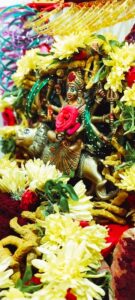
The Mother Who Holds the Poison Within Her Heart — The Supreme Expression of Motherly Love
Let us imagine a thought that helps us understand the selflessness inherent in a mother’s love.
A mother wishes that no hardship should ever befall her child. When her child suffers, she wishes she could bear his pain herself. She tries, to the best of her ability, to remove every problem her child encounters in life.
She forgets her own struggles so that her child may experience happiness. She conceals her tears so that her child may experience joy.
How noble is the heart of a mother who strives to offer her child nectar and protect him from poison!
The love of a mother who wishes to give her child nectar while keeping the poison of his life within her own heart is a deeply moving symbol of the selflessness of motherhood.
This is a spiritual metaphor for the motherly love that we can experience while meditating upon Skandamata.
The Puranic account of Lord Shiva retaining poison in His throat, becoming Neelakantha, reveals another profound truth. The Shiva principle, which accepted poison for the protection of the universe, stands as a symbol of the willingness to make sacrifices to reduce the suffering of others.
Similarly, a mother endures many hardships to lessen the suffering of her child.
However, this idea should not be understood to mean that every mother must harm herself. In true motherhood, protecting the child is important, but safeguarding the mother’s own health and peace of mind is equally essential.
The beauty of Skandamata’s philosophy lies not only in sacrifice but also in providing courage to her child through love and enabling him to grow into an independent individual.
The Divine Form of Skandamata — A Philosophy Hidden in Every Feature
Skandamata is generally depicted with four arms, seated on a lion or on a lotus. Baby Skanda rests in Her lap.
Every aspect of Her form reminds us of a spiritual truth.
The Lotus — Purity
Although the lotus grows in mud, it does not lose its purity. Similarly, we must preserve the purity of our inner being amidst the problems of life.
Baby Skanda — Motherly Love
The Divine Mother, who lovingly holds Her child in Her lap, reminds us of the selflessness inherent in love and the responsibility inherent in nurturing.
Abhaya Mudra — Protection and Courage
The Abhaya Hasta of the Divine Mother symbolises Her divine compassion, which assures devotees that they are protected. It reminds us to face life’s difficulties with courage.
The Lion as Her Vehicle — Valour
The lion symbolises courage and strength. The Divine Mother’s vehicle teaches us that courage is just as necessary as love.
In the form of the Divine Mother, we see a special emphasis on motherly love rather than weapons. Yet, She is not weak. Her love itself contains immeasurable power.
For the ability to love is a form of strength.
The ability to protect is a responsibility.
The ability to stand for Dharma is a divine quality.
Iccha Shakti — Jnana Shakti — Kriya Shakti
The philosophy of Skandamata can also be understood from another spiritual perspective.
In the Shakta traditions, Iccha Shakti, Jnana Shakti, and Kriya Shakti are described as important dimensions of divine power.
Iccha Shakti awakens determination within us.
Jnana Shakti provides the wisdom to recognise the right path.
Kriya Shakti translates that determination and knowledge into action.
A mother wishes for her child to grow into a good human being. That is her intention.
Her understanding of how to raise her child, guide him, and teach him the right values is her knowledge.
Practising that knowledge in her own life and becoming a guide for her child is her action.
The harmonious integration of these three powers is essential in our lives as well.
While meditating upon Skandamata, we must purify our intentions, acquire knowledge, and use that knowledge for righteous actions.
Our intention must be right.
Our knowledge must be clear.
Our actions must be guided by Dharma.
Only through the harmonious integration of these three can our lives become meaningful.
Skandamata — Vishuddha Chakra and Purity of Speech
In some modern yogic and spiritual interpretations, Skandamata is associated with the Vishuddha Chakra.
The Vishuddha Chakra is described in yogic traditions as the chakra located in the throat region. It is regarded as a symbol of purity, clear expression, and truthful speech.
Our words reflect our thoughts.
A kind word can give courage to someone who is suffering. A loving greeting can bring happiness to someone who feels lonely. A truthful statement can show someone the right path.
Similarly, words spoken without thought can hurt another person’s heart.
Therefore, purity of speech does not merely mean refraining from telling lies. Our words must contain truth, our hearts must hold compassion, and our conversations must reflect wisdom.
While meditating upon Skandamata, we can resolve to ensure that our thoughts, words, and actions all follow the same path of Dharma.
Purity in the mind…
Truth in our words…
Dharma in our actions…
This is the path to inner purity.
Skandamata — The Compassion That Responds When We Call Her Mother
No matter how many names we use or how many forms we worship, the Divine Mother holds a special place in the heart of every devotee.
We may call Her Adi Parashakti.
We may call Her Jagajjanani.
We may worship Her as Tripurasundari.
We may remember Her as Skandamata.
But when our hearts are filled with sorrow, when we need help, there is only one word that naturally rises from within us…
“Amma!”
The depth of faith contained in this single call cannot be fully expressed in words.
When we call out to Amma, we feel that there is a heart that will listen to our pain. When we feel weak, we gain the faith that there is a power that will stand by us.
A devotee who worships Skandamata also regards Her as the embodiment of such motherly compassion.
However, experiencing the Divine Mother’s compassion does not merely mean believing that all our problems will disappear immediately. Praying for the courage to face difficulties, the wisdom to make the right decisions, and the inner strength to preserve hope even in moments of despair is also a part of devotion.
Trusting in the Divine Mother’s compassion and practising the qualities She teaches—love, courage, and Dharma—in our daily lives is true spiritual practice.
The compassion of the Divine Mother cannot be completely described in words.
We can remember it with devotion…
We can experience it in our hearts…
We can express it through our actions.
Conclusion
Adi Parashakti, who revealed the power of determination as Shailaputri…
The Divine Mother who taught us penance and unwavering commitment as Brahmacharini…
The divine power who manifested courage and the protection of Dharma as Chandraghanta…
The Universal Mother who revealed the infinite consciousness that is the source of creation as Kushmanda…
Now, as Skandamata, She allows us to experience the motherly love within Her.
She creates.
She nurtures.
She protects.
She loves.
The compassion of Skandamata, who responds when we call Her “Amma,” cannot be expressed in words… It must be experienced!
Jai Mata Skandamata!
Jai Kumaraswamy!
Jai Adi Parashakti!
About the Author