Every form of the Goddess reveals a special spiritual truth. Although these forms appear different, the supreme divine power behind them is the same.
Sharan Navarathri is the sacred festival during which the nine divine forms of this supreme power are worshipped.
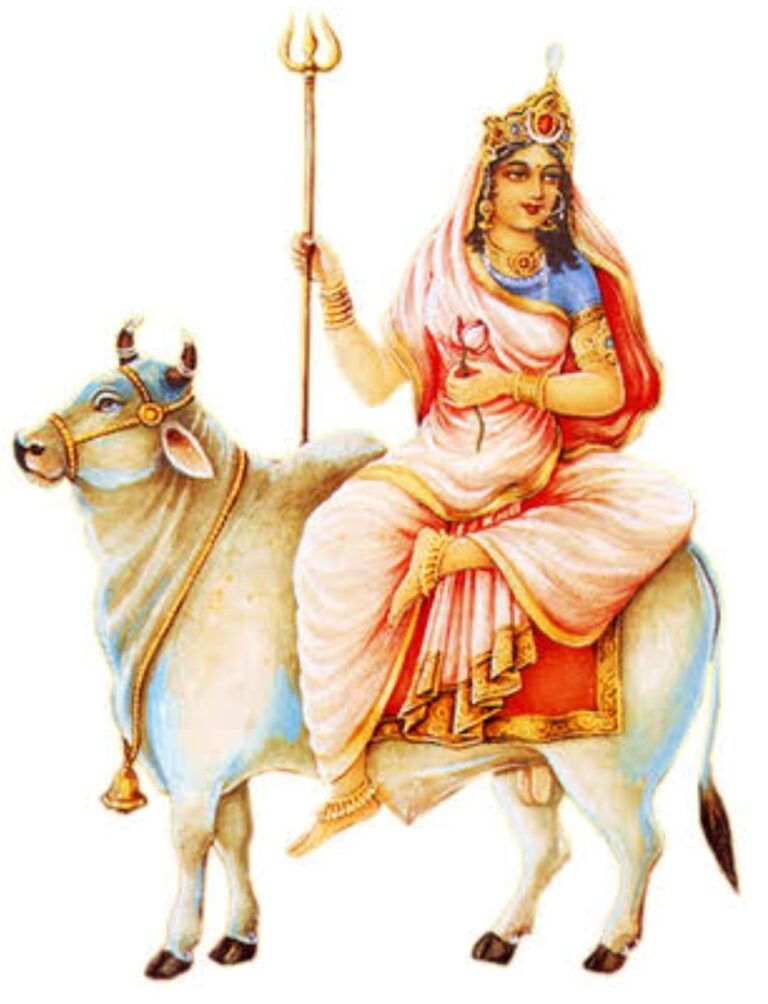
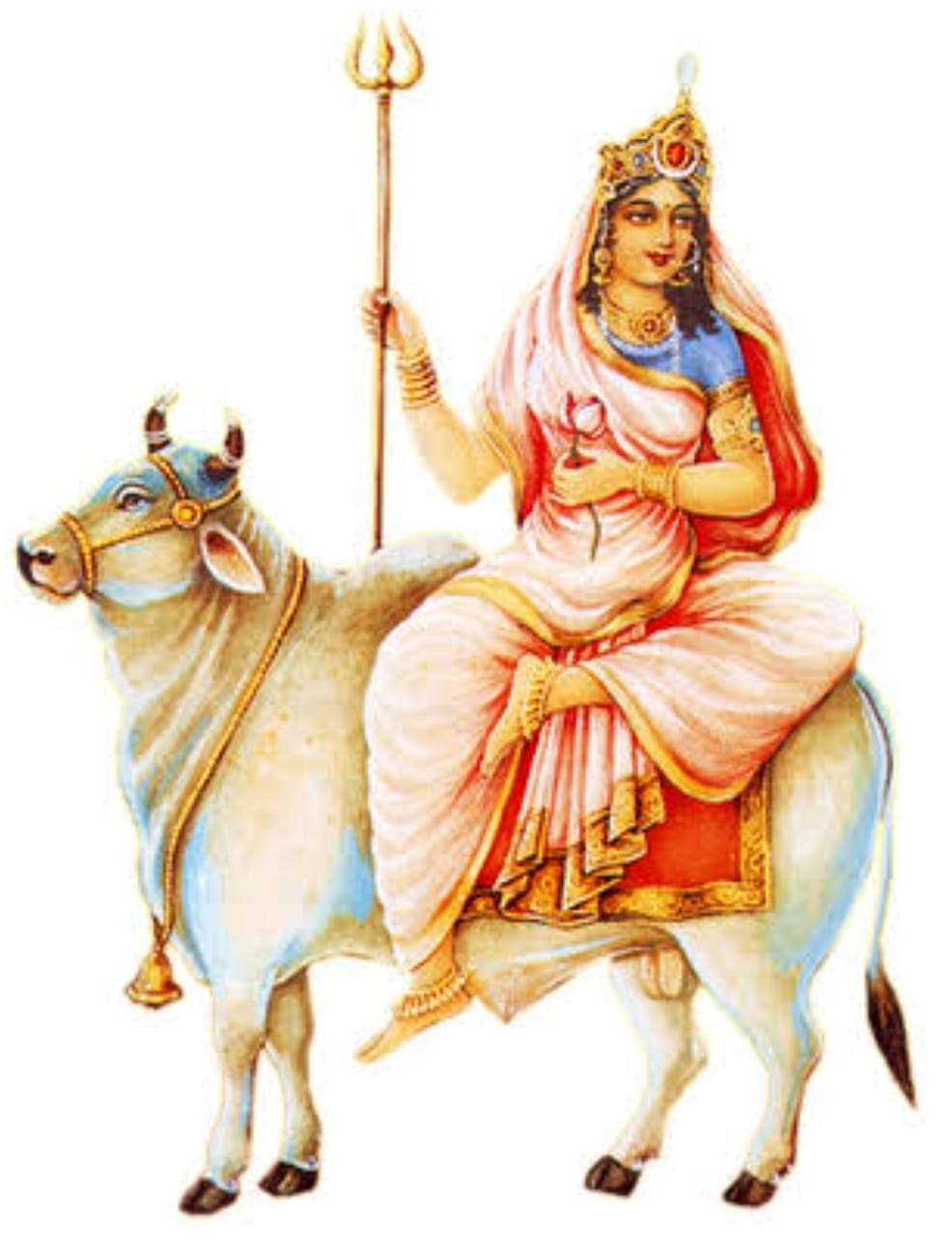
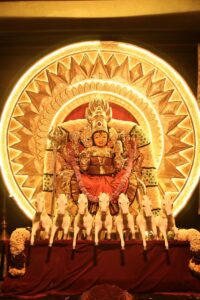
The Goddess worshipped on the first day of Navaratri is Sri Shailaputri Devi.
- Shailaputri — The First Divine Vision of Adi Parashakti
Shailaputri means the daughter of the Mountain King.
In Sanskrit, Shaila means mountain, and Putri means daughter. Goddess Parvati, who was born as the daughter of Himavan, the King of the Mountains, is worshipped as Shailaputri.
She is the first form among the Navadurga, the nine forms of Goddess Durga. She holds the first place in the worship of Navaratri.
However, the spiritual meaning of Goddess Shailaputri cannot be limited to the idea of being merely the daughter of the Mountain King.
A mountain represents stability, strength and the calmness and firmness that remain unshaken even when storms arise.
Goddess Shailaputri represents this kind of inner strength and stability within us.
To move forward on the spiritual path, the mind must first become stable. Our determination must be strong, and our spiritual practice must have a firm foundation.
Goddess Shailaputri represents this foundation.
Her worship gives us a simple message:
Before beginning your spiritual journey, recognise the power within you. Strengthen your determination. Keep your inner self pure.
- From Goddess Sati to Goddess Parvati — The Continuous Journey of Shakti
The story of Goddess Shailaputri is connected with Goddess Sati.
Sati was the daughter of Prajapati Daksha and the first wife of Lord Shiva.
Unable to bear the insult shown to her husband, Lord Shiva, during Daksha’s Yajna, Goddess Sati gave up her physical body. Later, she was born as the daughter of Himavan in the form of Goddess Parvati and once again became the consort of Lord Shiva.
A deep spiritual message is hidden in this story.
Shakti never comes to an end. Her form changes, but her journey continues.
Just because one form disappears does not mean that the divine power behind it is destroyed. The same power expresses itself through another form.
We can observe the same truth in nature. Seasons change. Old leaves fall. New shoots appear. Flowers blossom, and fruits develop. The cycle of life continues without interruption.
Behind these changes, we can see the continuous vitality of nature.
Similarly, the divine story from Sati to Parvati reminds us that Shakti is eternal and continuous.
Her form may change, but her essence remains the same.
She is Sati.
She is Parvati.
She is Durga.
She is the Divine Mother of the entire universe.
- The Deeper Meaning of Goddess Shailaputri’s Form
Goddess Shailaputri is depicted seated on a bull, holding a trident in one hand and a lotus in the other. A crescent moon adorns her head.
Every element of her divine form conveys a spiritual message.
The Crescent Moon — A Symbol of Consciousness
In many spiritual traditions, the moon is associated with the mind, emotions, and the cycles of nature.
The crescent moon adorning the Goddess’s head reminds us of her divinity and her close connection with nature.
Recognising our inner consciousness even amid the constant changes of nature is an important part of spiritual practice.
The Lotus — A Symbol of Purity
Although the lotus grows in muddy water, it does not lose its purity or beauty.
In the same way, the lotus teaches us that even when we face many problems and difficulties in life, we can preserve the purity of our inner self.
The lotus represents spiritual growth, purity, and the awakening of wisdom.
The Trident — The Principle of the Three Times
In one traditional interpretation, the three points of the trident represent the past, present, and future.
The past gives us experience. The present is the opportunity we have in our hands. The future is connected with our intentions, actions, and circumstances.
The trident reminds us to keep our minds balanced across these three dimensions of time and to follow the path of righteousness.
The Bull — Stability, Patience, and Devotion
Goddess Shailaputri is known as Vrishabhavahini, the Goddess who rides a bull.
The bull is considered a symbol of strength, patience, stability, and determination.
These qualities are equally important in spiritual practice.
We cannot achieve perfection by practising spirituality for just one day. Lasting inner transformation is possible only through continuous practice, dedication, patience, and devotion.
Therefore, the form of Goddess Shailaputri teaches spiritual seekers the importance of maintaining a steady and disciplined spiritual practice.
- Goddess Shailaputri — The Presiding Deity of the Muladhara Chakra
In Yoga and Tantric traditions, Goddess Shailaputri is associated with the Muladhara Chakra.
Muladhara means foundation or root.
Just as our body needs a foundation, our spiritual journey also requires a strong foundation.
According to yogic philosophy, the Muladhara Chakra is associated with the base of the spine. It symbolises stability, our connection with the Earth, and the foundation of life.
Traditional teachings describe the spiritual journey of Kundalini Shakti as beginning from the Muladhara Chakra.
The worship of Goddess Shailaputri can be understood as a spiritual invitation to recognise our inner power and establish stability in our spiritual practice.
When the mind is restless, concentration during spiritual practice becomes difficult.
When determination is weak, we may stop our practice halfway through.
Therefore, the first step is stability, followed by concentration, and then the inward spiritual journey.
The principle of Shailaputri symbolically teaches us this sequence.
When the foundation becomes stable, a strong base for spiritual practice is established. When the inner self becomes purified, the path towards the expansion of consciousness becomes easier.
- Kundalini Shakti — The Journey from Shakti Towards Shiva
In Shakta, Yogic, and Tantric traditions, Kundalini Shakti is described as the spiritual power that lies within every human being.
A well-known symbolic explanation states that this power remains dormant in the Muladhara Chakra.
According to traditional yogic teachings, when this power awakens, it rises through the chakras and eventually reaches the Sahasrara.
The Sahasrara is an important spiritual centre associated with the crown of the head. It is considered a symbol of supreme consciousness and higher spiritual experience.
Tantric philosophy explains this journey as the union of Shakti with Shiva.
Here, Shiva can be understood as a symbol of consciousness, while Shakti represents the active expression of that consciousness.
Some Shakta traditions explain that Shiva without Shakti represents inactive consciousness, while Shakti without Shiva represents activity without direction.
The union of Shiva and Shakti represents the perfect harmony of these two principles.
This journey need not be understood only as a process taking place within the physical body. From a spiritual point of view, it also represents the journey in which ignorance disappears, consciousness expands, and we come to understand our true nature.
When we look at the worship of Goddess Shailaputri from this perspective, Navaratri is not merely a nine-day festival of rituals and prayers.
It is a spiritual journey that leads us from external worship towards inner exploration.
- From the Principle of Shailaputri to the Mystery of Sri Chakra
Sri Chakra is one of the most sacred Yantras in the Sri Vidya tradition. It is worshipped as the divine form of Goddess Lalita Tripurasundari.
The nine enclosures of Sri Chakra are traditionally explained as symbols of the spiritual journey from the outer world towards the supreme truth within.
Moving inward from the outer enclosures and reaching the central Bindu is one of the main principles of this worship.
According to the Sri Vidya tradition, the Bindu represents the supreme principle from which creation emerges and the inseparable unity of Shiva and Shakti.
The worship of Goddess Shailaputri and the worship of Sri Chakra are not the same type of ritual practice. However, when we examine them from a spiritual perspective, we can recognise a deeper connection between them.
The principle of Shailaputri reminds us of the foundation of spiritual practice, inner stability, and our connection with nature.
Sri Chakra worship guides the spiritual seeker from external worship towards inward meditation.
One reminds us of the foundation of the spiritual journey, while the other reveals the depth of inner exploration along that journey.
In the Sri Vidya tradition, Lalita Tripurasundari is the supreme source of all forms of divine energy.
She manifests as creation. She is the power that protects and sustains creation. She is also present in the principle of dissolution.
The understanding that no power exists apart from Her is one of the highest spiritual perspectives of Shakta philosophy.
Everything is filled with Shakti. Everything is filled with the Divine Mother. Everything is a manifestation of the Supreme Shakti!
- Shailaputri — The Divine Mother in Nature
Goddess Shailaputri is the daughter of the Mountain King. Her form has an inseparable connection with nature.
The mountain is her birthplace. The bull is her vehicle. The lotus blossoms in her hand.
Many symbols connected with nature can be seen in her divine form.
One of the important messages of her worship is that we should not view nature merely as a resource that fulfils our needs, but as a sacred system through which divine power expresses itself.
Trees provide us with oxygen. Flowers add beauty to nature. Rivers support life. Mountains provide shelter to many living beings.
Every element of nature plays a special role in the ecosystem.
When we look at a tree, if we see not just a plant but also the power of nature that sustains life, that itself becomes a deeper form of worship.
When we offer a flower to the Goddess, if we recognise not only its beauty but also the biodiversity gifted to us by nature, that reflects the sensitivity of true devotion.
Loving nature, protecting it, and showing compassion towards other living beings are all ways of expressing respect for divine creation.
Worshipping the Divine Mother also means respecting and protecting the nature She has created.
- The First Day of Navaratri — An Invitation to Inner Purification
On the first day of Navaratri, devotees begin their spiritual journey by worshipping Goddess Shailaputri.
On this day, people observe practices such as fasting, puja, chanting mantras, and meditation according to their respective traditions.
Fasting does not mean only controlling the food we eat. It can also be an opportunity for inner practice, such as observing unnecessary thoughts, reducing anger, speaking with restraint, and examining our own behaviour.
When we light a lamp before the Goddess, we can pray for the removal of ignorance within us and the growth of wisdom.
When we offer a flower, we can pray that our hearts blossom with purity like the flower.
When we chant a mantra, we can resolve to make our minds more focused and our inner selves more peaceful.
When we bow before the Divine Mother, we can pray for our ego to decrease and our humility to grow.
This is the path through which external worship becomes connected with inner spiritual practice.
- The Colour Yellow — A Symbol of New Beginnings
In many regions, people follow the tradition of wearing yellow clothes on the first day of Navaratri. However, the colours associated with Navaratri may vary according to regional traditions and the customs followed in different years.
Yellow is considered a symbol of brightness, happiness, enthusiasm, and optimism.
Just as a new morning removes darkness and brings light, this colour reminds us that new intentions can bring light into our lives.
The first day of Navaratri is a wonderful opportunity to reduce negative thoughts and begin a new spiritual journey with positive intentions.
Whether we decorate the Goddess with yellow flowers or wear yellow clothes, the true beauty of worship lies in having devotion in our hearts, peace in our minds, and goodness in our behaviour.
- The Life Lessons Goddess Shailaputri Teaches Us
When we apply the principles of Goddess Shailaputri to our lives, we discover many valuable lessons.
Remain steady like a mountain.
Move forward with strong determination like a bull.
Protect your purity even in difficult situations, just as the lotus remains pure.
Remember the principle of the three times represented by the trident. Learn lessons from the past, live righteously in the present, and remain hopeful about the future.
Respect nature.
Show compassion towards all living beings.
Recognise the power within you.
Guide your intentions towards noble and pure goals.
Try to see the Divine not only in temples but also in your heart, in nature, and in every living being.
This is because spirituality is not limited to rituals and methods of worship. Reflecting divinity through our thoughts, words, and actions is also an important part of a spiritual life.
Conclusion — From the Feet of the Divine Mother to the Inner Bindu
Worshipping Goddess Shailaputri on the first day of Navaratri means welcoming a divine beginning.
As the daughter of the Mountain King, She reminds us of stability.
As the Goddess who rides a bull, She teaches us determination.
As the bearer of the lotus, She reminds us of purity and inner growth.
As the embodiment of Adi Shakti, She calls upon us to recognise the divine power hidden within us.
The journey of Navaratri begins with Shailaputri and continues through the worship of the nine forms of Navadurga.
We can also experience these nine days as a spiritual process through which our fears gradually diminish, courage grows, wisdom blossoms, and our understanding of divine consciousness deepens.
In the path of Sri Vidya, the ultimate goal of a spiritual seeker is not merely to experience the external vision of the Divine. It is also to understand the principle of Parashakti more deeply through the guidance of a Guru, traditional spiritual practice, devotion, and inner enquiry.
Whether we meditate upon Parashakti in the Bindu of Sri Chakra, hold the form of Goddess Shailaputri in our minds, or see the beauty of the Divine Mother in nature, true devotion should guide us:
From ego towards humility.
From restlessness towards peace.
From ignorance towards wisdom.
From a Shakta philosophical perspective, the Divine Mother is not merely a power that exists somewhere far away from us. She is the Supreme Power manifesting throughout the entire creation.
The journey of understanding Her is also connected with the journey of understanding ourselves.
She is the source. She is the path. She is the destination!
She is Shakti. She is Consciousness. She is Parashakti!
Sri Shailaputri Devyai Namah.
Sri Matre Namah.
May this Navaratri journey, which begins with the worship of Goddess Shailaputri, become an inner journey in which we recognise the power lying dormant within us and experience, in our hearts, the principle of Adi Parashakti, the ultimate source of that power.
About the Author