From Determination to Fulfilment… From Inner Purification to Divine Grace
When the layers of ignorance begin to disappear from the mind, when impurities dissolve from the heart, and when consciousness shines with purity, the divinity within us becomes more evident.
Goddess Maha Gauri represents this beautiful transformation of the inner self.
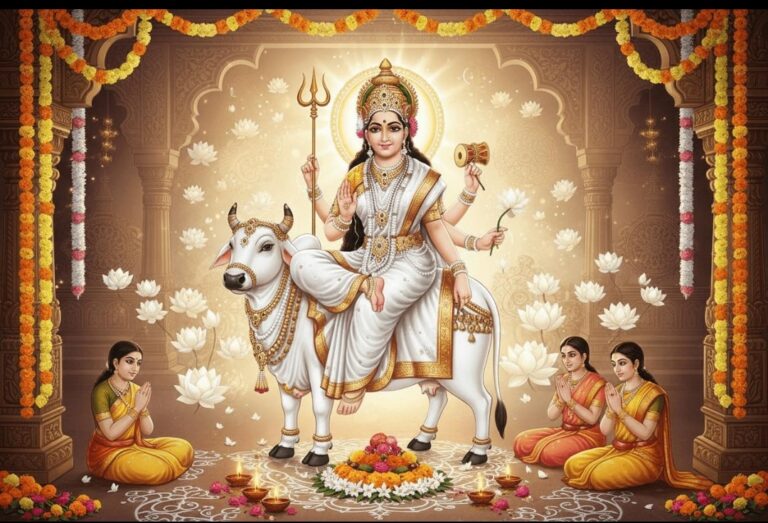
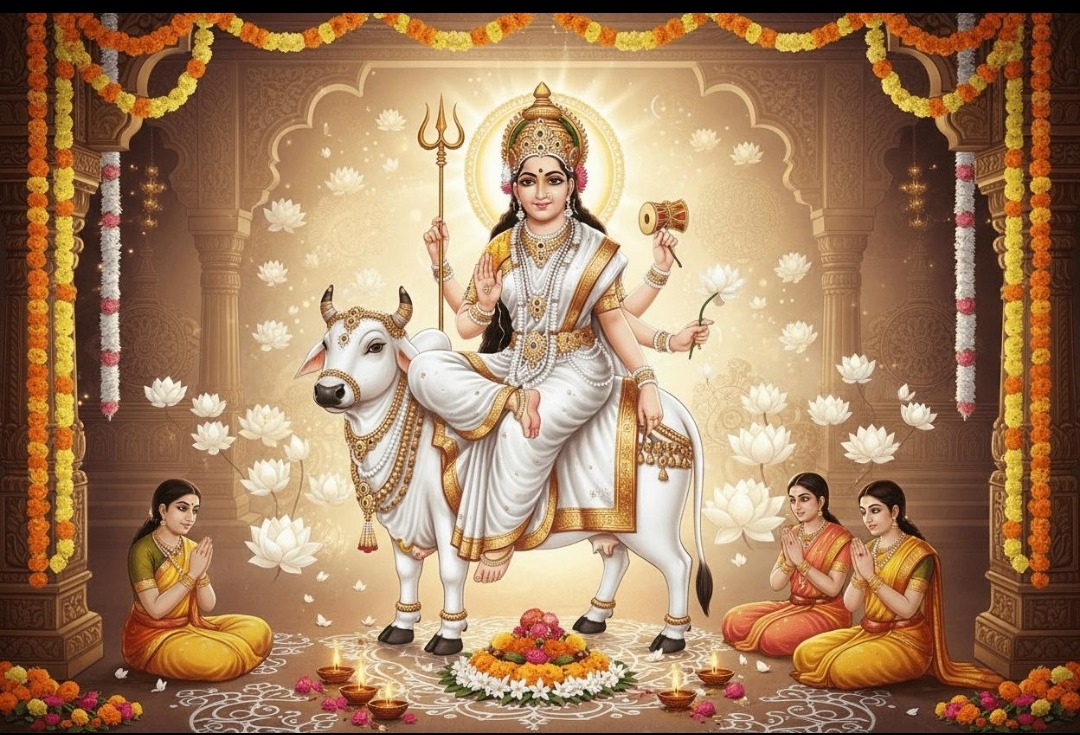
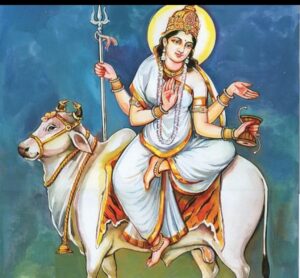
Goddess Maha Gauri, the eighth form of Navadurga, is worshipped on the eighth day of Navaratri. Adorned in white garments and divine ornaments, her radiant complexion and majestic presence on a white bull symbolise purity, serenity, compassion, and spiritual refinement.
Yet, the significance of Maha Gauri extends far beyond her divine beauty. Her story reveals the power of penance, the strength of unwavering determination, and the inner transformation that can unfold through sincere spiritual practice.
Goddess Maha Gauri teaches us that worshipping the Divine is as important as practising the virtues that the Divine represents in our everyday lives.
- The Penance of Goddess Parvati — The Power of Unwavering Determination
According to Hindu Puranic traditions, after Goddess Sati relinquished her physical body during the Daksha Yajna, Adi Parashakti was reborn as Goddess Parvati, the daughter of Himavan and Menavati.
From an early age, Parvati felt a profound devotion towards Lord Shiva. With the determination to attain him as her divine consort, she undertook severe penance.
Leaving behind the comforts of the royal palace, she retired to the forest. She endured the scorching summer heat, the pouring monsoon rains, and the biting cold of winter. Gradually, she reduced her food intake and eventually gave up food altogether, immersing herself in meditation upon Lord Shiva.
Her body became affected by the elements of nature and was covered with dust, losing its natural radiance. Yet, her determination remained unshaken.
Pleased with her extraordinary devotion and penance, Lord Shiva eventually accepted Parvati as his consort.
According to a popular account associated with the Navadurga tradition, Lord Shiva bathed Parvati with the sacred waters of the Ganga. Through this divine ablution, her complexion became radiant and luminous, shining like the moon and a jasmine flower. This resplendent form came to be known as Goddess Maha Gauri.
The deeper meaning of this story is profound.
Parvati’s penance reminds us of the value of determination, patience, and persistent effort. When our goals are noble and our efforts sincere, difficulties need not weaken us; they can help shape and strengthen our character.
Penance does not merely mean subjecting the body to hardship. It means disciplining the mind, preserving the purity of our intentions, and remaining committed to our purpose.
- The Divine Form of Maha Gauri — A Spiritual Message in Every Symbol
Goddess Mahagauri is depicted with four hands. She holds a trident in one hand and a damaru, or sacred hand drum, in another. Her remaining two hands display the Abhaya Mudra, the gesture of fearlessness and protection, and the Varada Mudra, the gesture of blessings and benevolence.
Her white garments, white bull, divine weapons, and sacred gestures offer profound insights into our spiritual journey.
The White Garments — A Symbol of Inner Purity
White represents purity, peace, and clarity.
The white form of Mahagauri can be contemplated as a reminder to rise above prejudice, hatred, jealousy, and ego, allowing us to perceive life with greater clarity.
Our experiences often influence our opinions about others. When someone hurts us, we may carry that pain within ourselves and begin interpreting their every action with suspicion.
However, a pure mind does not mean justifying wrongdoing or tolerating injustice. It means understanding situations with wisdom rather than allowing hatred to dictate our responses.
In spiritual traditions, Shuddha Sattva is associated with a state of pure, luminous consciousness. Mahagauri’s radiant white form can be contemplated as a symbol of this inner purity.
True purity is not merely reflected in outward appearance. It must find expression in the honesty of our thoughts, the gentleness of our words, and the righteousness of our actions.
The White Bull — Stability, Patience, and Strength
The bull, the divine vehicle of Mahagauri, symbolises strength, stability, and endurance. It also reminds us of Nandi, the sacred vehicle of Lord Shiva.
Strength alone is not enough; it must be guided by wisdom. Determination should not become stubbornness, and authority should never become a source of arrogance.
Our strength acquires true value when it benefits others, supports those who depend on us, and serves the path of righteousness.
The Trident — Time, Karma, and Transformation
The three prongs of the trident are interpreted in different spiritual traditions as representing the past, present, and future, or the three gunas: Sattva, Rajas, and Tamas.
Within the spiritual understanding of Mahagauri, the trident can be contemplated as the divine power that helps us overcome the negative tendencies that bind us.
We cannot change the past, but we can learn from it. We cannot completely control the future, but we can prepare for it wisely. What remains within our hands is the way we think, choose, and act in the present.
Recognising our mistakes, correcting them, and working to change harmful habits are essential steps towards inner transformation.
The Damaru — The Cosmic Rhythm of Creation
The Damaru, closely associated with Lord Shiva, symbolises the rhythm of creation and the principle of sacred sound in Shaivite traditions.
Everything in the universe follows a rhythm. Nature moves according to its own order. Our breathing, heartbeat, the cycle of day and night, and the changing seasons all reflect patterns of movement and continuity.
Yet the human mind often remains restless, filled with thoughts, worries, desires, and expectations.
Practices such as meditation, mantra chanting, and mindful breathing can help us observe the mind and cultivate inner calm.
The Damaru reminds us that even when the external world is restless, we can seek tranquillity within ourselves.
The Abhaya Mudra — The Courage to Overcome Fear
The Abhaya Mudra of the Goddess symbolises divine protection, reassurance, and fearlessness.
Fear is a natural part of human life. The possibility of failure, uncertainty about the future, the fear of loss, and concern about the opinions of others can all disturb our peace of mind.
However, courage does not mean the complete absence of fear. It means making the right choices and continuing along the path of righteousness even when fear is present.
When we meditate upon Mahagauri’s reassuring hand, we should pray not only for our difficulties to disappear but also for the wisdom, patience, and courage to face them.
The Varada Mudra — Divine Grace and Auspicious Blessings
The Varada Mudra symbolises divine grace, benevolence, auspiciousness, and compassion.
We pray to the Goddess for health, prosperity, family well-being, and success. Along with these blessings, we can also seek gifts that enrich our inner lives.
May we receive a peaceful mind during difficult times, the humility to acknowledge our mistakes, the compassion to understand another person’s suffering, and the wisdom to make the right decisions.
Sometimes, receiving what we desire is a blessing. At other times, receiving the strength and wisdom to navigate the circumstances before us can be an even greater blessing.
As we seek the grace of the Goddess, let us also pray for the wisdom to use her blessings responsibly.
- Inner Purification — The Deeper Meaning of Mahagauri’s Spiritual Practice
What does spiritual practice truly mean?
Is it performing daily worship, lighting a lamp, chanting mantras, or visiting a temple?
All these are sacred expressions of devotion. They can cultivate discipline, deepen our remembrance of the Divine, and strengthen our spiritual connection. However, their deeper purpose is to bring about a transformation within us.
Inner purification begins when we examine our thoughts, words, and actions; recognise tendencies such as anger, jealousy, ego, and hatred; and sincerely work towards overcoming them.
Our experiences leave impressions upon the mind. Past suffering, humiliation, and failure may influence the way we behave in the present.
When someone has hurt us, we may begin to distrust even those who have done us no harm. When we experience failure, we may become reluctant to try again.
Spiritual practice helps us become aware of these patterns rather than allowing them to control our lives unconsciously.
Pausing before reacting in anger, acknowledging our mistakes when our words hurt someone, and examining the roots of our jealousy are all meaningful forms of spiritual discipline.
This is where the deeper significance of Mahagauri’s form becomes clear.
Her divine radiance reminds us not only of external beauty but also of the purity that we must cultivate within ourselves.
Inner purification does not mean believing that we have no flaws. It means recognising our imperfections honestly and making a continuous effort to overcome them.
Surrender — The Sacred Waters of the Ganga
The sacred waters of the Ganga hold an important place in the traditional account of Mahagauri’s transformation. According to the legend, Lord Shiva bathed Parvati with the holy waters flowing from his matted locks, revealing her radiant divine form.
Spiritually, these sacred waters can be contemplated as a symbol of devotion, surrender, and inner purification.
Surrender does not mean abandoning our responsibilities or giving up our efforts. It means fulfilling our duties sincerely while learning not to become excessively anxious about outcomes beyond our control.
It means performing our responsibilities with dedication and offering the results to the Divine.
It means reducing our ego, acknowledging our mistakes, and learning from past suffering without remaining imprisoned by it.
This is the deeper beauty of surrender.
Just as the Ganga continues to flow, our spiritual practice must also continue. We can devote time each day to remembering the Divine, refining our conduct, and making an effort to benefit others through our actions.
- The Philosophy of Mahagauri — From Adi Parashakti to Tripurasundari
Adi Parashakti is worshipped as the primordial Divine Power, the source of all creation. She is revered through many divine names, including Tripurasundari and Lalita Parabhattarika.
Although the Goddess manifests in many forms, the devotee seeks the experience of the Divine through each of them.
Every form reveals a particular spiritual quality. While Kalaratri reminds us of the power to confront darkness and fear, Mahagauri represents purity, serenity, and inner transformation.
We visit temples to have the darshan of the Goddess. We offer flowers, light lamps, chant mantras, and place our wishes, sorrows, and worries at her feet.
But what changes within us when we leave the temple?
Does the peace we experience during worship accompany us into our daily lives?
Does compassion find expression in our words?
Do we approach difficult decisions with greater wisdom?
Can we show love and responsibility towards the living beings around us?
These questions make our spiritual practice more meaningful.
Devotion should soften our hearts. Spiritual discipline should bring greater awareness to our minds. Remembrance of the Divine should guide our actions towards righteousness.
When this happens, worship ceases to be merely a ritual and becomes a way of life.
Conclusion — May the Radiance of the Goddess Blossom Within Us
The story of Goddess Mahagauri reminds us that the spiritual journey is not completed in a single day. It is a continuous process of discipline, self-reflection, and transformation.
Choosing patience when anger arises, practising humility when the ego surfaces, and responding to suffering with wisdom rather than hatred are small but meaningful steps along this path.
The radiant white form of the Goddess reminds us of purity. Her penance teaches us perseverance, while her compassion inspires us to cultivate humanity in our hearts.
Let us not merely seek the Goddess outside ourselves; let us also nurture the virtues she represents within our own being.
Let us fill our hearts with love, cultivate wisdom in our thoughts, and express compassion through our actions.
May the radiant light of Goddess Mahagauri purify our hearts and bless us with the wisdom to recognise the divinity within ourselves and all creation.
Om Devi Maha Gauryai Namah!
About the Author