From the Destruction of Adharma to the Fulfilment of Devotion…
The Divine Power That Destroys Ego… The Mother of the Universe Who Blesses Our Sacred Resolve…
The Adi Parashakti, who revealed the stability of nature as Shailaputri, the power of penance as Brahmacharini, courage as Chandraghanta, the power of creation as Kushmanda, and the sweetness of motherhood as Skandamata…
Appears as Sri Katyayani Devi on the sixth day of Navaratri.
As we journey into the glory of Katyayani Devi, we encounter two extraordinary legends. One is the Divine Mother’s victory over Mahishasura, establishing the triumph of Dharma. The other is the Katyayani Vratam the Gopis performed to attain Sri Krishna.
These two legends reveal one profound truth to us — divine power destroys Adharma and guides those whose devotion is pure.
The Arrogance of Mahishasura — Adharma That Enveloped the Heavens
According to the Puranic legends, Mahishasura performed intense penance and pleased Lord Brahma.
A well-known Puranic tradition describes that he obtained a boon that no male could kill him. He never imagined that a woman could possess the power to bring about his end.
His arrogance, born from underestimating feminine power, ultimately became the cause of his downfall.
Intoxicated by the power of his boon, Mahishasura invaded the celestial realm. He defeated Indra and occupied heaven. He drove the gods from their positions and attempted to establish his dominance over the three worlds.
Unrest prevailed everywhere. Dharma grew weak. Adharma crossed all boundaries and spread unchecked.
Finally, all the gods approached Brahma, Vishnu, and Maheshwara, praying to them to protect the worlds from Mahishasura’s atrocities.
Thus, the stage was set for a magnificent divine event.
The Manifestation of Adi Parashakti — The Confluence of All Divine Powers
To restrain Mahishasura’s arrogance, the powers of all the gods united.
The radiant energies of Brahma, Vishnu, Maheshwara, and the other gods emerged as brilliant divine effulgence and manifested as an immeasurable feminine power.
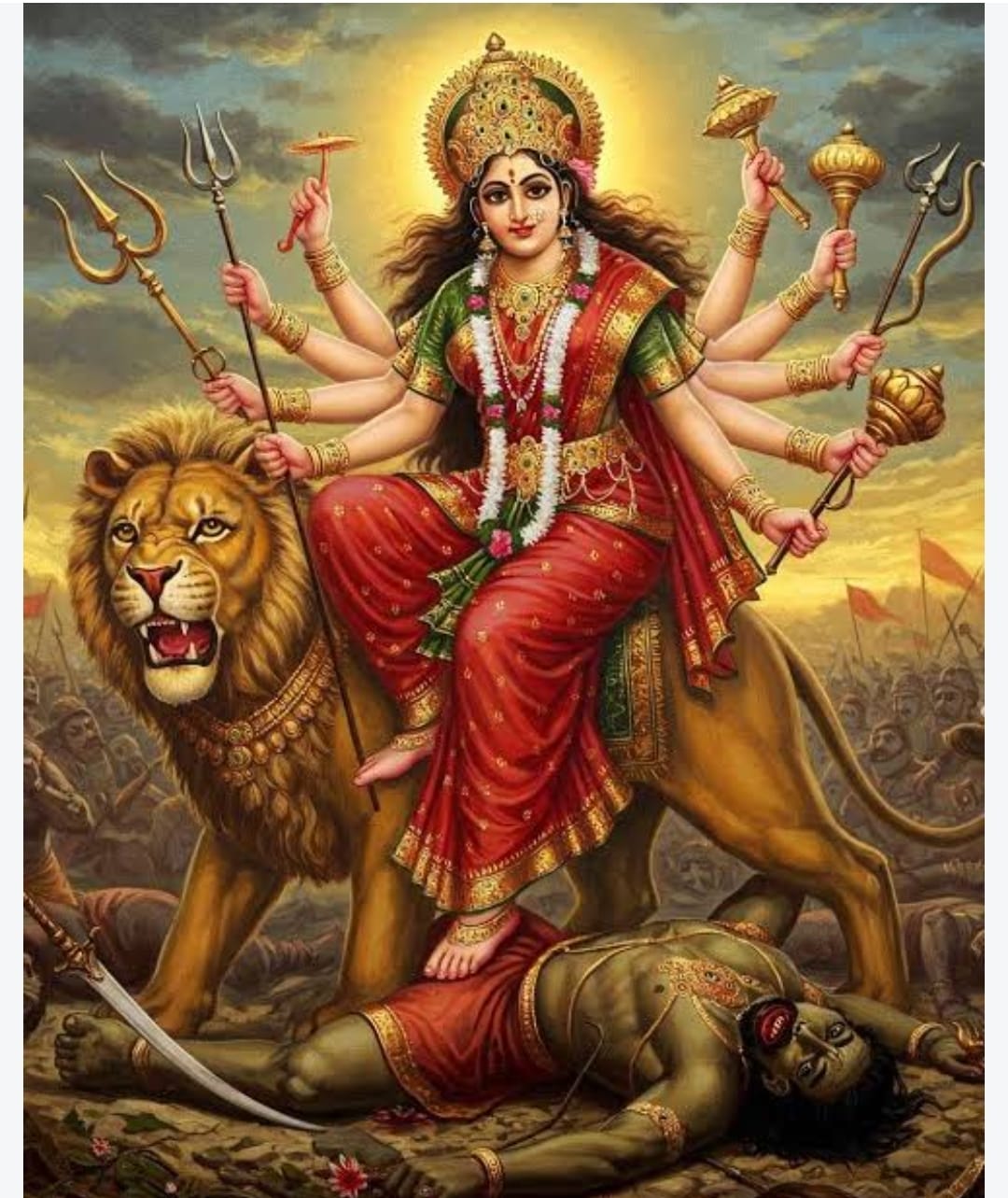
She was no ordinary goddess. She was the embodiment of the powers of all the gods. She was the Mother of the Universe. She was Adi Parashakti. She was Goddess Durga!
According to the Devi Mahatmyam, the Divine Mother manifested from the radiant energies of the gods, shining with immeasurable brilliance.
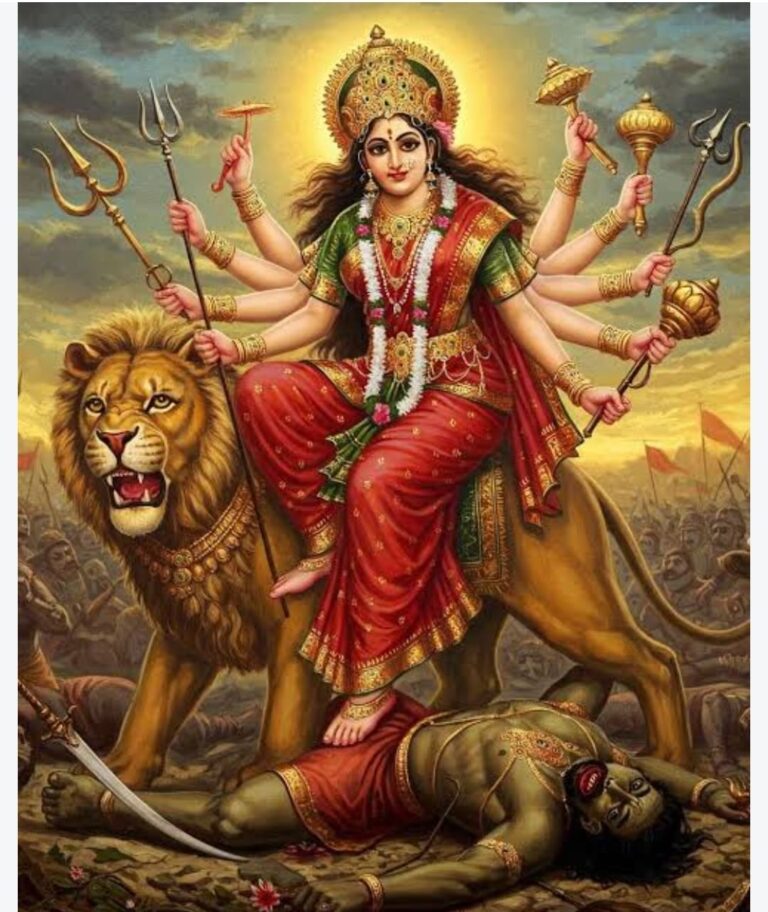
Lord Shiva offered her his trident, Lord Vishnu his Sudarshana Chakra, and Indra his thunderbolt. The other gods also presented her with their respective divine weapons. According to the Puranic legend, Himavan, the king of the mountains, gave her a lion as her mount.
Seated upon her lion, the Divine Mother shook the three worlds with her mighty roar.
The mountains echoed. The directions resounded. Hope blossomed in the hearts of the gods.
For a supreme divine power had manifested to protect them.
A profound spiritual message lies hidden here.
When powers that appear separate unite, they can accomplish even what seems impossible.
In our own lives, too, when knowledge, courage, patience, and determination come together, an inner strength awakens within us, enabling us to face numerous challenges.
This is the deeper meaning of the Divine Mother’s incarnation and the lesson it teaches us.
How Did She Receive the Name Katyayani?
According to a popular Puranic tradition, Sage Katyayana performed penance with the desire to have the Divine Mother as his daughter.
It is said that, in response to his devotion, the Divine Mother incarnated as his daughter. Since she manifested as the daughter of Sage Katyayana, she became widely known as Katyayani.
There is a beautiful spiritual idea within this legend.
Adi Parashakti, the Mother of the entire universe, responds to the penance of her devotee and incarnates as his daughter.
The infinite power that pervades the entire universe becomes intimately close in response to the love of a devotee.
What we need to reach the Divine is not merely external grandeur or elaborate displays of worship. What we need is a pure heart, unwavering faith, and sincere devotion.
When a devotee transforms the heart into a sacred ground of penance, divine grace blossoms within that very heart.
The Great Battle with Mahishasura — The Divine Mother Who Upholds Dharma
Mahishasura learned that the powers of all the gods had united in the form of a woman to confront him. Yet his arrogance did not diminish.
He sent his enormous army of demons against the Divine Mother.
But there was one thing he did not understand — the one he was facing was no ordinary woman; she was the Mother of the Universe, the very source of all power.
The Divine Mother’s lion charged fiercely at the demonic army. The demons could not withstand the force of her divine weapons.
Her sword flashed like lightning. Her trident challenged the might of Adharma. The roar of her lion spread fear throughout the demonic army.
No matter how vast the army or how formidable its strength, it could not withstand the supreme divine power that had manifested to protect Dharma.
Finally, Mahishasura himself entered the battlefield.
The Transformations of Mahishasura — Supreme Divine Power Against Illusion
According to the description in the Devi Mahatmyam, Mahishasura used his powers of illusion to assume various forms, including those of a buffalo, a lion, a man, and an elephant, and fought against the Divine Mother.
Each time he changed his form, the Divine Mother confronted his attacks and demonstrated her extraordinary valour.
The Purana describes how, in the form of a buffalo, he shook mountains with his horns and spread terror through his roars.
But the Divine Mother remained undisturbed.
Mahishasura’s forms changed. His attacks changed. His powers of illusion changed.
But the Divine Mother’s resolve to establish Dharma never changed.
Finally, as Mahishasura attempted to emerge from his buffalo form into a human form, the Divine Mother brought him under control and destroyed him with her divine weapons.
The arrogance of Adharma was brought to the ground.
The gods rejoiced and praised the Divine Mother.
Peace returned to the three worlds.
Dharma emerged victorious.
Because the Divine Mother destroyed Mahishasura, she became renowned by the glorious name Mahishasuramardini — the Slayer of Mahishasura.
This battle is not merely the story of a demon’s death.
It is a profound Puranic message that reveals how divine power takes action to uphold Dharma.
Mahishasura — A Symbol of the Ego Within Us
When we apply this story to our own lives, we discover a profound spiritual truth. Mahishasura was proud of his strength. He believed that no one could defeat him. Ego grows within us in much the same way. Sometimes, it appears as anger.
At other times, it manifests as jealousy, a thirst for power, or the tendency to look down upon others. Until we recognise these negative tendencies within ourselves, they continue to influence us in different forms.
Just as Mahishasura assumed different forms, our ego, too, can take on many forms.
Wisdom, courage, and self-restraint are necessary to recognise and overcome them. That is the Durga Shakti within us.
Conquering an external enemy may be an act of valour. But conquering the ego within ourselves is the true spiritual victory.
The Spiritual Mystery of Katyayani Devi’s Form
Katyayani Devi is generally depicted seated upon a lion, holding divine weapons and blessing her devotees.
Every aspect of her form conveys a spiritual message to us.
The Sword — The Wisdom That Removes Ignorance
The sword in the Divine Mother’s hand symbolises the power that destroys Adharma.
Spiritually, it represents the wisdom that removes ignorance, false thoughts, and unnecessary fears from within us.
Sometimes, the fears we create about our problems cause us more suffering than the problems themselves.
At such times, we need the wisdom to recognise reality and make the right decisions.
That is the sword within our inner being.
The Lotus — A Symbol of Purity
Although the lotus grows in mud, it does not lose its purity.
Similarly, the lotus teaches us that no matter what circumstances we find ourselves in, we can preserve our values, uphold Dharma, and retain our goodness.
Living in the world without becoming enslaved by its negativity is a profound spiritual practice.
The lotus held by the Divine Mother reminds us of this practice.
The Lion Mount — Courage and Self-Confidence
The lion symbolises bravery and valour.
Running away from the challenges of life is not always the solution.
Standing courageously when necessary, confronting injustice with wisdom, and fulfilling our responsibilities are also part of divine worship.
Abhaya Mudra — Fear Not
The Divine Mother’s Abhaya Mudra is regarded as a divine sign that grants fearlessness to her devotees.
Having faith in the Divine does not mean that we will never face problems in life.
It means praying for courage, stability, and wisdom when we encounter difficulties.
Varada Mudra — Divine Grace
The Varada Mudra symbolises blessings and the granting of boons.
When we pray to the Divine Mother, we place our wishes before her.
However, true prayer should not be limited to obtaining what we desire.
We should also seek the wisdom to understand what is truly beneficial for us, the strength to make the best use of the opportunities we receive, and the maturity to accept the outcomes of our actions.
Divine grace does not merely mean that our wishes are fulfilled; it also means receiving the inner strength necessary to grow into better and more evolved human beings.
Sri Krishna — The Katyayani Vratam of the Gopis
Katyayani Devi is not merely the warrior goddess who destroyed Mahishasura. She also holds a special place in the prayers of devotees.
To understand this, we must learn about the Katyayani Vratam performed by the Gopis of Vrindavan, as described in the Srimad Bhagavatam.
During the time when Sri Krishna’s childhood pastimes were unfolding in Vrindavan, the Gopis had immense love for him.
They resolved to attain Sri Krishna, the son of Nanda Gopa, as their husband.
With this resolve, they observed a sacred vow during the month of Margashirsha, worshipping Goddess Katyayani.
The tenth canto, chapter 22, of the Srimad Bhagavatam describes this sacred episode.
Every day, the Gopis bathed in the Yamuna River, fashioned an image of Goddess Katyayani from sand, and worshipped the Divine Mother with devotion and reverence, offering flowers, sandalwood paste, and other ritual offerings.
They prayed to Goddess Katyayani as the Mother of the Universe, resolving to attain Sri Krishna as their life partner.
The unwavering faith, devotion, and concentration of the Gopis are reflected in their prayers.
In this sacred legend, Katyayani Devi appears as the Divine Mother who blesses the sincere intentions of her devotees.
Why Do Unmarried Young Women Worship Katyayani Devi?
The Bhagavata episode in which the Gopis prayed to Goddess Katyayani to attain Sri Krishna as their husband became the inspiration for a significant devotional practice in later traditions.
Therefore, unmarried young women who desire to get married worship Katyayani Devi, praying that they may find a suitable life partner.
However, the deeper meaning of this worship does not end with the attainment of marriage.
It also involves praying to the Divine Mother for a relationship founded on love, mutual respect, understanding, responsibility, and compatibility between life partners.
The Gopis’ Vratam teaches us an important lesson.
Determination must be accompanied by devotion. Devotion must be accompanied by discipline. Discipline must be accompanied by patience.
Prayer gives strength to our hearts. Our efforts guide us towards our goals.
Devotion does not merely mean asking for something; it also means transforming our hearts to become aligned with the divine principle we seek.
Katyayani Devi — A Symbol of Feminine Power
When we examine the form of Katyayani Devi deeply, we discover the many dimensions of feminine power.
She is the Mother who nurtures creation.
She is the warrior who confronts Adharma when necessary.
She is the compassionate Mother who cares for her devotees.
She is the supreme power who establishes Dharma.
Her form reminds us of the immense capabilities inherent in women.
A woman is not merely someone who shares love.
She possesses the power to make decisions.
She has the courage to stand against injustice.
She has the ability to lead her family and society forward.
At the same time, qualities such as compassion, patience, and motherhood can also blossom within her.
What Katyayani Devi teaches us is this — compassion and courage are not contradictory qualities. Both can coexist naturally within the same heart.
True power does not mean suppressing others. It means standing up for Dharma when necessary, protecting the vulnerable, and safeguarding the truth.
That is the principle of Adi Parashakti.
Katyayani Devi — The Aagna Chakra and Inner Vision
In certain Navaratri meditation traditions, Katyayani Devi is associated with the Aagna Chakra.
The Aagna Chakra is generally associated with the region between the eyebrows. In spiritual traditions, it is described as a symbol of inner vision, concentration, discernment, and introspection.
When we become angry, reacting immediately is easy.
However, it is essential to pause for a moment, examine the situation, and make the right decision.
Observing our emotions, examining our thoughts, and understanding the consequences of our actions help us lead our lives with greater balance.
While meditating upon Katyayani Devi, we may pray for the strength to reduce the restlessness within us, cultivate discernment, and make decisions guided by Dharma. Before conquering the external world, we must understand our inner world.
When ignorance within the mind is removed and clarity emerges in our thoughts, the path towards experiencing the divine consciousness within us becomes clearer.
The Principle of Katyayani — The Message for Our Lives
Listening to the story of Katyayani Devi merely as a Puranic legend is one experience.
Applying the deeper meaning of that story to our own lives is another experience.
The worship of the Divine Mother offers us five important lessons.
First — The courage to confront injustice.
Remaining silent when we witness injustice around us is not always the right course of action. As far as possible, we must respond in accordance with Dharma and with wisdom.
Second — Steadfastness in our resolve.
The Katyayani Vratam of the Gopis reminds us of determination strengthened by devotion. We must clearly define our goals in life and work towards them with discipline.
Third — Victory over our inner enemies.
Recognising and overcoming qualities such as anger, ego, jealousy, and greed is also a spiritual victory.
Fourth — Mutual respect in relationships.
When praying to the Divine Mother for a life partner, we must also pray for a relationship built upon love, respect, responsibility, and understanding.
Fifth — Self-effort accompanied by faith in the Divine.
Prayer can give strength to the mind. However, bringing change into our lives also requires our own efforts, decisions, and sense of responsibility.
Worshipping the Divine Mother does not mean merely offering flowers. It also means removing negative qualities within ourselves and allowing noble qualities to blossom.
Lighting a lamp for her means lighting the lamp of wisdom within us to dispel the darkness of ignorance.
Offering flowers to her means allowing the flowers of love, compassion, patience, and courage to blossom in our hearts.
Praying to her means seeking the strength to guide our intentions along the path of Dharma.
Beholding the Goddess externally is worship. Experiencing her divine principle within ourselves is a spiritual journey.
Conclusion — Katyayani Is the Power of Dharma That Awakens Within Us
Katyayani Devi, who destroyed Mahishasura, reminds us of the courage needed to conquer the ego within ourselves.
The Mother of the Universe, who listened to the prayers of the Gopis, stands as a symbol of pure intention and devotion within us.
Her fierce form tells us to confront injustice.
Her compassionate form teaches us to live with love.
Her sword reminds us of discernment.
Her lotus teaches us purity.
Her lion mount inspires us to stand courageously.
Her Abhaya Mudra assures us not to be afraid.
Her Varada Mudra instils faith in divine grace.
This is the ultimate truth that Katyayani Devi teaches us — power is not merely valour; it is also the courage to uphold Dharma, the steadfastness to fulfil our resolve, and the wisdom to preserve the purity of love.
Let us remember the principle of the Divine Mother in every effort we make to transform fear into courage, ignorance into wisdom, ego into humility, and restlessness into steadfast determination.
Let us experience her not merely as a Goddess who grants boons, but as the Mother of the Universe who awakens divine consciousness within us.
Because…
She herself is Power. She herself is Devotion. She herself is Wisdom. She herself is Courage. She herself is the Source of the Universe. She herself is the Divine Consciousness that shines within our hearts.
Jai Sri Katyayani Mata!
Jai Mahishasuramardini!
Everything is filled with Shakti — Everything is filled with the Divine Mother!
About the Author