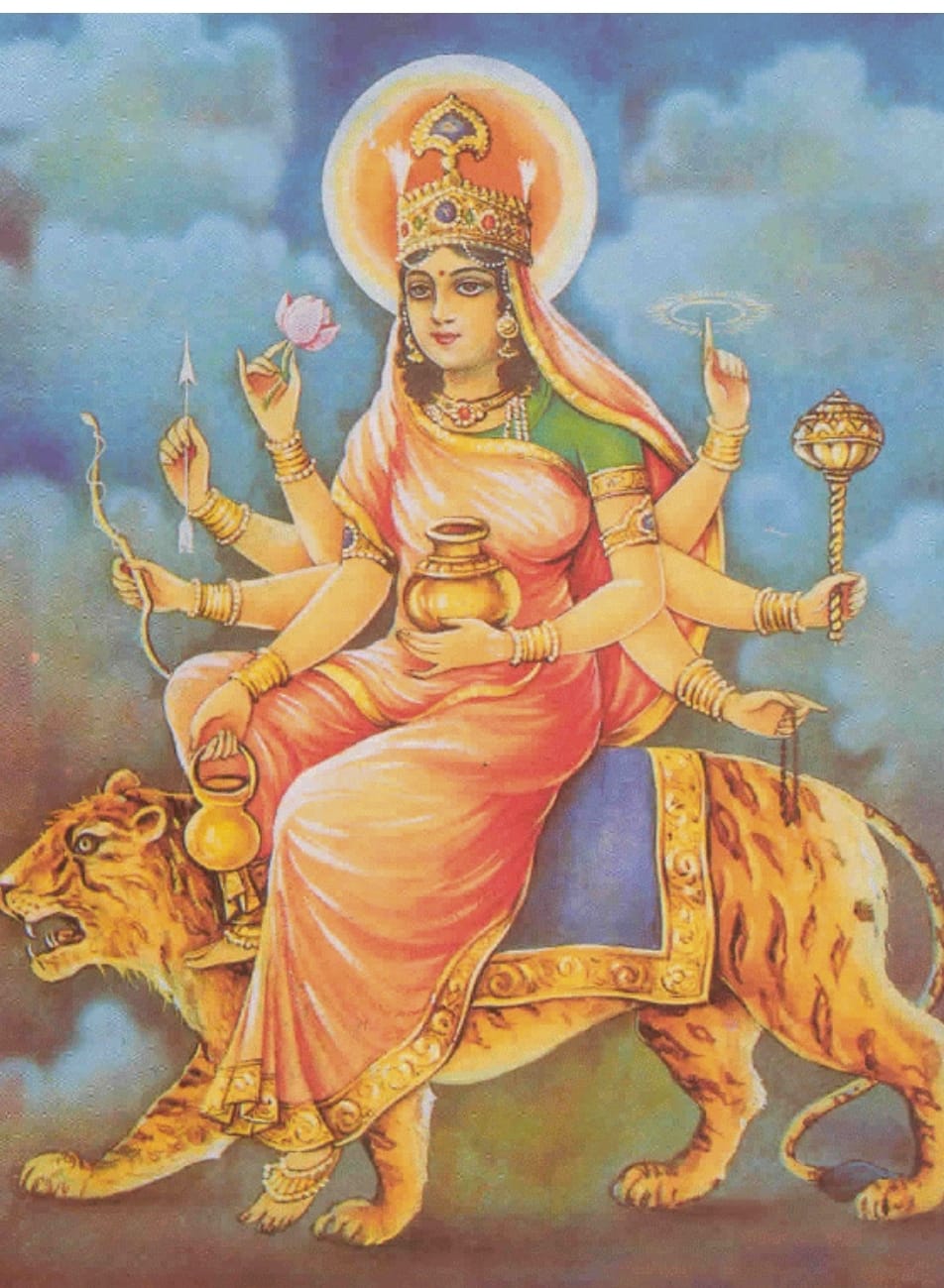
The Creation of the Universe Through the Divine Mother’s Smile… From Darkness to Infinite Consciousness…
Every form of the Goddess teaches us a special spiritual truth.
As Shailaputri, the Mother represents the stability of nature. As Brahmacharini, She teaches us the power of determination through penance. As Chandraghanta, She gives us courage. On the fourth day, as Sri Kushmanda Devi, She reveals Her limitless creative power, which is the source of the creation of the universe.
How did this universe come into existence? How did the spark of life emerge from the endless emptiness filled with darkness? What is the power behind this creation?
Sri Kushmanda Devi is the divine form who answers these questions through spiritual symbols.
Sri Kushmanda Devi — The Primordial Power Behind the Creation of the Universe
According to the Puranic tradition, before creation began, everything was covered in darkness. There was no light. There was no life. The universe, as we know it today, had not yet appeared in its present form.
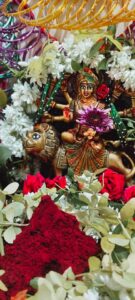
The traditional stories that explain the Devi Mahatyam say that Adi Parashakti began the process of creation with Her divine smile in that endless darkness.
The divine light that emerged from Her smile spread throughout the universe and became the cause of creation.
This Puranic story describes how the Sun, planets, stars, galaxies, and all living beings emerged from Her creative power.
That is why the Mother is worshipped as the Goddess who is the source of the creation of the Brahmanda, or cosmic universe, and as the Primordial Power who fills the universe with the energy of life.
The deeper meaning we must understand here is truly wonderful.
The Mother’s smile is not just a beautiful description of Her appearance. It is a symbol of joy, creativity, and consciousness in creation.
A small smile can fill a person’s heart with hope. A loving word can give courage to someone who feels discouraged. A small idea can become the foundation of a great invention.
In the same way, the spiritual symbol of the universe emerging from Adi Parashakti’s smile teaches us a great truth.
Behind creation, there is not just a form, but the power that brings that form into existence. Behind that power is infinite consciousness. That consciousness itself is Adi Parashakti.
The Spiritual Secret in the Name Kushmanda
According to one popular traditional explanation, the name Sri Kushmanda Devi can be understood through three parts.
Ku — Small or little.
Ushma — Heat, radiance, or energy.
Anda — An egg; a symbol of the cosmic egg or Brahmanda.
Imagining the vast creative power of the universe through the symbol of a small cosmic egg reminds us of something wonderful.
A huge tree lies hidden within a tiny seed.
The seed sprouts in the soil, gradually grows, spreads its branches, and produces flowers and fruits. Yet the beginning of that mighty tree was only a small seed.
In the same way, viewing the infinite universe through the symbol of the Brahmanda helps us understand the immense power of creation.
Something great being hidden within something small, and the potential for creation remaining within what has not yet become visible, are the spiritual messages this symbol gives us.
Many abilities also remain hidden within us. Our determination, thoughts, knowledge, love, and creativity help bring them into action.
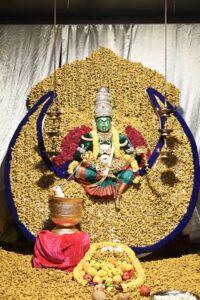
Recognising the power sleeping within us and directing it towards good deeds is an important part of true spiritual practice.
The Divine Mother Who Shines in the Solar Realm
Hindu tradition believes that Sri Kushmanda Devi resides in the realm of the Sun. She is regarded as the power that gives the Sun its radiance, light, and heat.
Without the Sun, the life systems we know on Earth could not continue. The production of food in plants, temperatures on Earth, weather systems, and the cycles of life are all connected to solar energy.
When we look at this natural truth from a spiritual perspective, we can understand why the radiance of the Sun is worshipped as a form of the Divine Mother’s energy.
The Sun spreads its light equally to everyone. Its light falls on mountains, rivers, and flowers. It supports life, from tiny plants to mighty trees.
In the same way, the tradition of devotion teaches us that the compassion of the Divine Mother embraces all living beings.
The light of the Sun illuminates the outer world, while knowledge illuminates our inner world.
Ignorance keeps a person in darkness. Knowledge shows the right path. Despair weakens the mind, while hope fills a person with new life.
Therefore, while worshipping Kushmanda Devi, we must remember not only the external radiance of the Sun but also the light of knowledge within us.
The Mother’s grace does not simply mean that light enters our lives. It also means gaining the wisdom to recognise the right path in that light.
The Eight-Armed Form — Eight Spiritual Messages in Her Eight Hands
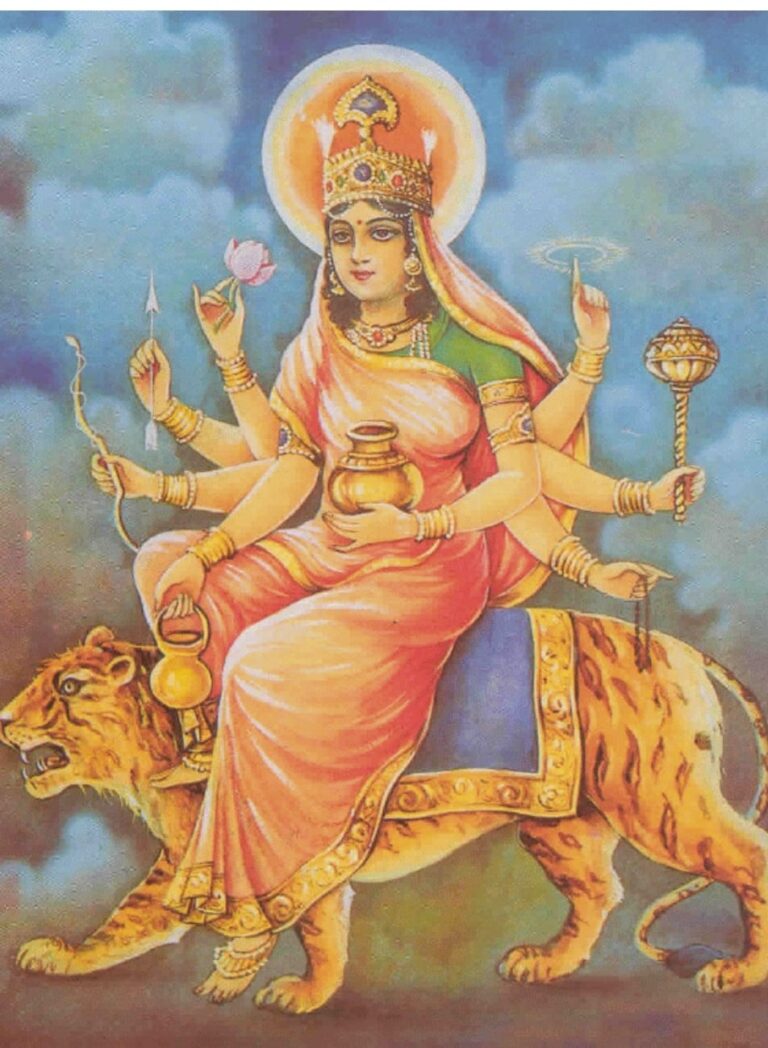
Sri Kushmanda Devi is generally worshipped in Her eight-armed form, known as Ashtabhuja Devi. Her eight hands hold various divine weapons and sacred objects. In different traditions, She is also depicted seated on a lion or a tiger.
Each object in Her hands has a special significance in the tradition of devotion.
- Kamandalam — A Symbol of Purity
The Kamandalam, or sacred water pot, can be understood as a symbol of spiritual practice, discipline, and purity.
Just as external worship is important, inner purity is equally important.
When our thoughts are pure, our words are gentle, and our actions benefit others, true purity becomes visible in our lives.
- Bow — A Symbol of Achieving Our Goals
The bow teaches us that we must have a goal in life.
A life without a goal is like a journey without direction. Only when we know where we are going can we use our energy in the right way.
The Mother’s bow teaches us to focus our determination on our goals.
- Arrow — A Symbol of Concentration
An arrow moves towards its target with focus.
When the mind is scattered among many thoughts, our abilities become weaker. But when we focus our mind on a single goal, our efforts become fruitful.
Students need concentration in their studies. Spiritual seekers need concentration during meditation. Every person needs concentration to fulfil their duties.
- Pot of Amrita — A Symbol of Life Energy
The pot of Amrita, or divine nectar, is considered a spiritual symbol of life, health, prosperity, and immortality.
Just as the body needs good health, the mind also needs peace.
When we see the Mother holding the pot of Amrita, we can pray for a healthy life, positive thoughts, and spiritual growth.
- Sudarshana Chakra — A Symbol of the Wheel of Time and Dharma
The chakra reminds us of continuous movement.
Time never remains the same. Happiness and sorrow, success and failure, favourable and unfavourable situations keep changing throughout life.
The chakra teaches us to move forward with wisdom without abandoning our principles of dharma, even amid these changes.
- Mace — A Symbol of Strength and Courage
The mace represents power, strength, and courage.
When we face problems in life, we must not lose heart. We must recognise the self-confidence within us.
However, true strength does not lie only in defeating others. It also lies in overcoming our own anger, ego, and fear.
- Japa Mala — A Symbol of Continuous Spiritual Practice
The Japa Mala, or prayer beads, reminds us of the discipline required in spiritual practice.
Instead of praying with devotion on one day and completely forgetting it the next, it is better to remember the Mother with concentration for at least a few minutes every day.
Chanting, meditation, and remembering the Divine Name help calm the mind and encourage inner reflection.
- Lotus — A Symbol of Spiritual Growth
Although the lotus grows in mud, it does not lose its beauty. Even while remaining in water, it maintains its unique nature.
In the same way, whatever our circumstances may be, we must preserve the goodness within us.
The spiritual message of the lotus is that we should live in this world without becoming slaves to selfishness, hatred, jealousy, and similar negative feelings.
The Mother’s Abhaya Mudra, or gesture of fearlessness, represents courage and faith in divine protection for Her devotees.
The eight arms of the Mother remind us of one important truth: to make our lives meaningful, we need not only devotion but also wisdom, courage, concentration, discipline, and compassion.
Anahata Chakra — Divine Consciousness Blossoming in the Heart
In yogic and Tantric traditions, the Anahata Chakra is associated with the heart region. It is symbolically connected with qualities such as love, compassion, balance, and emotional connection.
There are also spiritual interpretations that connect Sri Kushmanda Devi with the Anahata Chakra.
Whenever we think of the heart, love comes to our mind.
However, love does not mean affection towards only one person. Understanding the pain of others, helping people in difficult situations, loving nature, and showing kindness towards living beings are also forms of love.
When hatred fills our hearts, the mind becomes restless. Jealousy reduces our happiness. Anger influences our decisions.
Compassion teaches us patience. Love strengthens our relationships. Gratitude helps us recognise the good things in our lives.
Installing the Goddess in our hearts does not simply mean having devotion towards Her. It also means practising the qualities She represents, such as compassion, love, and positivity, in our daily lives.
The Mother’s Smile — A Message for Our Lives
The Puranic story that Kushmanda Devi created the universe with Her smile gives us a beautiful way of looking at life.
Problems are unavoidable in human life. Sometimes, we face unexpected situations. Our efforts may not bring the results we hope for. We may feel hurt by people we love. We may become worried about the future.
At such times, we must not lose the hope within us.
A small smile may not completely remove our disappointment, but it can give us the courage to try again.
A positive thought may not solve a problem immediately, but it can help us search for a way to overcome it.
This is the very message the Mother’s smile reminds us of.
No matter how vast the darkness may be, there is always a possibility for light to emerge.
Transforming our despair into hope, fear into courage, impatience into patience, and selfishness into a spirit of service are all small acts of creation that take place within us.
We can consider the positive consciousness that brings about these changes as the grace of the Divine Mother.
Worship of Kushmanda Devi — From Devotion to Inner Transformation
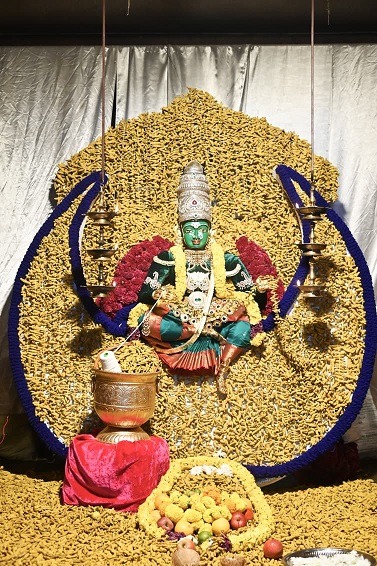
On the fourth day of Navaratri, devotees worship Sri Kushmanda Devi by decorating Her with various flowers, performing the lighting of lamps, chanting mantras, reciting hymns, and offering food according to traditional methods of worship.
In some traditions, the colour green is associated with this day. Green is considered a symbol of nature, growth, renewal, and the energy of life.
Every aspect of worship leads us towards a spiritual understanding.
By lighting a lamp, we pray that the light of knowledge may shine within us.
By offering flowers, we offer our devotion to the Mother and try to let go of our ego.
Through mantra chanting, we try to concentrate our minds.
By offering food to the Goddess, we express our gratitude, recognising everything we receive as a blessing of the Divine.
In this way, external worship gradually guides us towards inner spiritual practice.
Life Lessons We Must Learn from Kushmanda Devi
The form of Sri Kushmanda Devi offers us many valuable messages.
- We Must Recognise the Creative Power Within Us
Every one of us has some special ability. We must recognise it, develop it, and use it in ways that benefit society.
- We Must Never Lose Hope in Darkness
Difficult situations do not last forever. We must face problems with courage and continue searching for solutions.
- We Must Use Our Power for Good Deeds
Knowledge, wealth, talent, and authority gain true value only when we use them in ways that benefit others.
- We Must Respect Nature
Sunlight, water, air, soil, plants, and living beings are the foundations of our lives. Protecting nature is also a way of respecting the power that creates and sustains life.
5. We Must Develop Love and Compassion in Our Hearts
7. We Must See Every Day as a New Beginning
We must learn from the mistakes of the past, fulfil our duties in the present, and remain hopeful about the future.
When we practise these truths in our lives, the worship of Navaratri does not remain merely a ritual. It becomes a path towards the development of our personality.
Because worshipping the Primordial Power who illuminated the universe means filling our own lives with the light of knowledge, love, hope, and creativity.
The spiritual symbol of the universe emerging from the Mother’s smile gives us a great message: the light within us can make not only our own lives but also the world around us more beautiful.
Sri Kushmanda Devyai Namah!
Sarva Mangala Mangalye Shive Sarvartha Sadhike,
Sharanye Tryambake Gauri Narayani Namostute.
Praying that the Mother’s grace may be upon all of us and that our lives may be filled with knowledge, good health, happiness, peace, and spiritual consciousness…
About the Author