One divine form. Two distinct qualities. One Supreme Truth.
The third day of Navaratri is dedicated to worshipping Goddess Chandraghanta, the third manifestation of the nine forms of Goddess Durga. She represents courage, valour, compassion, wisdom, self-confidence and divine protection. Her divine form conveys a profound spiritual message: true strength lies not merely in being fierce, but in standing courageously for what is right without losing love, compassion and humility.
On one side, she embodies infinite love, boundless compassion, and a mother’s tenderness. On the other, she represents the fierce power that protects righteousness, destroys evil and triumphs over fear.
The harmonious union of these two qualities is the essence of Goddess Chandraghanta.
Behind every manifestation of the Divine Mother lies a spiritual mystery. Every divine incarnation conveys a truth about life, guiding human beings towards self-understanding and awakening the dormant power within.
Navaratri is not merely a festival celebrated over nine days. It is a spiritual journey that invites us to overcome ignorance, purify our minds and awaken the divine consciousness within.
Through her nine sacred manifestations, Adi Parashakti teaches nine profound spiritual truths essential to human life.
On the first day, Goddess Shailaputri reminds us of our connection with nature, the importance of stability and the strength of our foundations. On the second day, Goddess Brahmacharini teaches us the value of penance, spiritual discipline, perseverance and unwavering determination.
On the third day, that determination must transform into courage. Spiritual discipline must awaken our inner strength. Fear must gradually give way to faith, and a restless mind must become receptive to divine consciousness.
This is why devotees worship Goddess Chandraghanta on the third day of Navaratri.
Her greatest teaching is that genuine power does not always express itself through aggression. It is the ability to stand firm when circumstances demand courage while preserving kindness, compassion and wisdom.
- Goddess Chandraghanta: The Spiritual Meaning Behind Her Name
Goddess Chandraghanta is also described in devotional traditions by names such as Chandika, Ranchandi and Vrukavahini.
The name Chandraghanta is associated with the crescent moon adorning her forehead, which is described as resembling a bell. The name itself evokes the image of the moon and the sacred bell, bringing together the symbolism of the mind, awareness and spiritual awakening.
The moon is traditionally associated with the mind. Like the changing phases of the moon, the human mind is constantly changing. At times, it is calm and peaceful. At other times, it becomes restless, overwhelmed by thoughts, fears, doubts and uncertainties.
The sound of a temple bell symbolises awakening. When a bell rings in a place of worship, it draws our attention towards the Divine. Amid the distractions of the outside world, the mind pauses for a moment and turns towards prayer.
- The Divine Form of Goddess Chandraghanta
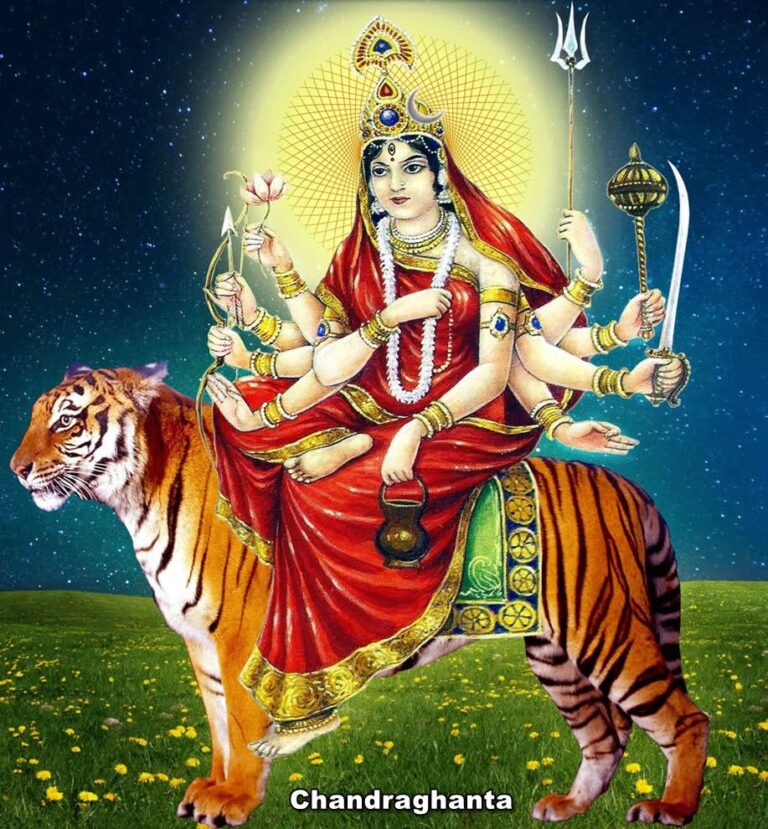
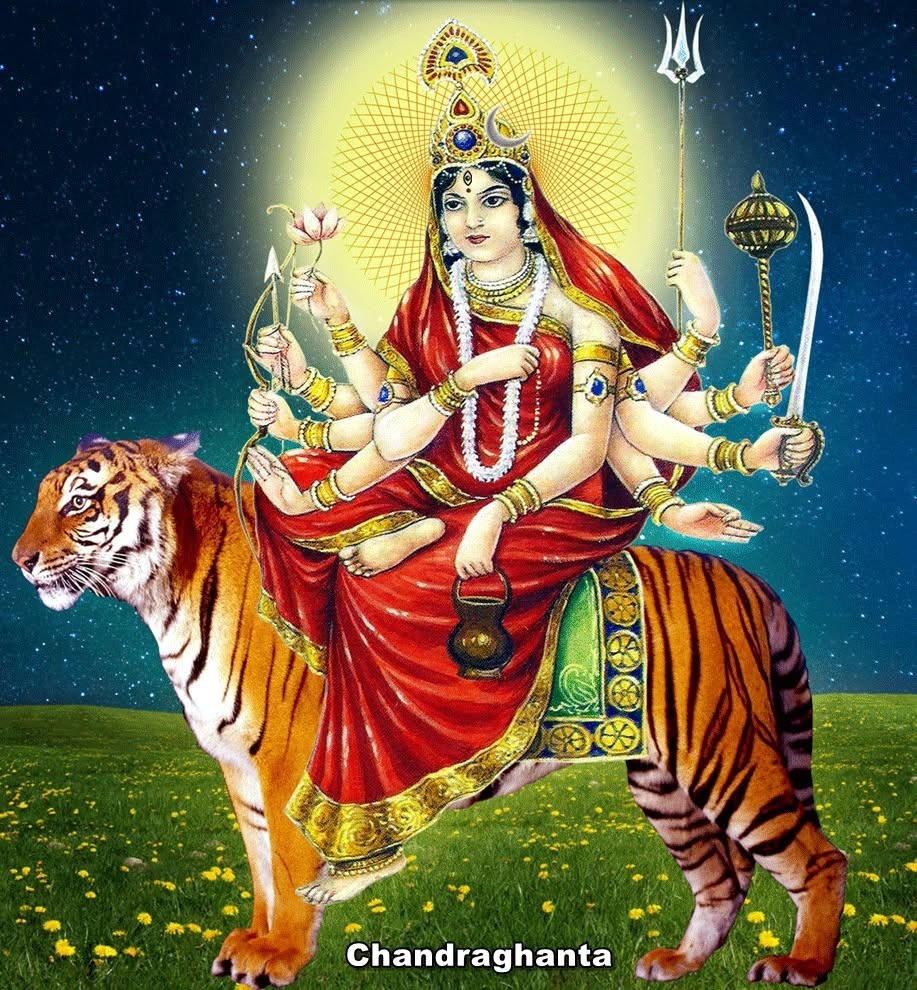
Goddess Chandraghanta is traditionally depicted radiating a golden glow, with ten arms carrying divine weapons and sacred objects.
Her hands are described as holding a trident, mace, spear, bow, arrow, discus, sword, lotus, water vessel and bell. These attributes represent different dimensions of divine power, protection, wisdom and spiritual awakening.
One of her hands is raised in the Abhaya Mudra, the gesture of fearlessness, assuring devotees that they need not surrender to fear. Another displays the Varada Mudra, the gesture of blessing, symbolising divine grace, generosity and compassion.
A crescent moon resembling a bell shines upon her forehead. Her third eye is traditionally depicted as open, symbolising heightened awareness, wisdom and the power to recognise and overcome negative forces.
She is generally portrayed riding a lion, although some traditional descriptions associate her with a tiger. Her mount represents courage, strength, fearlessness and the triumph of righteousness over unrighteousness.
The weapons in her hands are not merely instruments of battle. They can also be understood as symbols of the inner strength required to overcome negative tendencies within ourselves.
The Trident: The trident may be interpreted as a symbol of overcoming ignorance, ego and inner weakness.
The Sword: It represents discernment and wisdom—the ability to distinguish right from wrong, truth from falsehood, and what is lasting from what is temporary.
The Bell: It symbolises awakening, calling forth the courage and awareness that lie dormant within us.
The Abhaya Mudra: It inspires fearlessness, faith and confidence in the face of uncertainty.
The Varada Mudra: It represents divine blessings, compassion and grace.
The Lion or Tiger: It symbolises courage, strength and the determination to uphold righteousness.
- Goddess Parvati’s Penance: From Brahmacharini to Chandraghanta
To understand the spiritual significance of Goddess Chandraghanta, we must reflect on Goddess Parvati’s intense penance and her realisation of the deeper truth of Lord Shiva.
Born as the daughter of Himavan, the king of the mountains, and Menavati, Goddess Parvati resolved to marry Lord Shiva.
Her determination was not merely a personal wish. It represented a profound spiritual aspiration.
She understood Shiva’s essential nature. She recognised the renunciation behind his fierce appearance and understood the supreme reality that transcended his external form.
Yet her wisdom did not make her indifferent to the feelings of others.
That was one of the most remarkable aspects of her divine character.
True wisdom does not increase arrogance. It deepens our compassion and our ability to understand the hearts of others.
This understanding leads us from the spiritual discipline of Brahmacharini to the divine manifestation of Chandraghanta.
- Menavati’s Fear: How Parvati Understood a Mother’s Heart
Pleased with Goddess Parvati’s unwavering devotion, Lord Shiva eventually agreed to marry her.
The moment represented the fulfilment of Parvati’s long and arduous spiritual aspiration.
When the time for the wedding arrived, however, Lord Shiva appeared in a form far removed from what Menavati had expected.
His body was smeared with sacred ash. His matted locks framed his head, serpents adorned his body, and garlands of skulls formed part of his appearance. He was accompanied by an extraordinary gathering of spirits, supernatural beings and ascetic followers.
To those who understood the deeper truth of Shiva, this appearance represented renunciation, detachment and the supreme reality beyond worldly conventions.
To an ordinary observer, however, the same form could appear frightening.
When Menavati saw the fierce appearance of the groom arriving to marry her daughter, she was overcome with fear and fainted.
Her distress was understandable. A mother who wishes to see her daughter happy and secure may naturally become anxious when confronted with an unfamiliar and frightening situation.
This is where the extraordinary compassion of Goddess Parvati becomes evident.
Parvati knew the truth of Shiva’s divine nature. She understood the spiritual significance behind his fierce appearance and knew that his outward form did not diminish his supreme nature.
But she also understood her mother’s heart.
Menavati might not have understood the deeper philosophy of Shiva. She might have been worried about her daughter’s future. To her, the frightening appearance before her seemed to be the reality of the situation.
- Lord Shiva as Sundareswara: Love, Respect and Mutual Understanding
According to traditional accounts of the divine wedding, Lord Shiva accepted Parvati’s request and set aside his fierce appearance, assuming a beautiful and gentle form appropriate for the occasion.
Some versions describe Lord Vishnu personally adorning Lord Shiva for the wedding.
In this graceful manifestation, Shiva is associated with names such as Chandrashekhara and Sundareswara, reflecting his beautiful, auspicious appearance.
The narrative also describes Parvati adorning her forehead with a crescent moon as a loving expression of her devotion to Shiva.
This episode can be understood as more than a transformation in Shiva’s outward appearance. It also conveys a meaningful lesson about marriage and relationships.
Parvati did not insult Shiva, reject his divine nature or abandon her commitment because his appearance was frightening. At the same time, she did not ignore the fear in her mother’s heart.
She approached the situation with love, understanding and discernment.
In the narrative, Shiva also honours Parvati’s request and responds to her concern.
The underlying message is that love is not simply an attempt to change another person. It also involves understanding one another’s feelings, responding appropriately to circumstances and maintaining mutual respect.
In married life, partners may have different temperaments, opinions and ways of expressing emotions. Such differences need not become sources of conflict when both individuals are willing to listen and understand each other.
When mutual respect is present, differences can strengthen a relationship rather than weaken it.
The divine wedding of Shiva and Parvati therefore offers a beautiful lesson for family life.
- The Slaying of Jatukasura: The Bell That Pierced the Darkness
Another narrative associated with Chandraghanta’s fierce power and protection of righteousness concerns the slaying of Jatukasura.
According to this account, Tarakasura, upon learning of the union of Shiva and Parvati, sent a bat demon named Jatukasura to attack Mount Kailash.
Jatukasura surrounded Kailash with an army of bats. Soon, the sky was filled with their presence, and the mountain was plunged into darkness.
The situation became frightening.
Parvati initially looked for Nandi, but he could not be found. The followers of Shiva also sought her protection.
With Lord Shiva absorbed in meditation, Parvati recognised that she would have to draw upon her own strength and prepare to confront the danger.
This part of the narrative carries an important lesson: she did not simply wait helplessly for someone else to arrive and solve the problem.
Goddess Chandraghanta teaches us that courage is not merely the ability to fight a problem. It is also the wisdom to identify its root cause and work towards resolving it.
- The Sacred Bell: Awakening the Inner Consciousness
When entering a temple, devotees often ring a bell before offering prayers. This simple act carries a beautiful spiritual meaning.
The mind is frequently occupied with memories of the past, worries about the future and the responsibilities of everyday life. These thoughts continually draw our attention away from the present moment.
The sound of the bell offers a moment of pause. It brings our attention back to the present and serves as a reminder to focus on the Divine.
It helps establish a sense of attentiveness as we enter a sacred space and begin our prayers.
The bell in the hand of Goddess Chandraghanta can be understood in a similar spiritual context.
In traditional depictions, its sound represents the power to drive away negative forces. As a spiritual symbol, it can also inspire us to recognise and overcome fear, despair and destructive thought patterns within ourselves.
This is the inner meaning that devotees may draw from the sacred bell of Goddess Chandraghanta.
- The Philosophy of Chandraghanta: Compassion Within Fierceness, Strength Within Compassion
Two qualities that may appear contradictory come together in the divine form of Chandraghanta.
On one side are motherhood, love, compassion and serenity. On the other are courage, fierceness, protection of righteousness and the destruction of evil.
A person may deeply love their family, yet when injustice occurs within the family, that person may need to speak up courageously to help put things right.
These are practical ways to apply the philosophy of Chandraghanta to everyday life.
Love should keep us compassionate. Wisdom should guide our decisions. Courage should help us act when the moment demands it.
The harmonious union of these three qualities forms the foundation of inner strength.
- The Manipura Chakra: Awakening Self-Confidence and Inner Power
In yogic traditions, the Manipura Chakra is associated with the region around the navel. It is commonly linked with inner strength, determination, self-confidence and the ability to take purposeful action.
Some traditions of Navadurga worship associate Goddess Chandraghanta with the Manipura Chakra.
The word Manipura is commonly interpreted as the city of shining jewels.
Just as precious gems reflect their brilliance, every human being possesses abilities and potential that may not yet have been fully realised.
To make use of this potential, however, we must cultivate confidence in ourselves.
We need to understand our goals, work towards them with discipline and continue moving forward when obstacles arise. At times, we may need to adjust our plans without abandoning our purpose.
This is the central message associated with the Manipura Chakra in this spiritual interpretation.
Through the worship of Chandraghanta, devotees seek to cultivate courage, confidence, decision-making ability and inner strength.
Prayer and spiritual practice can encourage us to reflect on our goals, organise our thoughts and approach challenges with greater determination.
At the same time, spiritual practice must be accompanied by practical effort.
- Who Are the Jatukasuras in Our Lives?
Just as Jatukasura and his army of bats plunged Mount Kailash into darkness, certain situations in our lives can obscure our thoughts and weaken our confidence.
These challenges do not necessarily appear in the form of demons. They may emerge as fear, anxiety, family problems, financial difficulties, workplace pressure or a loss of faith in our own abilities.
Some of the Jatukasuras we encounter in everyday life include:
Fear: Preventing us from beginning something new or taking a necessary step forward.
Anxiety: Constantly worrying about events that have not yet occurred and losing our peace in the present.
Failure: Believing that one setback means we can never succeed again.
Lack of self-confidence: Doubting our abilities even when we possess the potential to grow and achieve our goals.
Family problems: Allowing misunderstandings to turn minor disagreements into serious conflicts.
Financial difficulties: Becoming so worried about the future that making practical decisions becomes difficult.
Workplace stress: Losing our peace of mind when professional responsibilities and expectations increase.
Illness: Facing emotional distress alongside the physical challenges of a health condition.
- The Life Lessons Taught by Goddess Chandraghanta
The stories and symbolism associated with Chandraghanta offer several valuable lessons for everyday life.
- Recognise Your Strength When Fear Arises
Parvati did not remain helpless when confronted with a difficult situation. She recognised her own strength and prepared to act.
- People With Knowledge Must Respect the Feelings of Others
Parvati understood Shiva’s divine nature, yet she did not dismiss Menavati’s fear.
- Mutual Respect Is Essential in Love
The traditional account of Shiva and Parvati’s divine wedding highlights the importance of respecting one another’s feelings.
- Identify the Root Cause of a Problem
Just as the Goddess recognised the importance of Jatukasura’s army of bats, we must learn to identify the underlying causes of recurring problems.
- Peacefulness Is Not Weakness
Chandraghanta is compassionate, yet she can assume a fierce form to protect righteousness.
- Faith Must Be Accompanied by Effort
Worshipping the Divine Mother can inspire hope, peace of mind and inner strength.
- Spiritual Discipline Must Become Practical Action
Spiritual practice can help us reflect on our goals, organise our thoughts and develop courage. We do not view the divine manifestations of the Goddess merely as mythological stories. We also seek to understand the philosophy behind them and the lessons they offer for our lives. Recognising Chandraghanta Within Ourselves
That is the journey from a restless mind to divine consciousness.
Jaya Jaya He Mahishasura Mardini! Jaya Jaya He Chandraghanta Mata!
Om Devi Chandraghantayai Namah!
May Goddess Chandraghanta bless all devotees with courage, peace, wisdom, compassion and spiritual awakening this Navaratri.
🙏 Happy Navaratri! 🙏
About the Author