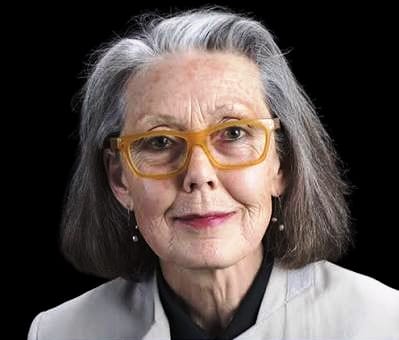
Anne Carson, the Canadian poet, translator and essayist, who turns ancient Greek fragments into startlingly new forms, is the 2026 Nobel Laureate in Literature
Feature Article by: Dr. E. RAM BHASKAR RAJU
WARANGAL, OCTOBER 11, 2026: “They’re all crazy.” That was Anne Carson’s verdict on the Swedish Academy members who chose her, offered to Iceland’s national public broadcaster RÚV (Ríkisutvarpið). When the Academy first telephoned on October 8, 2026, she did not answer; only after her husband urged her did she ring back, telling Permanent Secretary Ingrid Carlberg that she was in Iceland, “listening to the wind…”
The moment is typical of the writer. Carson, 76, has spent five decades away from literary celebrity, producing work that is erudite, playful, private and impossible to classify. On October 8, the Academy honoured her “for her bold and inventive oeuvre that, in playful dialogue with the classical tradition, has created new forms for contemporary literature.”
A Philologist’s Imagination
Born in Toronto in 1950, Carson trained as a classicist and has taught Greek, Latin, translation and artistic collaboration at universities in Canada and the United States. The etymology of a word, she says, is often where her work begins. Greek, she once remarked, feels “more like being in the morning of language.”
Her first book, Eros the Bittersweet (1986), takes its title from a word coined by Sappho. In my rendering:
“Once again limb-loosening Eros shakes me,
that sweetbitter, unmanageable creature that creeps in.”
— Sappho, Fragment 130
From Sappho’s glukupikron, “sweetbitter,” Carson builds a theory of desire: love involves the lover, the beloved and the gap between them. Desire lives in that gap; close it, and the longing that drives poetry dies. The idea explains her lifelong fascination with absence and the incomplete.
Breaking the Boundaries of Genre
Autobiography of Red (1998), her best-known work, begins with ruins. Stesichorus wrote of Geryon, a red, winged monster killed by Herakles; only fragments survive. Carson takes the monster’s side. Her Geryon is a shy, red-winged boy who keeps a photographic diary and is hurt by a careless young Herakles. The book opens with Carson’s “translations” of the fragments, “…some faithful, some mischievously invented. Small details carry the emotion: Geryon hides his wings under a coat, and his photographs record what he cannot bring himself to say”.
Elucidation: Carson rewrites the heroic tradition from the victim’s side; the “monster” is simply someone different. Indian readers will recognise the gesture from retellings of the epics that give voice to Karna, Surpanakha or Ekalavya!
In “The Glass Essay,” from Glass, Irony and God (1995), a woman recovering from a broken affair visits her mother on a bleak northern landscape and rereads Emily Bronte. 2
Visions of herself stripped to the bone, her “Nudes,” recur until a gentler image arrives at the end. In that last vision, the wind, which has stripped her bare all along, seems at last to leave something standing, a body that has survived.
“…and a father failing in the murky depths of dementia.”
Elucidation: The poem shows literature helping us survive grief; close reading becomes a way of reading one’s own pain. To see the narrator’s heartbreak through the lens of Emily Bronte’s severity is to see how art can act as an anchor when everything else is stripped down.”
The Beauty of the Husband (2001), a portrait of a charming, faithless husband built around Keats, made her the first woman to win the T.S. Eliot Prize. Men in the Off Hours (2000) won the Griffin Poetry Prize.
The Poetry of the Gap
Her Sappho translations, If Not, Winter (2002), changed how English readers meet the poet. Earlier translators smoothed over the holes in the papyrus; Carson marks each with square brackets, leaving a lone word and white space.
Elucidation: The reader feels what has been lost. The theory of Eros the Bittersweet is put into practice: the gap is where the longing lives.
Her most personal book, Nox (2010), mourns her estranged brother Michael. At its centre is Catullus’s elegy for his own brother, which closes, in my rendering:
“And forever, brother, hail and farewell.”
— Catullus, Poem 101
Carson gives each Latin word a dictionary entry that slowly fills with memory, photographs and letters, all printed on a single accordion-folded sheet in a box.
Elucidation: Translation becomes mourning. Each word is as elusive as the brother she barely knew; another person, like an ancient text, can never be fully translated.
Decreation (2005) studies Sappho, Marguerite Porete and Simone Weil, three women who sought to get the self out of the way. Her other work includes versions of Sophocles, Aeschylus and Euripides, Antigonick (2012), Float (2016) and Norma Jeane Baker of Troy (2019), which joins Euripides’ Helen to Marilyn Monroe.
Why the Swedish Academy Chose Her…?
The Academy member Steve Sem-Sandberg called Carson an author of our time who connects the present with antiquity. For her, the classics are living voices to argue with and tease: Herakles can sit beside a tape recorder, and Antigone can speak modern politics. The citation’s “playful dialogue” is exact. The critic Stephen Burt once observed that Carson meets T.S. Eliot’s test of a major poet: “each of Carson’s works casts light on all the rest.”
This is how the Academy explained its decision. Anders Olsson, the Swedish literary scholar, critic and poet, and the chair of the Swedish Academy’s Nobel Committee for Literature, said almost all of her work centres on the meeting point between the philologist’s fixation on words and the poet’s search for new meaning, and that her mix of sources, from ancient Greek writers to Keats, Virginia Woolf and Emily Brontë, produces playful, ironic work that moves between classical and modern poetry.
Anne Carson succeeds Alice Munro (2013) as a Canadian laureate, and follows Laszlo Krasznahorkai, Han Kang and Jon Fosse. 3
Meaning for Indian Readers
Carson resonates in India, where translation and retelling have shaped literature for centuries: the many Ramayanas, the Sanskrit and Tamil classics renewed by later poets. Like those traditions, she treats an ancient text as an invitation, not a monument. For teachers and students of English, the award shows that the lines between creative and critical writing, and between original and translation, need not be fixed. A footnote can be a poem, a dictionary entry an elegy.
A Writer of the In-between
Carson told the Nobel Foundation her writing happens almost by accident, while she is trying to do something else. Her books live between languages, centuries, genres and people, and she has made those spaces feel inhabited. This year’s Nobel honours a writer who, more than any other living author, makes ancient voices sound new.
Speaking to RUV beside a windy Icelandic road, she suggested that poetry may suit an impatient age simply because it is quick to read. Then, did come the classicist’s wink: “So basically I think it’s good because it’s brief. Except Homer! Homer’s not brief.”

Dr. E. Ram Bhaskar Raju
Associate Professor of English
Kakatiya Government College (A)
Hanamkonda – Telangana State, India.
Contact No. 9849169320
e-mail: rambhaskarraju@gmail.com
About the Author