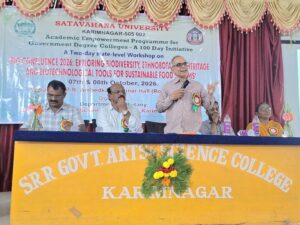
KARIMNAGAR, OCTOBER 07, 2026: A two-day State-Level Workshop, “Bio-Confluence–2026: Exploring Biodiversity, Ethnobotanical Tools and Sustainable Food Systems,” was inaugurated on Wednesday at S.R.R. Government Arts & Science College (Autonomous), Karimnagar, under the aegis of the Department of Botany. The workshop is being conducted on October 7 and 8, 2026.
The workshop commenced with registration at 10:00 AM, followed by a biodiversity poster presentation by UG and PG students. The students presented posters highlighting biodiversity, environmental protection, conservation of biological resources and sustainable food systems.
The inaugural session emphasised the importance of creating awareness among students, faculty and researchers about biodiversity, ethnobotany, biotechnology and modern scientific technologies, while developing a research-oriented approach towards sustainable development. The workshop also aims to provide participants with an opportunity to exchange knowledge and understand the latest developments in biodiversity conservation and biotechnology.
Technical Session on Biotechnology and Molecular Innovation
The first technical session was conducted by Tirunahari Ugandhar, Associate Professor of Botany, Kakatiya Government College (A), Hanamkonda, as the resource person. He delivered a lecture on “Biotechnology, Molecular Innovation: From Biobanking to Genetic Rescues of Endangered Ecosystems.”
He explained the significance of modern biotechnology and molecular technologies in biodiversity conservation and highlighted their potential applications in protecting endangered ecosystems and biological resources.
Sadasivaiah Highlights Snake Diversity and Conservation
The second technical session was conducted by Sadasivaiah, Associate Professor of Botany, Dr. BRR Government Degree College (A), Jadcherla, on “Biodiversity and Conservation.”
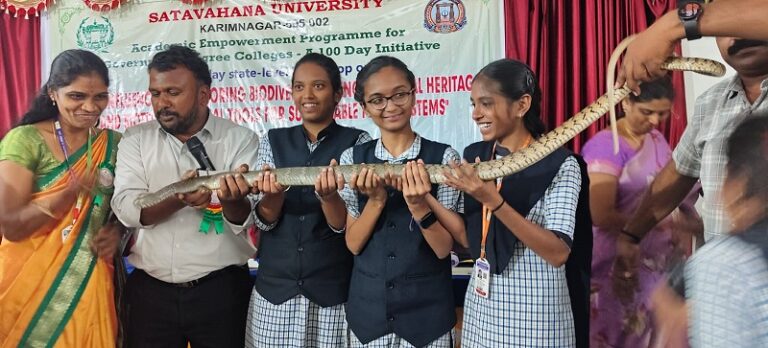
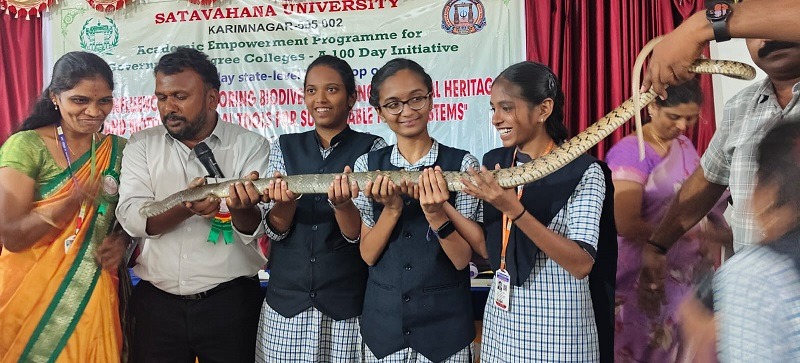
During the session, Sadasivaiah presented students with information on the diversity of different types of snakes through photographs, examples and scientific explanations. He explained the distinguishing features of venomous and non-venomous snakes, their habitats, identification characteristics and ecological importance.
He highlighted the important role of snakes in maintaining ecological balance by controlling populations of rodents and other organisms. He also stressed the need to remove misconceptions and unnecessary fear about snakes and to create awareness about their ecological significance.
Sadasivaiah further explained various snake conservation practices, protection of natural habitats and the importance of safely rescuing snakes rather than killing them and releasing them into suitable natural habitats. He emphasised that every organism has a specific role in maintaining biodiversity and ecological balance.
His presentation on snake diversity, habitats, ecological roles and conservation methods attracted considerable interest among the students and helped develop greater awareness and responsibility towards biodiversity and wildlife conservation.
Cultural Programmes
As part of the workshop, M.Sc. Botany students presented cultural programmes, showcasing their talent and adding enthusiasm to the event.
The two-day State-Level Workshop provides a valuable platform for students, faculty and researchers to gain knowledge and exchange ideas on biodiversity conservation, ethnobotany, biotechnology, snake diversity, wildlife conservation and sustainable food systems. The workshop is expected to strengthen scientific awareness, research interest and conservation-oriented thinking among the participants.
The programme is being successfully organised under the coordination of In-charge Principal Nithin Pathak, Professor Tirukovela Srinivas, Head, Department of Botany, Organising Secretary Padala Thirupathi, Routhu Radhakrishna, M.D. Taher Hussain, Kala Jyothi, Ande Bunga Thirupathi, Satish, Md. Thajuddin, Swaroopa Rani, faculty members and the workshop organising committee.
About the Author