
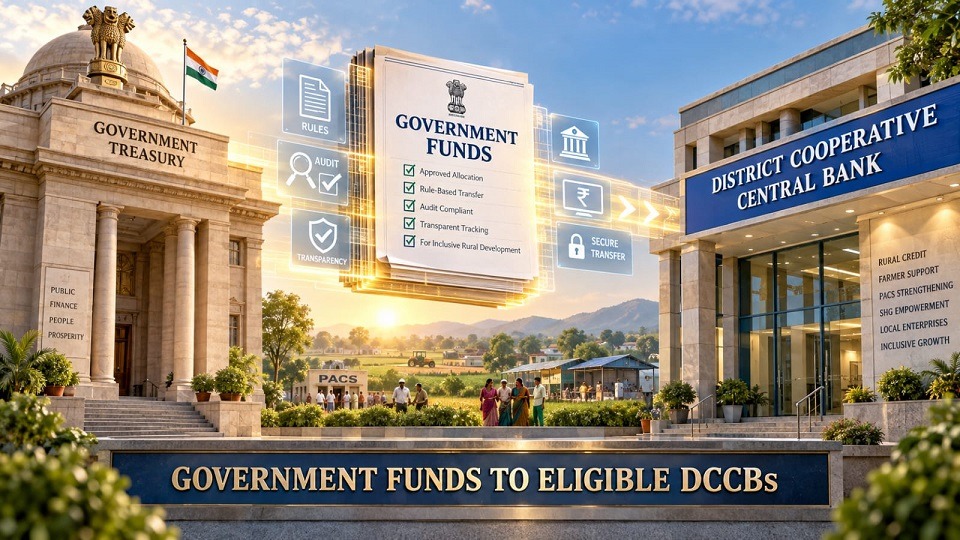
A policy editorial on why eligible District Cooperative Central Banks deserve a rule-based role in handling public funds
But where a District Cooperative Central Bank is licensed, financially sound, digitally enabled, professionally managed and compliant with regulatory norms, the continued reluctance to use it for public business weakens the very rural financial architecture that governments claim to strengthen.
The time has come for RBI, NABARD, the Ministry of Cooperation and State Governments to examine a performance-based public funds framework for DCCBs
Editorial Article
KARIMNAGAR, SEPTEMBER 18, 2026: India’s District Cooperative Central Banks are not marginal banking outposts. They are century-old rural financial institutions placed between State Cooperative Banks and Primary Agricultural Credit Societies, and they remain among the few formal institutions that still understand the credit rhythm of villages, crops, local markets, self-help groups and small rural enterprise. Yet, in many States, public funds and government accounts continue to be concentrated largely in other banks, while eligible District Cooperative Central Banks are treated as secondary channels. This is not merely an administrative habit. It is a policy question that now deserves a serious national review.
The issue must be stated with care. No bank, cooperative or otherwise, can claim government funds as a matter of right. Public money must be handled only by institutions that satisfy prudential, technological, governance and audit standards. But where a District Cooperative Central Bank is licensed, financially sound, digitally enabled, professionally managed and compliant with regulatory norms, the continued reluctance to use it for public business weakens the very rural financial architecture that governments claim to strengthen.
The safer policy position is neither a blanket demand nor a criticism of existing treasury practice. It is a limited reform proposal: subject to State Treasury Rules, Finance Department instructions, RBI and NABARD norms, only eligible and compliant District Cooperative Central Banks may be considered for specified categories of government business.
A Legal Banking Institution, Not a Peripheral Body
Publicly available regulatory material makes one point clear. State Cooperative Banks and District Cooperative Central Banks are part of the regulated cooperative banking structure. RBI’s own overview records that the banking functions of State Cooperative Banks, District Cooperative Central Banks and Urban Cooperative Banks are regulated under the Banking Regulation Act, 1949, as applicable to cooperative societies. The Banking Regulation Amendment Act 2020 has also brought important changes for State Cooperative Banks and District Cooperative Central Banks from April 1, 2021. In a 2022 notification, RBI further clarified that DCCBs require prior approval of the Reserve Bank for opening a new place of business, installing ATMs or shifting offices.
These facts matter because they show that a DCCB is not a casual local society handling money outside the banking framework. It is a banking institution operating under a layered regulatory environment involving RBI, NABARD and the Registrar of Cooperative Societies. The question, therefore, is not whether DCCBs should be exempted from discipline. The question is whether the same discipline can become the basis for greater trust and greater use.
The Uneven Recognition Problem
The Reserve Bank has built a differentiated regulatory framework for Urban Cooperative Banks. It has adopted a four tier approach based on deposit size and area of operation, with norms relating to net worth, capital adequacy, branch expansion and exposure limits. RBI also maintains lists of Scheduled Urban Cooperative Banks and State Cooperative Banks. This approach is understandable: every cooperative bank is not the same, and regulation must distinguish between institutions by size, strength and risk.
The same principle should be extended more consciously to District Cooperative Central Banks. DCCBs a comparable performance based pathway Many DCCBs serve deeper rural geographies than Urban Cooperative Banks. They are directly linked with PACS, agriculture, allied activities, women’s self-help groups and district level rural enterprise. Yet the national conversation on scheduled status and public fund eligibility has not given. This is the inconsistency that needs correction.
A stronger role for DCCBs should also be matched by stronger democratic and professional governance. Regular cooperative elections, wider participation by youth and qualified members, fit-and-proper standards, and accountable boards can make the cooperative structure both representative and professionally managed.
Why Public Funds in Eligible DCCBs Matter
When government deposits and scheme accounts are routed through eligible DCCBs, the effect is not confined to the balance sheet of one bank. It can improve the supply of low-cost rural credit, strengthen PACS, deepen financial inclusion and keep local public money circulating in the local economy. Stable deposits can support crop loans, dairy finance, small business loans, SHG finance, rural housing, warehouse-linked credit and other productive activities.
This creates a local multiplier effect. Public balances held in a compliant local cooperative banking channel can support local credit, local recovery, local employment and local enterprise, provided public fund safety, audit trail and liquidity requirements are not compromised.
This is particularly important for women’s economic participation. DCCBs and PACS are well placed to serve self-help groups, women farmers, dairy groups, micro enterprises and rural livelihood collectives. If governments are serious about women priority and women empowerment, eligible cooperative banks can be used as a disciplined delivery channel for savings, credit, insurance, digital payments and financial literacy. Such use must be tied to measurable performance, not sentiment.
There is also a democratic dimension. A public rupee parked only in distant or urban centred banking channels may remain administratively safe, but it does not necessarily build local institutional capacity. A public rupee placed in a compliant DCCB can support the same safety requirements while also strengthening a district level rural financial institution. The policy choice is not between safety and cooperation. It is to design safety through cooperation.
The Concerns Are Real But Not Final
Governments may hesitate because some cooperative banks have suffered from weak governance, political interference, poor recovery, technology gaps or accumulated losses. These concerns cannot be dismissed. Public money demands high standards. But the existence of weak institutions is not a reason to deny recognition to strong institutions. It is a reason to create a transparent eligibility framework.
A reform minded policy should separate eligible DCCBs from non-eligible ones through clear indicators: capital adequacy, net NPA, audit classification, profitability, CBS coverage, cyber security, statutory compliance, professional management, internal controls, grievance redressal and timely reporting. Banks that satisfy the framework should be permitted to handle specified categories of government business. Banks that do not satisfy it should be given a time bound improvement plan under NABARD and RBI supervision.
A Rule-Based Way Forward
India needs a national framework for District Cooperative Central Banks similar in spirit to the differentiated approach used for Urban Cooperative Banks, but suited to rural cooperative banking. Such a framework can classify DCCBs by financial strength, technology readiness, governance quality and service capacity. It can then permit graded access to public business: local body accounts, scheme accounts, SHG linked funds, district level deposits, welfare payments and other government transactions, subject to State rules and RBI NABARD norms.
The question is not whether public money should be handed over to cooperative banks as a favour. The question is whether public money, when held by eligible and regulated District Cooperative Central Banks, can serve a larger rural public purpose without compromising safety.
The demand, therefore, should not be framed as a blanket demand that all government funds must immediately be shifted to all DCCBs. That would invite legitimate legal and prudential objections. The stronger and safer argument is that governments should not ignore eligible DCCBs merely because they are cooperative banks. Where they meet objective standards, they should receive an equal, transparent and rule based opportunity.
Conclusion
District Cooperative Central Banks were created for a purpose larger than routine banking. They were built to connect public policy with rural credit, and rural savings with rural development. If India is now speaking of cooperative federalism, financial inclusion, women led development and rural enterprise, it cannot keep its district cooperative banks at the edge of public finance.
The time has come for RBI, NABARD, the Ministry of Cooperation and State Governments to examine a performance based public funds framework for DCCBs. The reform should be prudent, legally sound and phased. But it should begin with a simple recognition: a strong District Cooperative Central Bank is not a risk to public money; with proper regulation, it can be one of the most effective instruments for putting public money to public rural use.
Legally Safer Policy Position
This article deliberately avoids alleging deliberate discrimination by any authority. The safer policy position is that present practice may reflect historical caution, prudential concerns and administrative habit, but that these reasons should now be reviewed in light of strengthened regulation, technology, PACS computerisation and the role of DCCBs in rural credit delivery.
The recommended formulation is: eligible and compliant DCCBs should be considered for government business through a transparent, objective and regulator approved framework, subject to applicable law, financial soundness and public fund safety.
Suggested Eligibility Matrix for Government Business
| Area | Suggested Standard | Purpose |
| Capital and asset quality | Minimum CRAR, controlled NPA levels and adequate provisioning | Protect public funds and depositor confidence |
| Audit and compliance | Good audit classification, timely statutory returns and no serious unresolved regulatory observations | Ensure accountability and regulatory discipline |
| Technology readiness | CBS, digital payments, reconciliation capacity, cyber security and ATM or business correspondent capability | Enable government transactions safely and transparently |
| Governance | Fit and proper governance, professional management, internal audit and risk controls | Reduce political and operational risk |
| Rural delivery capacity | PACS linkage, SHG outreach, farmer credit network and field monitoring | Convert public deposits into local development credit |
| Women priority | Dedicated SHG and women enterprise products with financial literacy support | Make women empowerment measurable in rural banking |
Verified Public Sources Used
| Source | Document | Relevant Point | URL |
| RBI | Regulating co-operative banking overview | Banking functions of StCBs, DCCBs and UCBs are regulated under the Banking Regulation Act as applicable to cooperative societies. | https://m.rbi.org.in/scripts/FS_Overview.aspx?fn=2755 |
| RBI | Notification dated May 24 2021 | Banking Regulation Amendment Act 2020 notified for StCBs and DCCBs with effect from April 1 2021. | https://www.rbi.org.in/Scripts/NotificationUser.aspx?Id=12096&Mode=0 |
| RBI | Notification dated August 11 2022 | DCCBs require prior RBI approval for opening new places of business, installing ATMs or shifting offices. | https://www.rbi.org.in/Scripts/NotificationUser.aspx?Id=12375&Mode=0 |
| RBI | Four tier framework for UCBs press release | RBI adopted a differentiated regulatory framework for Urban Cooperative Banks. | https://rbi.org.in/Scripts/BS_PressReleaseDisplay.aspx?prid=54059 |
| RBI | List of Banks in India | RBI separately lists scheduled state cooperative banks, scheduled UCBs and other cooperative bank categories. | https://www.rbi.org.in/commonman/english/scripts/BanksInIndia.aspx |
| PIB Ministry of Cooperation | Cooperative Banks in India 2025 | Public statement records 34 StCBs, 351 DCCBs and 1457 UCBs under RBI and NABARD supervision. | https://www.pib.gov.in/PressReleasePage.aspx?PRID=2157875&lang=2®=3 |
| PIB | Rural credit and inclusive growth | Recognises cooperative banks among institutions supporting rural credit delivery. | https://www.pib.gov.in/PressReleasePage.aspx?PRID=2285236&lang=1®=3 |
| PIB | NABARD Turn Around Plan reference | Records NABARD efforts for improving financial performance of StCBs and DCCBs. | https://www.pib.gov.in/PressReleasePage.aspx?PRID=2244066&lang=1 |
Prepared for policy discussion. This draft should be reviewed against the latest State Government treasury instructions and specific RBI NABARD permissions before formal publication or official submission.
About the Author