India’s Exports Nearly Double to Over USD 860 Billion in 2025-26 Through Policy Reforms, Market Diversification and Digital Trade Facilitation
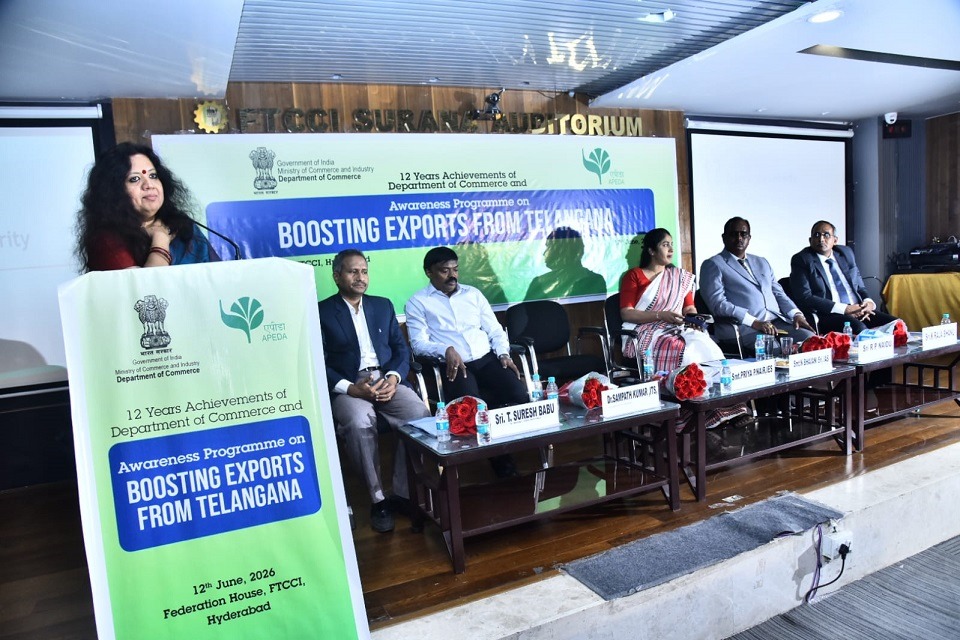
HYDERABAD, JUNE 12, 2026: The Department of Commerce, Ministry of Commerce & Industry, Government of India, in association with APEDA, organised an Interaction Programme on “12 Years’ Achievements of the Department of Commerce and Awareness Programme on Boosting Exports from Telangana” in Hyderabad on Friday, bringing together exporters, industry representatives, trade promotion organisations and government stakeholders.
Addressing the gathering, Ms. Priya P. Nair, Economic Adviser, EP (Agri) Division, Department of Commerce, Government of India, said that over the last 12 years, the Department of Commerce has played a pivotal role in strengthening India’s position in global trade through sustained policy reforms, export promotion initiatives, market diversification and digital transformation.
She highlighted that India’s total exports have nearly doubled from around USD 468 billion in 2013-14 to over USD 860 billion in 2025-26, driven by robust growth in both merchandise and services exports despite significant global economic uncertainties. She noted that sectors such as engineering goods, electronics, pharmaceuticals, marine products, textiles, agricultural products, spices, and gems & jewellery have registered substantial growth during this period, while services exports have emerged as a major engine of India’s export expansion.
Ms. Nair further stated that the Department has significantly enhanced trade facilitation through initiatives such as Trade Connect, digital trade intelligence platforms and targeted support for Micro, Small and Medium Enterprises (MSMEs). Simultaneously, India has pursued an ambitious agenda of Free Trade Agreements (FTAs), creating new market opportunities for exporters across sectors. Emphasising the Department’s long-term vision, she said that a strong focus on quality standards, traceability, infrastructure development and stakeholder engagement has laid a solid foundation for realising the vision of making India a leading global trade and export hub.
Speaking on the occasion, Smt. N. Bhavanisri, IAS, Secretary, Trade & Commerce Department and National Turmeric Board, stated that India produces nearly 12 million metric tonnes of spices annually, but exports only about 13 per cent of its production, indicating significant scope for growth in international markets. She noted that spices account for more than 8 per cent of India’s agricultural exports and that India remains the world’s largest producer, consumer and exporter of spices.
Highlighting the contribution of Special Economic Zones (SEZs), she said that nearly 40 operational SEZs are functioning across Andhra Pradesh, Telangana and Chhattisgarh, with exports touching almost ₹15 lakh crore. Telangana’s SEZs have emerged as major hubs for pharmaceuticals, information technology, aerospace and defence manufacturing. She added that SEZs and Export-Oriented Units (EOUs) provide benefits such as duty-free imports, simplified customs procedures and single-window clearances, thereby improving ease of doing business and export competitiveness.
Sri K. Raja Bhanu, Director General, Pharmexcil, said that Indian pharmaceutical products today reach more than 190 countries, and ten of the world’s top twenty-five generic medicines are sourced from India. He said this reflects the country’s manufacturing excellence, quality standards and scientific capabilities, further reinforcing India’s position as a global healthcare supplier.
Sri R. P. Naidu, Assistant General Manager, APEDA, highlighted Telangana’s growing contribution to India’s agri-export sector. He said the state contributes ₹8,000–10,000 crore to India’s non-basmati rice exports and is emerging as a major confectionery export hub through companies such as Ravi Foods and Karachi Bakery. He also highlighted APEDA’s support for exports of GI-tagged Banganapalli mangoes, the promotion of organic trade through Tracenet, and financial assistance for export infrastructure and quality-testing facilities.
Sri Suresh Babu, ECGC, explained the corporation’s role in protecting exporters against payment risks in international trade through credit insurance solutions covering commercial and political risks. He said ECGC assists exporters in assessing overseas buyers, obtaining credit limits and securing protection against non-payment. He also highlighted specialised products designed for MSMEs, single-buyer exposures, pre-shipment risks and domestic trade credit, while emphasising the importance of documentation, compliance and timely declarations for effective risk management and claim settlement.
Dr. Sampath Kumar, ITS, Additional Director General of Foreign Trade (DGFT), outlined key export promotion measures being implemented under the Foreign Trade Policy, including digital services for exporters, benefits available under FTAs, support for MSMEs through e-commerce platforms, financial assistance schemes and trade facilitation initiatives aimed at helping Indian businesses expand their global footprint.
The speakers collectively urged exporters, particularly MSMEs, to proactively engage with the Department of Commerce, APEDA, DGFT, ECGC and other trade promotion agencies, participate in awareness and capacity-building programmes, leverage available government schemes and prioritize quality standards and certifications to scale up exports, generate employment and contribute to India’s journey towards becoming a global trade powerhouse.
About the Author