A delayed intervention that raises deeper questions
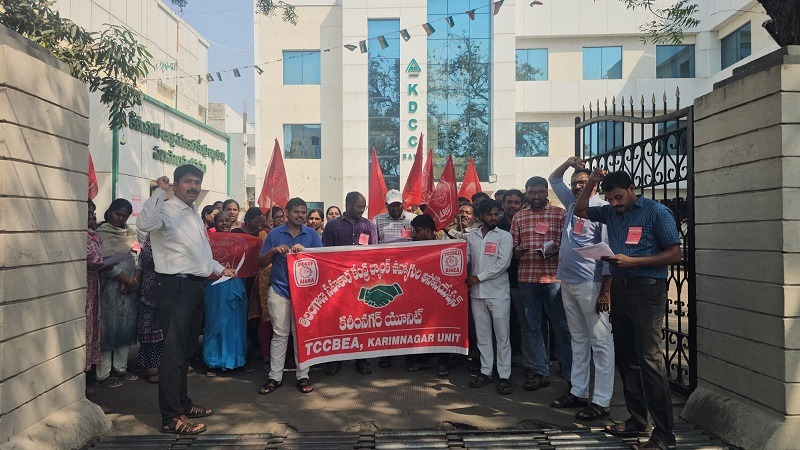
Telangana Cooperative Central Bank employees’ agitations opposing the recovery of incentives provided to employees entered their fourth day on Saturday
KARIMNAGAR, APRIL 18, 2026: In India’s cooperative banking ecosystem, governance rests on a carefully constructed statutory foundation. Decisions taken by the Boards of District Cooperative Central Banks (DCCBs) are not casual administrative acts; they are the outcome of structured deliberations within a legally constituted framework.
Yet, the recent move to retrospectively recover incentives paid to employees—after nearly two years—has triggered a fundamental question:
Can rights once exercised under law be revisited and reversed by subsequent administrative directions?
When oversight is present—but silent
Board meetings of DCCBs are not closed rooms of unilateral decision-making. They are attended by: The Registrar’s nominee, representing statutory compliance. Representatives of the financing bank, ensuring financial discipline. Oversight-linked participation from institutions like NABARD.
These are not symbolic presences. They are institutional checks built into the system.
If, at the time of approving incentives: No objection was raised and no dissent was recorded and no corrective direction was issued…then the approvals were not merely decisions—they were decisions validated through institutional silence.
That silence now becomes central to the present controversy. From approval to reversal: A troubling shift
The current attempt to recover incentives long after they were approved and disbursed signals a shift from contemporaneous oversight to retrospective scrutiny.
This shift is not just administrative—it is philosophical.
If a decision was flawed, why was it not corrected then?
If it was valid then, what has changed now?
Governance cannot oscillate between acceptance and rejection without explaining the transition.
Statutory rights vs. administrative reinterpretation
Cooperative laws provide Boards with a degree of autonomy in matters of internal administration, including employee-related decisions. These are not discretionary favours; they are statutory spaces of decision-making.
This raises a more pointed question:
Can administrative bodies reinterpret or effectively nullify rights already exercised under law?
If such reversals are permitted without clear statutory backing, the concern is not about one decision—it is about the future certainty of all decisions.
The Vaidyanathan vision: Strengthening, not constraining
The reform vision associated with Professor A. Vaidyanathan was rooted in strengthening cooperative institutions: Professionalising governance and ensuring functional autonomy and reducing excessive administrative interference. It is difficult to assume that such reforms intended to create a system where:
Decisions are allowed at one stage and questioned at another, without continuity. The larger concern, therefore, is whether the spirit of these reforms is being implemented—or inadvertently diluted.
A question of fairness to employees
Employees who received incentives did so:
Through formally approved Board resolutions
Within the institutional framework available to them
With full compliance, including tax liabilities
To revisit those decisions after a considerable lapse of time raises concerns of:
Financial disruption
Institutional uncertainty
Erosion of trust
This is not merely an accounting issue—it is a human and organisational concern.
Can silence be followed by enforcement?
An important dimension that emerges is this:
If those present in the Board had neither objected nor exercised any power to prevent such payments, can the same system later seek recovery without addressing that silence?
This is not a question of confrontation—it is a question of accountability symmetry.
Responsibility at the time of approval
Responsibility at the time of recovery
Both must be examined with equal seriousness.
Where does authority begin—and end?
The cooperative structure functions on a balance:
Statutory provisions that define authority
Institutional roles that guide decisions
Oversight mechanisms that ensure compliance
When actions appear to override or reinterpret decisions taken within that framework, it invites a broader reflection:
Are we strengthening governance, or complicating it?
Beyond legality: The question of institutional confidence
Even beyond legal interpretation, the episode carries a larger message.
If decisions taken in good faith within the system can be reopened after years:
Boards may become overly cautious
Decision-making may slow down
Institutional confidence may weaken
For a sector that depends on grassroots trust, this is a serious consideration.
Conclusion: The need for consistency, not correction alone
This is not a debate about incentives alone.
It is about:
Respecting statutory decision-making spaces
Ensuring timely oversight rather than delayed intervention
Maintaining consistency in governance actions
Reform is not just about correcting errors.
It is about ensuring that the system does not create new uncertainties in the process.
When rights granted under law are revisited after the fact, the question is no longer about correction—it is about consistency, credibility, and confidence. If statutory decision-making is to retain its meaning, then the authority to approve and the authority to question must operate in the same moment—not years apart.
About the Author