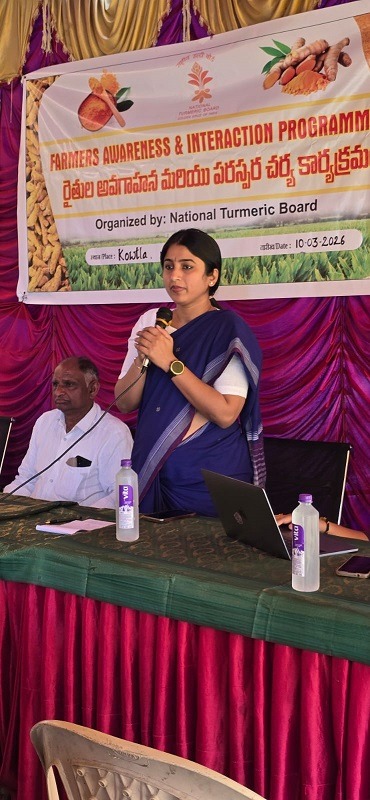
NIRMAL, MARCH 10, 2026: The National Turmeric Board conducted a farmer awareness and quality improvement training programme in Nirmal district to promote the adoption of Integrated Pest Management (IPM) in turmeric cultivation. More than 100 farmers and several Farmer-Producer Organisations from turmeric-growing areas in the district participated in the programme. The event was attended by farmers, co-operatives and officers from the National Turmeric Board.
The National Turmeric Board selected Nirmal district for this initiative in order to ensure that pesticide residue levels in turmeric are reduced and the overall quality improves. Through focused awareness programmes and training, the Board aims to reduce residue levels and promote residue-compliant turmeric suitable for premium export markets.
Addressing the gathering, N. Bhavani Sri, Secretary of the National Turmeric Board, explained the importance of adopting Integrated Pest Management practices to improve turmeric quality and strengthen India’s export potential. She explained that export markets such as the European Union, the United States, the United Kingdom, Japan and Korea follow strict regulations for pesticide residues, aflatoxins and other contaminants. Therefore, farmers need to adopt scientific cultivation practices at the farm level to ensure that turmeric meets international quality standards.
During the programme, the Secretary explained various IPM techniques and highlighted how biological, mechanical and botanical approaches can help farmers manage pests while reducing dependence on synthetic pesticides. She informed farmers that the use of biological agents such as Trichoderma viride and Pseudomonas fluorescens, along with pheromone traps and neem-based formulations, can help manage diseases such as rhizome rot and maintain crop health.
She also explained that most turmeric export quality parameters are determined at the farm level. The adoption of Good Agricultural Practices plays a crucial role in ensuring compliance with international standards. Issues such as aflatoxin contamination, microbial contamination including Salmonella, and pesticide residue levels are often linked to cultivation practices, post-harvest handling, moisture management and drying techniques. She emphasised that proper drying and moisture management are essential to preserve turmeric quality and avoid contamination that could lead to rejection in export markets.
The Secretary also highlighted that while organic production is an important goal, the conversion process requires soil replenishment and a transition period of nearly three years to meet certification requirements. She advised farmers that adopting Integrated Pest Management practices is a practical first step towards sustainable cultivation. Once IPM practices are established, transitioning to organic cultivation becomes easier in the next stage.
She further stated that the Board is taking initiatives to bring exporters and buyers who are interested in procuring turmeric directly from farmers, which can help farmers obtain better prices. At the same time, she encouraged farmers to produce turmeric that meets the quality requirements of the export market. She also said that cluster-based turmeric cultivation, quality standardisation, organic certification, and the establishment of traceability systems are crucial for export markets.
Farmers were trained on Good Agricultural Practices (GAP) and best practices in Integrated Pest Management (IPM), and officers of the National Turmeric Board also explained the various certification requirements during the training programme.
About the Author