
Three new Criminal Laws enacted under the leadership of Prime Minister Shri Narendra Modi will ensure time-bound justice from the Sessions Court to the Supreme Court by 2029
In 2021, there were no mobile forensic labs in the country; today, the number has reached 1,000
New criminal laws are accelerating investigations and increasing the conviction rate
An investment of ₹30,000 crore will be made to establish a network of forensic labs across the country in the next five years
By 2029, every state in the country will have a forensic university or a Central Forensic Lab
e-FIR and zero-FIR are proving to be a great relief for the poor and women
Data on all terrorism cases registered under UAPA is being separately recorded in the NIA database
Modi government has completely modernized all five pillars of the justice system – police, courts, prisons, forensics and prosecution
Modi government has reduced the ‘Grey Area’ by defining cybercrime, organized crime, terrorism and digital fraud
AI-based analysis of forensic results and disposal of pending cases in a mission mode are the goals of the Modi government
A Modus Operandi Bureau will soon be established for crime mapping
Integrated video conferencing portal developed for the country’s prisons and courts is making the justice system more time-bound, transparent and effective
The indigenous kits for narcotics, sexual assault, cybercrime, and food testing developed by NFSU are proving to be very useful
NFSU has achieved 100% placement so far, and by 2029, it will produce 35,000 forensic experts
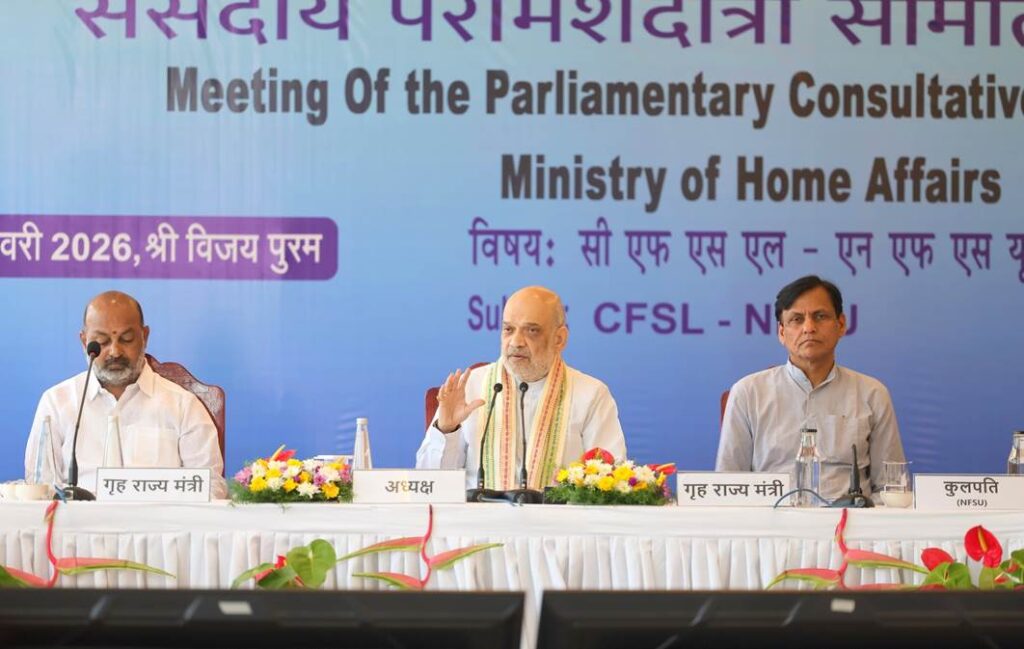
NEW DELHI, JANUARY 03, 2026: Union Home Minister and Minister of Cooperation Amit Shah, chaired a meeting of the Parliamentary Consultative Committee of the Ministry of Home Affairs at Sri Vijaya Puram in Andaman and Nicobar Islands. The subject of the meeting was Central Forensic Science Laboratory (CFSL) and the National Forensic Sciences University (NFSU). The Union Ministers of State for Home Affairs, Nityanand Rai, Bandi Sanjay Kumar, members of the Parliamentary Consultative Committee, Union Home Secretary, Vice Chancellor of NFSU, Director General of the Bureau of Police Research and Development (BPR&D), and other senior officials were present in the meeting.
Addressing the meeting, the Union Home Minister said that the Ministry of Home Affairs has held 12 meetings of the Parliamentary Consultative Committee from 2019 until now, which have yielded good results. He said that it is Prime Minister Shri Narendra Modi’s vision that after the new criminal laws are fully implemented, justice should be delivered on time. Shri Shah said that we will create such a system by 2029 in which the entire judicial process—from FIR to the Supreme Court—can be completed within three years. He mentioned that the reforms undertaken since 2022 have been efforts in this very direction. The Home Minister said that to turn the vision of completing the entire process from FIR to Supreme Court justice within three years into reality, the Ministry of Home Affairs is doing 360-degree monitoring of these efforts and is working to address any shortcomings.
Union Home Minister Amit Shah said that the Government of India has been focusing and working on forensics since 2020 itself to enhance and expand forensic capabilities for the process of delivering justice. He said that the new criminal laws came into effect from July 2024, but we had already begun the work of implementing them from the perspective of forensics starting in 2020, and positive results are now being seen.
Mr Amit Shah said that after the introduction of the New Criminal Laws, there has been an increase in the speed of investigations and the conviction rate. He said that in West Bengal, the accused in the rape of a minor girl was sentenced to death in just 62 days. In a triple murder case in Siwan district of Bihar, two accused were sentenced in only 50 days. Shri Shah said that these cases prove that we are getting positive results, but there is a need to further strengthen the system.
He said that earlier we faced five challenges, which included a major technology gap in forensic investigations, the limited quality of evidence due to Chain of Custody issues, instances where police did not submit forensic investigation reports to the courts, a shortage of skilled professionals and forensic laboratories, and the lack of nationwide standards. He said that in accordance with the provisions of the new laws, forensic laboratories will now send their reports directly to the court and provide a copy to the police. Shri Shah said that the Government of India and state governments are going to invest 30 thousand crore rupees over the next five years to build a network of forensic laboratories across the country. Along with this, a scientific mechanism has been established to address the lack of nationwide standards. He mentioned that by sharing best practices and shortcomings, a nationwide standard will be determined.