
Salt Satyagraha and the Rise of Mass Civil Disobedience in India
The Salt Satyagraha, popularly known as the Dandi March, was one of the most significant movements in India’s freedom struggle. It was launched on March 12, 1930, under the leadership of Mahatma Gandhi to protest against the unjust salt tax imposed by the British government. Based on the principle of nonviolent resistance, the movement marked a new phase in the national movement and awakened a strong spirit of freedom among the Indian people.
Background of the Salt Law
During British rule, strict regulations were imposed on the production and sale of salt in India. Indians were not allowed to produce salt independently, and the government maintained a monopoly over its manufacture and distribution. As a result, people were forced to purchase salt from government sources and pay heavy taxes on it.
Salt was an essential commodity used by everyone, regardless of economic status. Gandhi believed that taxing such a basic necessity was unjust and exploitative. Therefore, he decided to challenge the salt law through a peaceful protest.
In 1930, the Indian National Congress decided to launch the Civil Disobedience Movement against colonial rule. As a symbolic beginning of this movement, Gandhi resolved to break the salt law. This decision eventually led to the historic Dandi March.
Beginning of the Dandi March
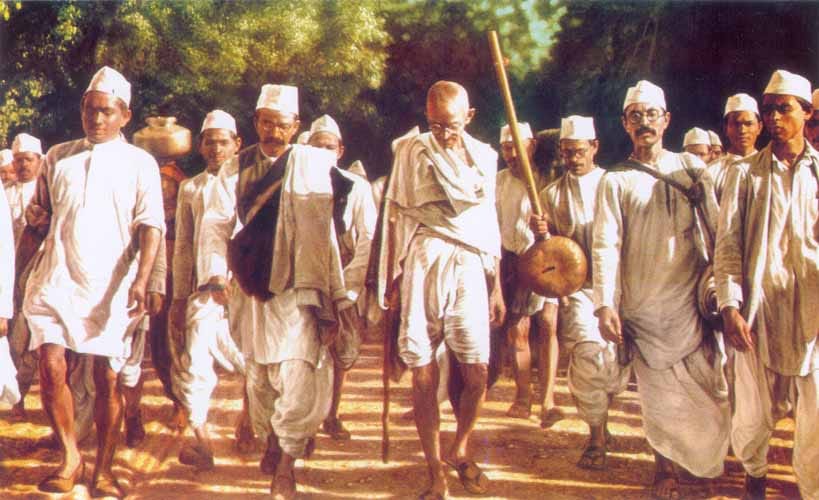
On March 12, 1930, Gandhi began the march from Sabarmati Ashram in Gujarat along with seventy-eight volunteers. These participants included members of the ashram and individuals from different sections of society.
The march was carefully organized and disciplined. Gandhi and his companions walked nearly ten to fifteen miles every day, passing through many villages. During the journey, Gandhi addressed gatherings and explained the importance of the freedom struggle, urging people to oppose British rule through nonviolent means.
As the march progressed, thousands of people joined Gandhi. Villagers welcomed him warmly and offered their support. Gradually, the march transformed from a small protest into a powerful mass movement that attracted attention across the country.
Breaking the Salt Law at Dandi
After walking nearly 390 kilometers for twenty-four days, Gandhi reached the coastal village of Dandi on April 5, 1930. The next morning, on April 6, he went to the seashore and symbolically produced salt from seawater.
This simple act was a direct violation of the British salt law and a powerful challenge to colonial authority. Gandhi’s action inspired people across the country to defy the unjust law by producing salt themselves.
Spread of the Movement
Following the Dandi March, the Salt Satyagraha spread rapidly across India. People in different regions began organizing protests and acts of civil disobedience. Women also played an active role in the movement.
The British government attempted to suppress the movement by arresting thousands of freedom fighters. Eventually, Gandhi himself was arrested in May 1930. However, the movement continued to grow, reflecting the strong determination of the Indian people to achieve freedom.
International Attention
The Salt Satyagraha attracted worldwide attention. Newspapers and journalists across the world reported the events of the Dandi March extensively. Gandhi’s philosophy of nonviolent resistance gained global recognition.
Significance of the Dandi March
The Dandi March marked a turning point in India’s freedom struggle. It transformed the independence movement from a limited political campaign into a mass movement involving ordinary citizens.
The movement conveyed several important messages. It proved that even a powerful colonial government could be challenged through nonviolent resistance. It also highlighted that unity and participation of the people were the greatest strengths of a national movement.
Conclusion
The Salt Satyagraha remains a landmark event in the history of India’s struggle for independence. What began as a protest against the salt tax soon developed into a nationwide movement that inspired millions of people.
Through the Dandi March, Gandhi challenged British authority while firmly adhering to the principles of truth and nonviolence. The movement demonstrated that collective courage, unity, and moral strength could become powerful tools in the fight against injustice.

Authored article by Kanaparthy Sudhakar,
Assistant Professor of History
SRR Government Arts & Science College (A), Karimnagar