Vande Mataram energised our freedom movement: PM
It is a matter of pride for all of us that we are witnessing 150 years of Vande Mataram
Vande Mataram is the force that drives us to achieve the dreams our freedom fighters envisioned
Vande Mataram rekindled an idea deeply rooted in India for thousands of years: PM
Vande Mataram also contained the cultural energy of thousands of years; it also had the fervor for freedom and the vision of an independent India: PM
The deep connection of Vande Mataram with the people reflects the journey of our freedom movement: PM
Vande Mataram gave strength and direction to our freedom movement: PM
Vande Mataram was the all-encompassing mantra that inspired freedom, sacrifice, strength, purity, dedication, and resilience: PM
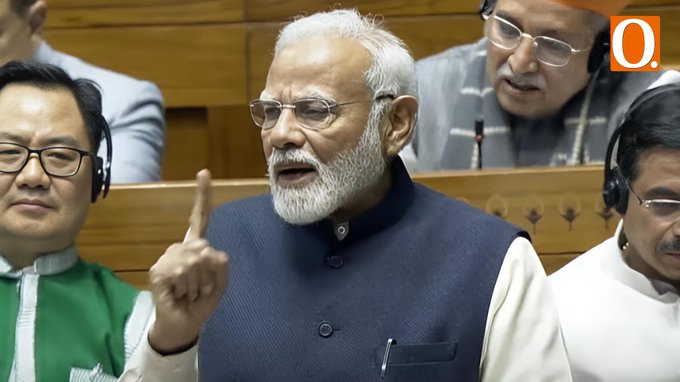
NEW DELHI, DECEMBER 8, 2025: Prime Minister Narendra Modi addressed a special discussion on the 150th anniversary of the National Song, “Vande Mataram,” in the Lok Sabha today. The Prime Minister expressed heartfelt gratitude to all the esteemed Members of the House for choosing the path of collective discussion on this significant occasion. He remarked that Vande Mataram, the mantra and the clarion call which energised and inspired the freedom movement of the nation, showing the path of sacrifice and penance, is being remembered, and it is a great privilege for all in the House. Shri Modi highlighted that it is a matter of pride that the nation is witnessing the historic occasion of 150 years of Vande Mataram. He stated that this period brings before us countless events of history. The Prime Minister emphasised that this discussion will not only reflect the commitment of the House but can also serve as a source of education for future generations, if all collectively make good use of it.
Mr Modi remarked that this is a period when many inspiring chapters of history are once again being revealed before us. He highlighted that the nation has recently celebrated 75 years of the Constitution with pride. He noted that the country is also commemorating the 150th birth anniversaries of Sardar Vallabhbhai Patel and Bhagwan Birsa Munda. He added that recently the nation observed the 350th martyrdom day of Guru Tegh Bahadur Ji.
The Prime Minister stated that today, on the occasion of 150 years of Vande Mataram, the House is making an effort to experience its collective energy. He emphasised that the 150-year journey of Vande Mataram has passed through many milestones. Recalling that when Vande Mataram completed 50 years, the nation was compelled to live under colonial rule, Shri Modi said that when it reached 100 years, the country was shackled by the chains of Emergency. He pointed out that at the time of the centenary celebrations of Vande Mataram, the Constitution of India was throttled. He further remarked that when Vande Mataram marked 100 years, those who lived and died for patriotism were imprisoned behind bars. The Prime Minister underscored that the song, which had given energy to the nation’s freedom, when it completed 100 years, unfortunately coincided with a dark chapter in our history, when democracy itself was under severe strain.
“The 150 years of Vande Mataram present an opportunity to re-establish that great chapter and glory, and neither the House nor the nation should let this occasion pass”, stressed Shri Modi. He highlighted that it was Vande Mataram which led the country to independence in 1947, and the emotional leadership of the freedom struggle was embodied in its clarion call.
Prime Minister stated that as he stood to initiate the discussion on Vande Mataram at 150 years, there was no division of ruling or opposition, as for all present it was truly an occasion to acknowledge the debt owed to Vande Mataram, which inspired goal-oriented leaders to carry forward the freedom movement, resulting in the independence that allows all to sit in the House today. He emphasized that for all Members of Parliament and representatives, this is a sacred occasion to accept that debt. Shri Modi underscored that from this inspiration, the spirit of Vande Mataram which fought the battle for freedom, uniting the entire nation—North, South, East, and West—in one voice, must once again guide us. He called upon all to move forward together, to fulfil the dreams envisioned by the freedom fighters, making Vande Mataram at 150 the source of inspiration and energy for all. He stressed that this is an opportunity to reaffirm the resolve to build a self-reliant nation and achieve the vision of a developed India by 2047.
Shri Modi stated that the journey of Vande Mataram began with Bankim Chandra Ji in 1875. He highlighted that the song was composed at a time when, after the 1857 freedom struggle, the British Empire was unsettled and imposed various pressures and injustices upon India, forcing its people into submission. The Prime Minister remarked that during that period, the national anthem of the British, ‘God Save The Queen’, was being conspired to spread into every household in India. He emphasised that it was then that Bankim Da issued a challenge, responding with greater force, and from that defiance Vande Mataram was born. He noted that a few years later, in 1882, when Bankim Chandra wrote ‘Anand Math’, the song was incorporated into the work.
Emphasising that Vande Mataram revived the thought that had been deeply ingrained in the veins of India for thousands of years, the PM highlighted that the same sentiment, the same values, the same culture, and the same tradition were gifted to the nation in the finest words and noble spirit through Vande Mataram. He emphasised that Vande Mataram was not merely a mantra for political freedom or simply about driving away the British and charting our own path; it went far beyond that. The Prime Minister stated that the freedom struggle was also a sacred battle to liberate the motherland, to free Mother India from shackles. He noted that when we look at the background of Vande Mataram and its stream of values, we see a recurring truth from the Vedic era. He underscored that when we say Vande Mataram, it reminds us of the Vedic declaration meaning that this land is my mother and I am her son.
The Prime Minister remarked that this very thought was echoed by Lord Shri Ram when he renounced the grandeur of Lanka, declaring “Janani Janmabhoomishcha Swargadapi Gariyasi”. He highlighted that Vande Mataram is the modern embodiment of this great cultural tradition.
Prime Minister stated that when Bankim Da composed Vande Mataram, it naturally became the voice of the freedom movement. He emphasized that from East to West, North to South, Vande Mataram became the resolve of every Indian.
Recalling that a few days earlier, at the commencement of Vande Mataram at 150, Shri Modi had stated that Vande Mataram embodied thousands of years of cultural energy, carried the spirit of freedom, and also held the vision of an independent India. He remarked that during the British era, a fashion had emerged to portray India as weak, incompetent, lazy, and idle, and even those educated under colonial influence echoed the same language. The Prime Minister highlighted that Bankim Da shook off this inferiority complex and revealed India’s powerful form through Vande Mataram. He underscored that Bankim Da composed lines which emphasised that Mother India is both the goddess of knowledge and prosperity, and also the fierce Chandika who wields weapons against enemies.
Underscoring that these words, sentiments, and inspirations gave courage to Indians in the despair of slavery, Shri Modi highlighted that these lines made millions of countrymen realize that the struggle was not for a piece of land, nor merely to capture the throne of power, but to break the chains of colonialism and to revive the great traditions, the glorious culture, and the proud history of thousands of years.
Prime Minister stated that the deep connect of Vande Mataram with the masses expressed itself as a long saga of our freedom struggle. He further remarked that whenever a river is mentioned—be it Sindhu, Saraswati, Kaveri, Godavari, Ganga, or Yamuna—it carries with it a stream of culture, a flow of development, and the impact of human life. He emphasized that similarly, every stage of the freedom struggle flowed with the spirit of Vande Mataram, and its shores nurtured that sentiment. The Prime Minister underscored that such poetic expression, where the entire journey of independence was intertwined with the emotions of Vande Mataram, may perhaps never be found anywhere else in the world.
Shri Modi remarked that the British had realized after 1857 that it would be difficult for them to remain in India for long, and with the dreams they had brought, they felt that unless India was divided, unless its people were made to fight among themselves, ruling here would be impossible. He highlighted that the British chose the path of divide and rule and made Bengal its laboratory, as they knew that Bengal’s intellectual strength at that time gave direction, power, and inspiration to the nation, becoming a focal point of India’s collective strength. The Prime Minister stated that this was why the British first worked towards breaking Bengal, believing that once Bengal was divided, the country too would collapse, and they could continue their rule. He recalled that in 1905, when the British committed the sin of partitioning Bengal, Vande Mataram stood firm like a rock. He emphasized that for the unity of Bengal, Vande Mataram became the resonant call in every street, inspiring the people. The Prime Minister underscored that with the partition of Bengal, the British sought to sow deeper seeds of weakening India, but Vande Mataram, as a single voice and unifying thread, became a challenge for the British and a rock of strength for the nation.
The Prime Minister remarked that although the partition of Bengal took place, it gave rise to a massive Swadeshi movement, and at that time Vande Mataram resonated everywhere. He highlighted that the British realized the power of the sentiment created by Bankim Chandra Chatterjee, whose song shook their foundations so much that they were compelled to impose legal bans on it. The Prime Minister stated that singing it was punished, printing it was punished, and even uttering the words Vande Mataram invited punishment under harsh laws. He emphasized that hundreds of women led and contributed to the freedom struggle, citing the example of Barisal, where the greatest atrocities were committed for singing Vande Mataram. He recalled that mothers, sisters, and children came forward in Barisal to defend the dignity of Vande Mataram. Shri Modi mentioned the courageous Sarojini Ghosh, who declared that until the ban on Vande Mataram was lifted, she would remove her bangles and not wear them again, a vow of immense significance in those times. He noted that children too were not left behind, as they were flogged, imprisoned at tender ages, yet continued to march in morning processions chanting Vande Mataram, defying the British. He highlighted that in Bengal’s streets, a Bengali song echoed meaning that, “Dear Mother, serving you and chanting Vande Mataram, even if life is lost, that life is blessed,” which became the voice of children and gave courage to the nation.
Shri Modi further recalled that in 1905, in Haritpur village, very young children chanting Vande Mataram were brutally flogged, forced into a struggle between life and death. Similarly, in 1906, children of Neel City High School in Nagpur faced atrocities for the same “crime” of chanting Vande Mataram in unison, proving the power of the mantra through their strength. The Prime Minister underscored that brave sons of India climbed the gallows without fear, with their last breath chanting Vande Mataram—Khudiram Bose, Madanlal Dhingra, Ram Prasad Bismil, Ashfaqulla Khan, Roshan Singh, Rajendranath Lahiri, Ramkrishna Biswas, and countless others who embraced the noose with Vande Mataram on their lips. He emphasized that though these sacrifices took place in different prisons, different regions, with different faces and languages, the mantra was one—Vande Mataram, symbolizing one India, a great India. The Prime Minister recalled the Chittagong uprising, where young revolutionaries challenged the British, with names like Hargopal Bal, Pulin Bikash Ghosh, and Tripur Sen shining in history. He noted that when Master Surya Sen was hanged in 1934, he wrote a letter to his comrades, and in it echoed only one word—Vande Mataram.