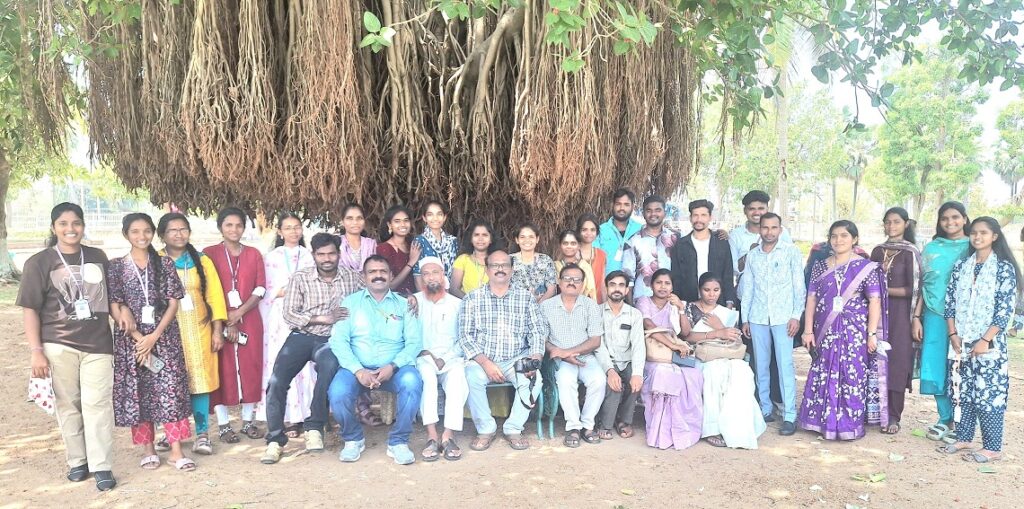
KARIMNAGAR, APRIL 11, 2026: As part of the Botany department’s academic programme, the MSc students of SRR Government Arts and Science College in Karimnagar town visited a field to explore the diversity of plants and understand their ecological and medicinal importance in Mulugu district. The visit helped bridge classroom learning with real-world observation.
The Botanical tour was organised under the guidance of Head of the Department Prof. T. Tirukovela Srinivas, with the permission of the College Principal Prof. K. Ramakrishna. The tour was conducted for MSc First Year and Second Year students as part of their field-based learning experience.
During this field visit, students explored various ecologically significant locations in the Mulugu district. The tour included visits to Palampet Lake and Pakala Lake, where students collected algal samples. They also visited the Ramappa Temple and studied the diverse plant species growing in and around the temple premises.
The team later visited Tadvai Wildlife Sanctuary, where students studied a wide variety of plant biodiversity. As part of environmental conservation activities, students collected seeds from wild plant species and prepared seed balls. Approximately 2000 seeds were collected during this activity, which will be used for dispersal in different areas during the rainy season.
Further, the students visited Laknavaram Lake, where they collected water samples to study both microscopic and macroscopic algae. These samples will be analysed in the college laboratory using microscopes to identify and classify different algal groups, as explained by the Head of the Department.
Faculty members Routu Radhakrishna and Mohammed Tahir Hussain provided detailed explanations about the deciduous forests, shrubs, and plant diversity surrounding the lake. Students also walked across the Laknavaram Cable Bridge and observed the natural surroundings, followed by a boating experience.
On the return journey, the team visited Hanumakonda and Warangal, exploring important spiritual and historical sites. At the Thousand Pillar Temple and Bhadrakali Temple, students studied plant diversity in temple ecosystems. They also observed aquatic plants such as lotus, floating vegetation, and other hydrophytes in Bhadrakali Lake.
In the evening, students visited Warangal Fort, once ruled by Rani Rudramadevi, where they observed both historical monuments and natural surroundings. A laser show highlighted ancient agricultural practices, irrigation systems like chain tanks, and crop cultivation methods followed during her reign. Students also experienced floating bricks and gained practical insight into historical construction techniques.
Throughout the tour, students actively participated with enthusiasm, singing and engaging in group activities, overcoming the summer heat under the guidance of faculty members. On their return journey, students shared their experiences and expressed gratitude to the Principal Prof. K. Ramakrishna and Head of the Department Prof. T. Tirukovela Srinivas for organising such a valuable field experience. They also requested more such educational tours in the future.
The programme was attended by faculty members Padala Tirupati, Kandukuri Kalajyothi, Bunga Tirupati, Mohammed Tajuddin, and Asampalli Swarupa Rani, along with MSc students.