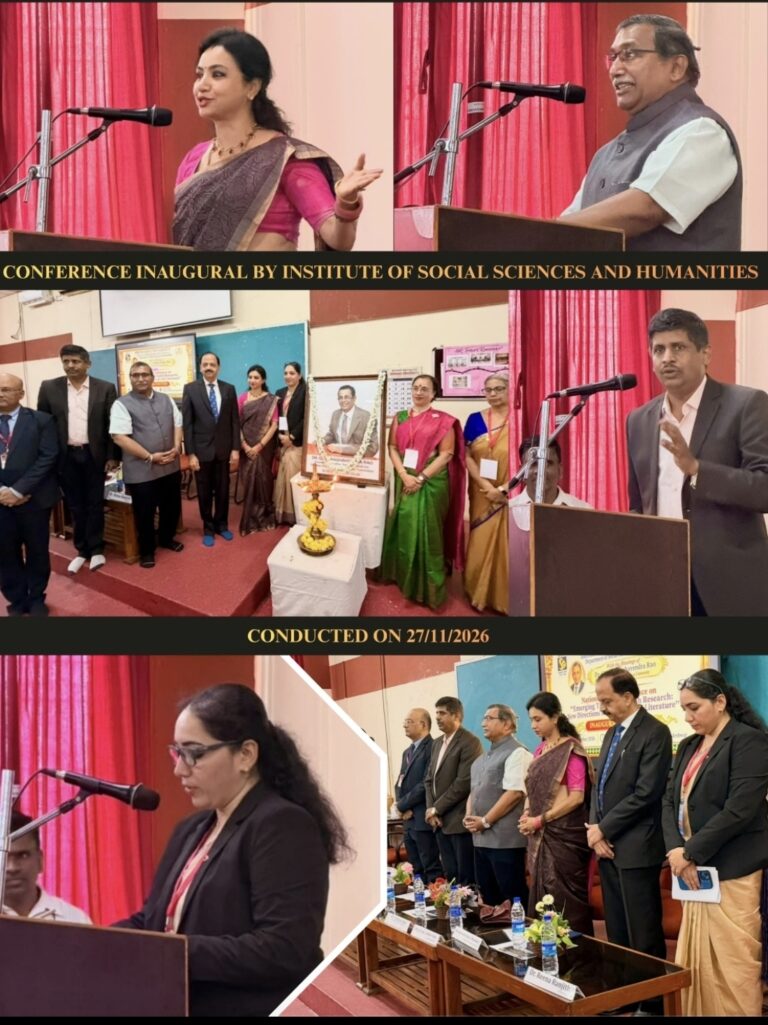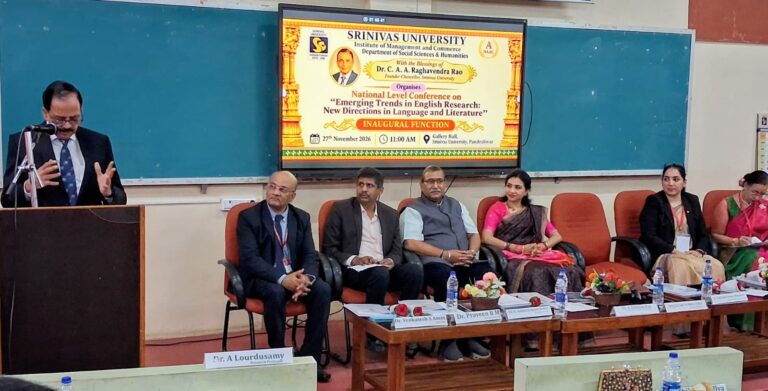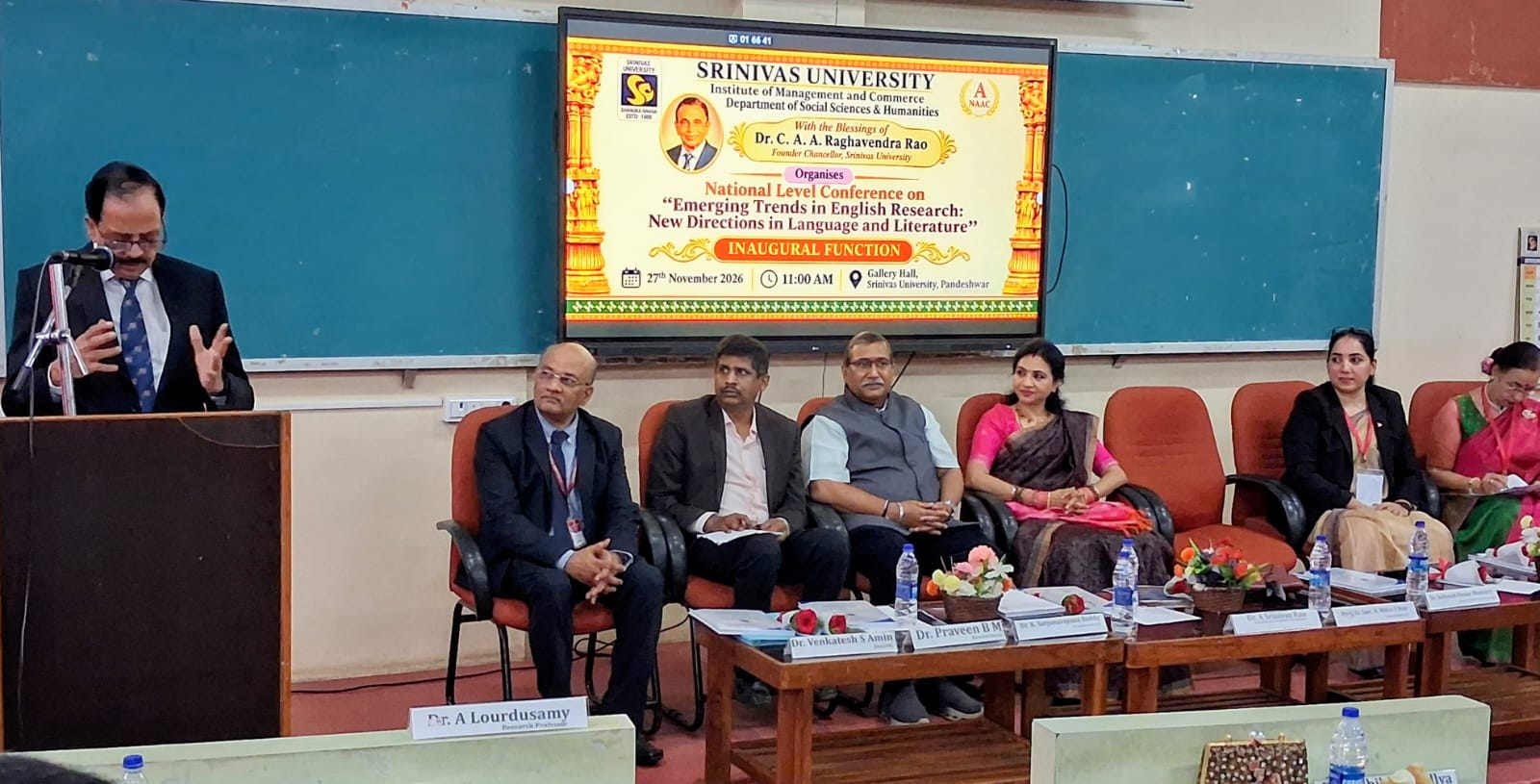
MANGALURU, NOVEMBER 27, 2026: English studies are no longer confined to language and literature alone, speakers observed at the inaugural session of a one-day national-level Conference on “Emerging Trends in English Research: New Directions in Language and Literature” organised by the Dept. of Social Sciences and Humanities of the Institute of Management and Commerce of Srinivas University, held here on Friday.
Addressing researchers, teachers and students from various institutions, chief guest former Vice Chancellor of NITTE University Dr Sateesh Kumar Bhandary congratulated the organisers for bringing together scholars to examine the changing landscape of English studies in the digital age. He said Artificial Intelligence, digital technology, social media, multilingualism, environmental concerns and global cultures are opening new avenues of research. Young researchers, he said, should look beyond traditional approaches, raise new questions and explore interdisciplinary possibilities, while keeping human values at the centre of education and scholarship.
Outlining ten key themes of the conference, he said AI and smart technologies are transforming English Language Teaching through personalised learning and automated feedback. However, he asserted, “AI should support the teacher, not replace the teacher.” The important question, he added, is not only how to use AI, but how to use it responsibly and creatively. On Digital Humanities and open-access research, he said digital archives and tools enable analysis of large data and new kinds of inquiry. Knowledge, he stressed, must remain accessible so that research benefits society at large. Referring to Ecocriticism and Environmental Humanities, he said literature can deepen understanding of humanity’s relationship with nature and promote environmental awareness.
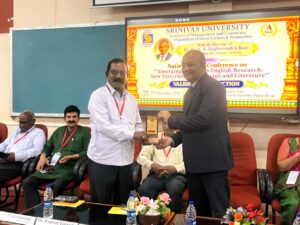
On World Englishes and Multilingual Education, he said English belongs to a global community and, in multilingual India, different languages are not obstacles but intellectual and cultural strengths. Speaking on academic writing and ethics in the AI era, he cautioned against plagiarism and issues of originality and authorship. “Technology can assist your research, but you are responsible for your research,” he said. He further noted that literature, peace studies and global citizenship promote empathy, tolerance and dialogue, and can become a powerful instrument of peace in a divided world. Media literacy, he said, helps distinguish facts from misinformation and communication from manipulation.
Innovations in methodology, language policy, lifelong learning, translation studies and cultural memory were also highlighted as emerging areas. Translation, he said, connects languages, cultures and histories, and can help regional literature reach wider audiences. Concluding, he advised young researchers that research begins with a good question. He urged them to question established ideas, think critically, verify information and maintain academic integrity. The real value of research, he said, lies not in increasing publications, but in creating knowledge, influencing thinking and making a positive difference to society. Speaking on the occasion, Director (Research) Dr Praveen BM said Srinivas University has always believed that education must move beyond classrooms and textbooks and must encourage inquiry, creativity, ethical scholarship and meaningful engagement with society. Stating that the university has more than 1000 research scholars thereby providing opportunity to those who aspire to do research, he said that the university has 300 patents and 600 copyrights. Vice Chancellor of Srinivas University Prof K Satyanarayana Reddy, Convenor of the Conference Dr Reena Ranjith also spoke on the occasion.
About the Author