Protecting ambition, restoring dignity and finding a way back from addiction
“Your youth is the foundation of your future. Do not surrender it to a pleasure that asks for everything in return.”
AUTHORED ARTICLE

KARIMNAGAR, NOVEMBER 16, 1015: This article, shared from the erstwhile Karimnagar district, raises an unsettling concern: intoxicating substances allegedly reaching young people through discreet supply networks and seemingly familiar products. These local allegations require official verification. But the question they raise cannot wait: what happens when the years meant for learning, friendship and discovery become organised around the next dose?
Behind every discussion of drug seizures lies a human possibility at risk — a student’s education, a young worker’s livelihood, a family’s peace. The most serious damage may begin well before a police case or hospital admission. It begins when a young person’s world starts becoming smaller.
When Tomorrow Loses Its Importance
Experimentation may begin with curiosity, peer pressure or the desire to escape distress. “Only once” can become “only on weekends”, and eventually, for some, an increasingly difficult habit to control. Not everyone who experiments develops dependence. Nevertheless, confidence in one’s ability to stop is no guarantee of safety.
Cannabis can affect attention, memory, learning and decision-making. These are precisely the abilities young people need to build their future. Difficulties in the classroom can therefore extend beyond an examination result into confidence, participation and educational opportunity. [1]
Consider how an ordinary day can unravel: a missed class, an unfinished assignment, a borrowed sum that cannot be repaid, a promise postponed. Repeated often enough, these setbacks can become a pattern. While friends prepare for interviews or learn a trade, the person struggling with dependence may spend increasing time obtaining, using or recovering from a substance.
Youth is not lost merely through the passage of years. It is also lost through opportunities repeatedly surrendered.
When the Home Carries the Burden
Dependence can change what receives priority. Money intended for transport, books or household needs may be diverted. Concealment can produce lies; discovered lies can produce arguments; arguments can make honest conversation harder.
A parent may begin waiting anxiously for a late return. A sibling may stop lending money. A partner may become exhausted by repeated assurances that tomorrow will be different. These are possible consequences, not an inevitable description of every person who uses drugs. Yet they explain why addiction can distress an entire household.
When substance use begins to outweigh family responsibilities, relationships risk becoming transactional: who will provide money, cover an absence or forgive another broken promise? Affection may remain, but trust becomes fragile.
Protecting Judgment and Personal Boundaries
The concern about losing vichakshana — the ability to judge wisely — deserves careful attention. Addiction can affect brain functions involved in judgment, decision-making and behavioural control. A person may continue using despite recognising the harm. [2]
Intoxication and impaired judgment can contribute to reckless decisions and disregard for other people’s boundaries. However, it would be inaccurate to suggest that everyone who uses drugs loses respect for family relationships or becomes sexually abusive or violent.
The principle must remain clear: consent, dignity and personal safety are non-negotiable. Intoxication does not excuse harassment, coercion or abuse. Families must protect those at risk while helping the affected person obtain appropriate care.
Understanding Psychological Distress
Calling distressed young people “psychos” obscures what may be happening. Cannabis can cause anxiety, disorientation and paranoia. Its use is associated with psychosis, with stronger associations among those who begin younger and use more frequently. Psychosis can involve hallucinations or difficulty distinguishing reality from false beliefs; it does not occur in every person who uses cannabis. [3]
Someone experiencing these symptoms needs prompt professional assessment. Ridicule, public humiliation or threats are poor substitutes for medical attention. Equally, mental illness should never be treated as proof that someone is violent or morally corrupt.
An effective warning must be truthful enough to earn young people’s trust.
Friendship and the Fragility of Trust
Repeated deception, unpaid borrowing or unsafe conduct can make friends step back. A teammate may hesitate to rely on someone who repeatedly fails to arrive. An employer may lose confidence after persistent absences. Invitations may diminish, leaving the affected person increasingly isolated.
But damaged trust must not be confused with diminished human worth.
Friends are entitled to protect themselves. They need not finance substance use or conceal harmful conduct. Yet friendship can still mean saying: “I will help you seek treatment, but I will not help you continue hurting yourself or others.”
Communities, too, must resist turning a person’s worst period into a permanent identity. If every attempt to return is met with suspicion, recovery becomes harder. Accountability should create a path towards restored trust.
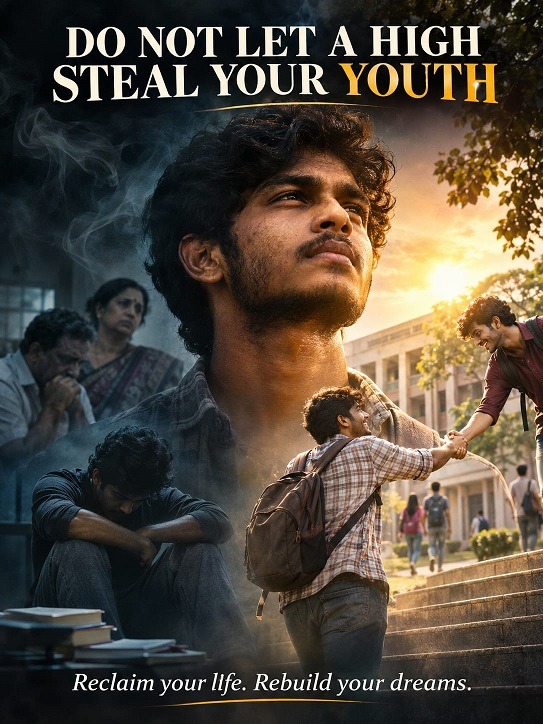
Reclaim Your Life and Rebuild Your Dreams
Substance use disorders are treatable. Recovery may require counselling, medical care, family support and sustained follow-up, with treatment adapted to the substance and the individual. Willpower alone is not an adequate treatment plan. [4]
For a young person already struggling, the first useful step is an honest conversation with a trusted adult or qualified health professional. Returning to education, work, exercise and supportive friendships can help rebuild daily life alongside treatment. Progress may be gradual. A setback calls for renewed assessment and support, not a verdict that recovery is impossible.
Schools need accessible counselling. Families need practical guidance. Authorities must investigate supply networks and protect young people from exploitation. Public campaigns should measure success through lives restored as well as substances seized.
To the young reader, the message is direct: you do not have to prove courage by accepting a substance, or loyalty by joining a harmful habit. Refusing pressure is a decision about the life you want to build.
Protect your youth. And if drugs have already taken part of it, seek help today — your remaining years still deserve your dreams.
Sources
[1] CDC — Cannabis and Teens
https://www.cdc.gov/cannabis/health-effects/cannabis-and-teens.html
[2] NIDA — Drugs Brains and Behavior
https://irp.nida.nih.gov/wp-content/uploads/2019/12/NIDA_DrugsBrainsAddiction_2018.pdf
[3] CDC — Cannabis and Mental Health
https://www.cdc.gov/cannabis/health-effects/mental-health.html
[4] CDC — Treatment of Substance Use Disorders
https://www.cdc.gov/overdose-prevention/treatment/index.html
About the Author