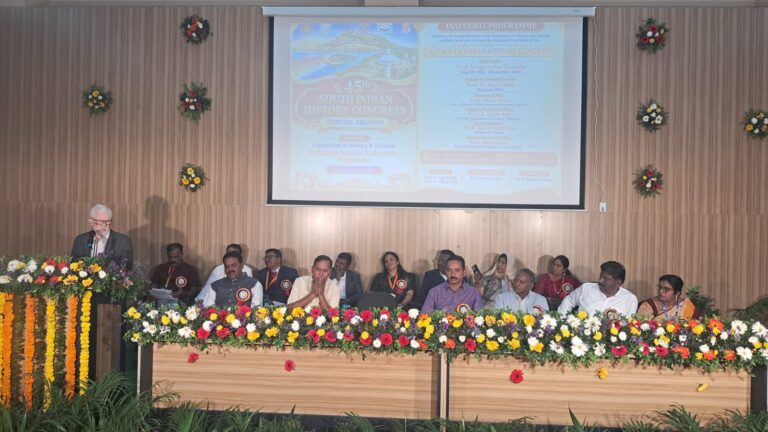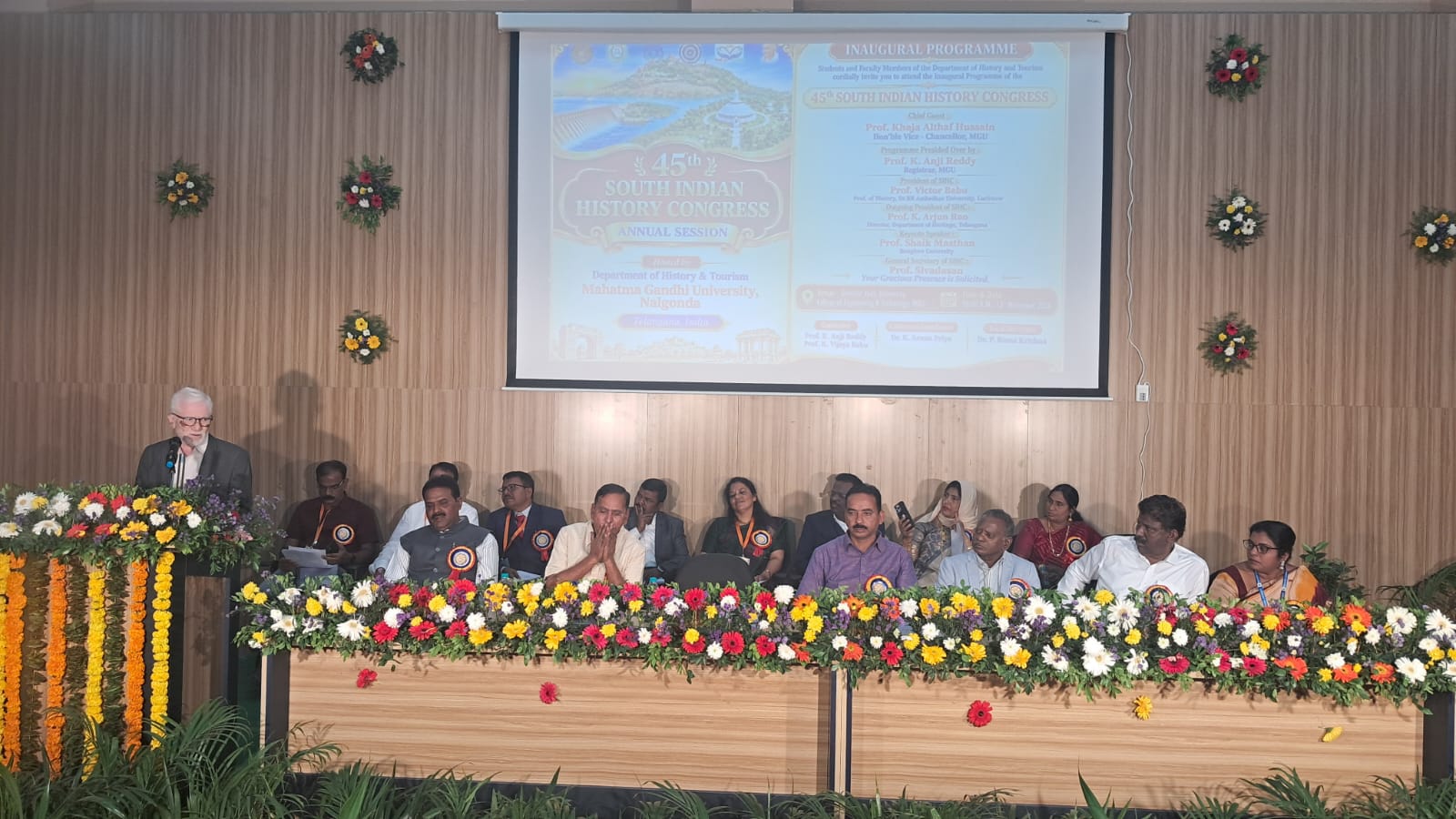
45th annual session of the South Indian History Congress hosted by Mahatma Gandhi University in Nalgonda
NALGONDA, NOVEMBER 13, 2026: “Historical research must be rigorous, evidence-based, inclusive, and humane. It should give voice to forgotten communities, preserve regional memories, and connect local experiences with national and global histories,” said Vice Chancellor of Mahatma Gandhi University (MGU) Prof Khaja Althaf Hussain.
Participating as the chief guest in the inaugural of the 45th annual session of the South Indian History Congress (SIHC) hosted by the Department of History and Tourism of Mahatma Gandhi University at the Seminar Hall of the University College of Engineering and Technology on the varsity campus on Friday, the Vice Chancellor remarked, “Study of history is not an escape from the present. It helps us understand how our present has been shaped. It teaches us to question assumptions, appreciate evidence, respect diversity, and learn from both the achievements and mistakes of earlier generations.”
Stating that the Congress is especially significant because it brings attention to the historical, cultural, social, economic and political heritage of South India, VC Prof Khaja Althaf Hussaian said that it would offer an opportunity to highlight the rich local history of Nalgonda and Telangana, its ancient sites, traditions, movements and contributions to the larger Indian society. “Hosting the session here will encourage greater interest in historical research among our students and teachers, while also promoting cultural awareness and heritage tourism in the region. The Inaugural was presided over by the Convenor of the 45th Annual Session of the SIHC and MGU Registrar, Prof K Anji Reddy.
Prof Victor Babu of Babasaheb Bhimrao Ambedkar University,Lucknow, who assumed charge as President of the South Indian History Congress, delivered the presidential address on conceptions of God and religious traditions in North and South India. He called for an understanding of India’s cultural interconnectedness that also recognises regional differences. Village deities, local beliefs and tribal traditions, he argued, must be studied alongside institutional religious traditions to understand how communities negotiated identity, authority and social change. He also stressed the need to critically examine colonial interpretations of Indian religious life.
Delivering the keynote address, Prof S K Masthan Vali of Bangalore University urged historians to recover the experiences of communities often relegated to the margins of dynastic narratives. Farmers, artisans, agricultural labourers, women, Dalits and Adivasis were not peripheral to civilisation, but central to its making, he opined. Archaeology, inscriptions, oral histories, folklore and community archives, he said, could help reconstruct their contributions and struggles. Artificial intelligence and digital research tools should widen historical inquiry rather than reproduce the exclusions of older accounts. Director of Archaeology and Museums, Government of Telangana and Former Congress President, Prof K Arjun Rao, and Congress Secretary Prof Sadasivan also spoke on the occasion.
Post-lunch academic sessions brought together scholars and researchers presenting papers on political, social, economic and cultural history, historiography, maritime history and histories of marginalized communities. K Rajan delivered the Prof B C Roy Memorial Lecture, Parimala Khadanga the Kasturi Misra Memorial Lecture, and Prof Srinath the Subhashini Endowment Lecture. An executive committee meeting followed.
The day’s proceedings extended from scholarly debate to cultural expression at the university’s new amphitheatre, where students presented classical and folk performances, with Telangana folk traditions drawing an enthusiastic audience response.
Earlier, the Vice Chancellor inaugurated the Seminar Hall to facilitate the proceedings of the SIHC Inaugural Session. Coordinator and Principal of the University College of Arts and Social Sciences K Aruna Priya, South Indian history Congress General Secretary Prof Sivadasan, office bearers of the executive committee, sessions presidents, joint secretaries, Vice Chancellor’s better half Dr Shahnaz Begum, Convenor of the 45th Annual Session Prof K Vijay Babu, SIHC Local Secretary Dr Panasa Ramakrishna, former Director of the Dept of Archeology Prof P Chenna Reddy, Dean of the Faculty of Commerce and Business Management Prof Aluvala Ravi, IQAC Coordinator Dr Miryala Ramesh, Dr Domala Ramesh, Dean of the Academic Affairs Dr Prashanti, Director (Infrastructure) Prof Akula Ravi, Dr Shareef, and Vivek attended, along with Principals, Directors, university officials, teachers of History and research scholars across South India were present.
About the Author