Authored Article
District retrofit camps can help Telangana cut roadside pollution and give owners of eligible vehicles a practical route to electric conversion.
Public health must guide the transition
A State may collect less fuel tax when vehicles go electric. It can still make a sound public investment if people breathe cleaner air. The World Health Organization links exposure to air pollution with heart disease, stroke and respiratory illness. A fully electric conversion removes the vehicle’s tailpipe emissions during use. Road dust and other sources of pollution still require separate action. [11]
From the RTC depot to private vehicles
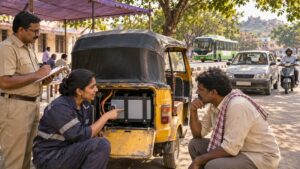
In October 2026, TGSRTC was reported to be considering 100 more electric conversions alongside a programme covering about 240 diesel buses. Telangana’s ₹200 crore scheme for Hyderabad’s Core Urban Region Economy area targets 18,766 petrol and diesel autos and offers eligible owners up to ₹1.5 lakh to retrofit or replace them. These figures describe programme scope. The State should publish completed conversions and actual disbursements, and give owners of eligible cars and scooters a practical route to apply. [1–2]
How other States approach electric retrofits
Delhi’s portal explains how to apply and use approved fitment centres. Yet in a March 2026 reply recorded by the Delhi Assembly, its Transport Department reported limited availability of approved products and said it was receiving no such applications at the time. Telangana should check kit availability and prices before inviting owners to a camp. [3]
Maharashtra’s road transport corporation bundled diesel-bus conversions, charging and maintenance in a 2026 tender. Tamil Nadu’s 2023 policy offered a different model, with retrofit incentives through December 2025 for eligible commercial two- and three-wheelers, capped at ₹15,000 and ₹20,000 respectively. Separate government revenue figures for electric retrofits could not be verified for these jurisdictions. [4]
What Telangana could collect
Telangana recorded 1.74 crore vehicles in March 2025. The number eligible for safe conversion and the likely demand remain uncertain. The table models three groups of completed conversions. In March 2026, the Centre told the Rajya Sabha that it had no proposal at the time to fund Telangana’s retrofit initiative. [5]
| Completed conversions | Pre-tax spend | RC alteration fees | Illustrative State GST share | Gross State receipts |
| 5,000 | ₹50 cr | ₹0.13 cr | ₹1.25–4.50 cr | ₹1.38–4.63 cr |
| 10,000 | ₹100 cr | ₹0.25 cr | ₹2.50–9.00 cr | ₹2.75–9.25 cr |
| 25,000 | ₹250 cr | ₹0.63 cr | ₹6.25–22.50 cr | ₹6.88–23.13 cr |
Illustrative scenarios for one cohort. Amounts in crore, rounded.
The model assumes a ₹1 lakh pre-tax bill per vehicle and a mix of 60% two-wheelers, 20% private light vehicles and 20% autos. Published alteration fees of ₹150, ₹300 and ₹500 yield an average of ₹250 if payable. The Central battery-vehicle waiver covers specified registration, renewal and new registration-mark fees. Telangana should confirm the alteration fee and applicable GST classification. The model tests GST at 5% and 18% and assumes half accrues to the State on an intra-State supply, before allowing for credits or settlements. [6–7]
The fuel VAT trade-off
The gross receipts are largely one-time. The Petroleum Planning and Analysis Cell lists Telangana VAT rates of 35.20% on petrol and 27% on diesel. If 10,000 converted vehicles each displace 300 litres a year at an assumed effective VAT of ₹25 a litre, annual fuel VAT falls by ₹7.50 crore. Against gross receipts of ₹2.75–9.25 crore, the illustrative balance after a full year is minus ₹4.75 crore to plus ₹1.75 crore, before camp costs, subsidies and other tax effects, including spending the conversions displace. The State should budget for this trade-off and assess exposure to roadside pollution separately. [8]
District camps can make the rules usable
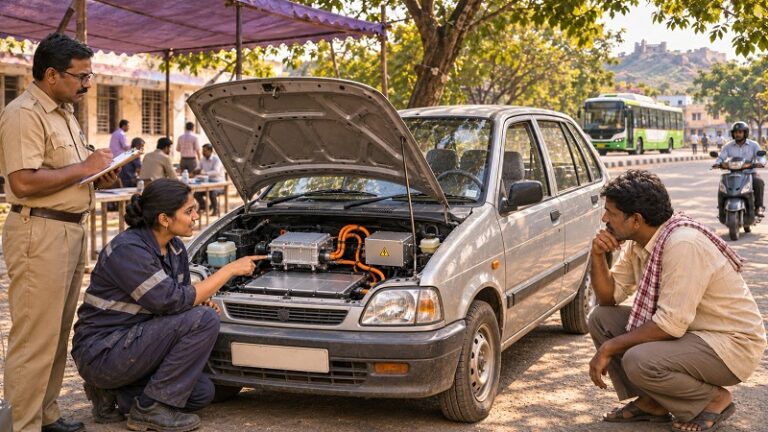
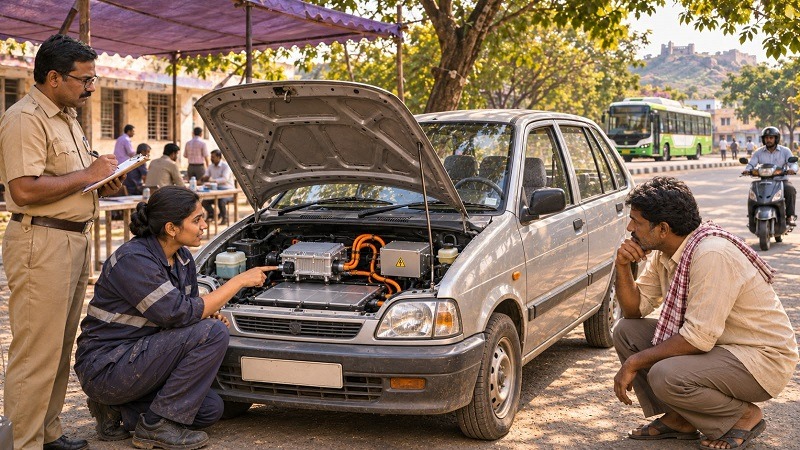
Start with a six-month pilot in Karimnagar, Warangal, Nizamabad, Khammam and Mahabubnagar. District transport offices should offer walk-in help in Telugu, check a vehicle’s condition and exact model against approved kits, and explain in writing why any application cannot proceed. Eligible owners should be helped to seek prior permission through Form 22C. Publish authorised fitters, itemised prices, battery warranties and service locations so families can compare offers before paying. [9]
Fitment belongs at authorised workshops using a type-approved kit for the model. The camp can book the post-fitment inspection and help owners submit Form 22D to update the registration certificate. Before vehicles return to service, owners should confirm insurance and any applicable fitness and permit requirements. Give applicants a dated receipt and a contact for delays. [9]
Publish the results before expanding
Prioritise high-mileage vehicles that have useful life remaining and access to charging, especially those serving busy streets and markets. Publish completion rates, waiting times, owner costs, safety complaints, camp expenditure and estimated fuel VAT losses. Where feasible, monitor roadside air quality along selected routes while accounting for weather and traffic changes. Use those results to decide whether to extend rotating camps to all 33 districts. [10]
Public health matters more than government revenue. Let us eliminate avoidable pollution and protect people’s health.
Sources
- TGSRTC fleet plans • 2. Telangana autorickshaw scheme
- Switch Delhi / Delhi Assembly report • 4. Maharashtra GeM tender record / Tamil Nadu EV Policy §6.3.2
- Telangana vehicle stock / Rajya Sabha answer 2175 • 6. Telangana registration fee table / Central battery-vehicle fee waiver
- CBIC on State GST • 8. PPAC State fuel VAT rates
- MoRTH Rule 115D amendment / Form 22C / Form 22D • 10. Telangana district directory
- WHO India on air pollution and health
About the Author