Karimnagar’s initiative on fish seed production and rearing should translate awareness into viable enterprises for Primary Agricultural Cooperative Societies.
KARIMNAGAR, NOVEMBER 03, 2026: The strength of a cooperative institution lies in its ability to respond to the changing economic needs of its members. For Primary Agricultural Cooperative Societies (PACS), expanding income-generating activities deserves serious consideration. Fish seed production and rearing offer an avenue worth exploring through technical guidance, careful financial planning and sustained institutional support.
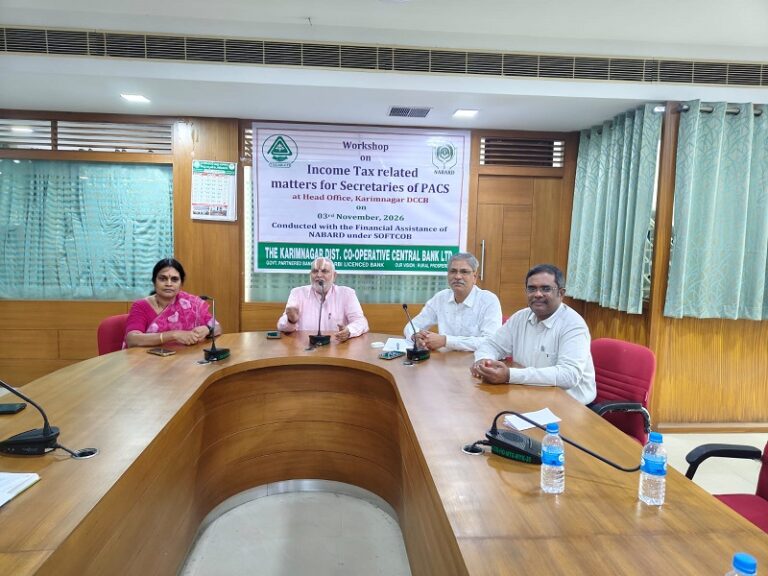
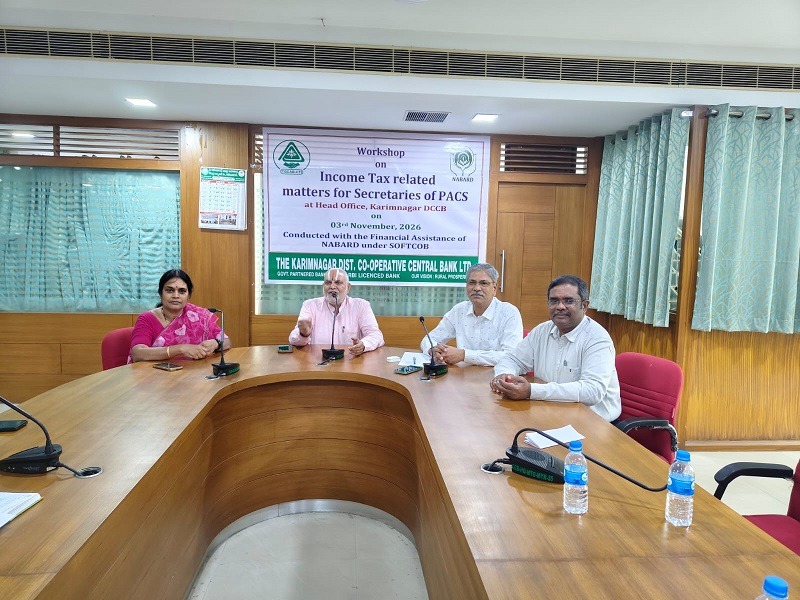
An awareness programme organised at the Karimnagar District Cooperative Central Bank on Tuesday (November 3, 2026) brought this opportunity into focus. The programme sought to familiarise PACS representatives with fish seed production and rearing, their operational requirements and their potential to generate additional income.

The meeting brought together District Fisheries Officer Smt. Vijaya Bharathi, District Cooperative Officer Shri Ramanuja Chary, NABARD District Development Manager Shri Jaya Prakash, Lead District Manager Shri Umashankar and Bank Chief Executive Officer Shri N. Satyanarayana Rao. The involvement of these institutions provided a useful platform for linking cooperative enterprise with technical expertise and financial planning.
Addressing the participants, Smt. Vijaya Bharathi explained the methods of fish seed production and rearing, the expenditure involved and the potential returns. She encouraged PACS to examine the activity as an additional business opportunity. Her assurance that the Fisheries Department and its staff would remain available to provide guidance and assistance was particularly significant. For societies entering an unfamiliar activity, continued technical support can be as important as access to finance.
The opportunity, however, must be approached with commercial discipline. Fish seed production and rearing involve distinct technical requirements, and each society should identify the activity suited to its resources and managerial capacity. An assessment of water availability, suitable facilities, operating costs, technical skills and local demand should precede any investment. Potential profitability should be established through a realistic feasibility study rather than assumed from general estimates.
PACS must also recognise that a sound business plan extends beyond production. Identifying prospective buyers, understanding their seasonal requirements and arranging timely supply are essential. Expenditure estimates should account for the full operating cycle, including inputs, labour, maintenance, transport and possible losses. Clear responsibilities and regular financial reporting would help societies monitor performance and take corrective action.
A practical next step would be to identify a small number of interested and suitably equipped PACS for pilot projects. These societies could prepare individual business plans with technical inputs from the Fisheries Department and financial appraisal through the appropriate institutions. Experience from the first production cycles could then guide expansion. Progress should be measured through actual costs, survival rates, sales and net income.
The Karimnagar initiative is therefore valuable for the direction it proposes. It encourages PACS to explore new sources of income while drawing on the support of specialised public institutions. Its lasting success will depend on converting an encouraging meeting into a structured programme of training, appraisal, implementation and review.
Cooperative diversification should ultimately strengthen both the society and the people it serves. With careful preparation and accountable management, fish seed production and rearing could become a useful addition to the rural cooperative economy.
About the Author