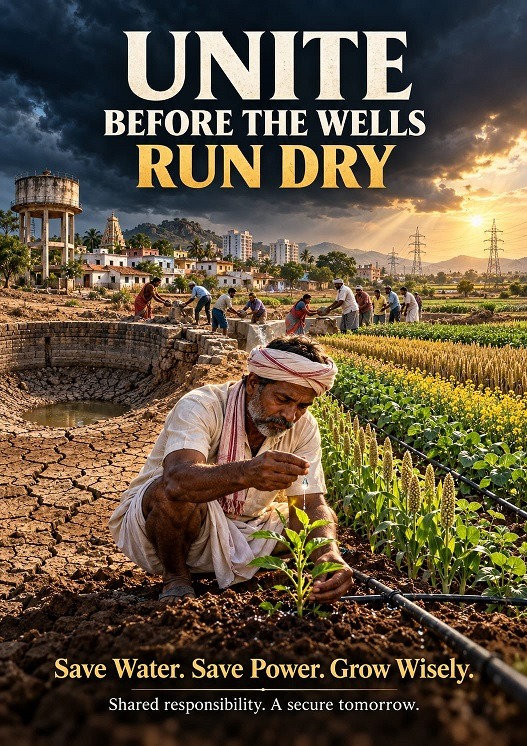
Telangana needs a common political programme to conserve water and electricity before scarcity becomes an emergency. Government and Opposition should agree on measurable action while continuing democratic scrutiny. When publicity is crowded with greetings and leaders’ portraits, drought preparedness deserves comparable visibility. Parties should redirect promotional spending towards practical conservation messages and explain the urgency.
Preparation must begin with evidence. Drought cannot be assumed inevitable without authoritative local assessments. The India Meteorological Department uses the Standardized Precipitation Index among its monitoring tools. Telangana should combine weather information with reservoir storage, groundwater levels, and soil moisture and drinking-water availability. District bulletins should identify vulnerable settlements, warning thresholds and required actions.
Every department needs an assignment. Water agencies should repair leaks; irrigation officials should publish water budgets; electricity utilities should explain efficient consumption. Municipalities and panchayats should coordinate inspections and complaints. Telugu messages must reach apartments, houses, function halls, cinema theatres, offices, banks and remote hamlets through newspapers, broadcasts, mobile alerts, public displays and village announcements.
Practical measures include repairing taps, preventing tank overflows, restoring rainwater harvesting and safely reusing treated wastewater for permitted purposes. Institutions should monitor consumption and nominate conservation officers. Banks and offices should check taps, lights and cooling equipment before closure. Efficient pumps, lighting and sensible cooling reduce electricity demand; the Bureau of Energy Efficiency promotes air-conditioning at 24°C. Essential services require continuity.
Agriculture must anchor this strategy. Crop rotation across seasons and diversification towards locally suitable, less water-intensive crops should become central to drought planning. Pulses, millets and oilseeds can provide alternatives where soil, rainfall and markets support them. The Union government already promotes such diversification according to local conditions. Telangana should publish village-level crop plans before sowing, backed by soil tests, water budgets, seed availability, extension advice and dependable marketing arrangements.
Public support should reinforce these plans. Farmers who knowingly cultivate crops contrary to legally notified, scientifically justified restrictions should bear the resulting commercial and foreseeable water-shortage risks. They should not automatically expect extraordinary rescue packages. Government should prospectively make specified discretionary agricultural subsidies and incentives conditional on compliance, with suspension for proven violations. These are proposals. Blanket withdrawal of unrelated welfare or accrued entitlements would undermine fairness.
Responsibility must also bind the State. Farmers cannot reasonably be penalised when recommended seeds are unavailable, promised procurement fails or official advice proves unsuitable. Consultation, viable alternatives and transition assistance should precede restrictions. Tenant farmers and smallholders need accessible guidance. Rules should distinguish deliberate violations from genuine hardship and provide advance notice, recorded reasons, independent review and time-bound appeals before benefits are suspended.
If existing provisions are inadequate, Telangana should consider a dedicated Water Security and Drought Preparedness Act, with a statutory coordinating authority inspired by HYDRAA’s institutional model. This would be a separate framework, not an extension of HYDRAA’s present mandate. It should define departmental duties, crop-planning powers, inspections, substantial graduated fines and lawful subsidy conditions. Oversight must prevent selective enforcement; public agencies and politically influential consumers should face equivalent accountability.
District administrations should publish monthly results covering repaired leaks, restored harvesting systems, crop diversification and consumption against credible baselines. Citizens need complaint channels and response deadlines. Conservation cannot prevent every rainfall deficit, but coordinated action can reduce avoidable shortages. Political cooperation and responsible administration must protect livelihoods.
As a senior journalist, I have been using my reporting, within my knowledge and reach, to inform people about public problems, drought risks and the need for preparedness. I consider public education an obligation: as an Indian citizen and a journalist, I must help people understand challenges and the steps they can take. That responsibility guides my call for action.
Sources
Ministry of Agriculture — Crop diversification and micro irrigation
HYDRAA — Official agency portal
India Meteorological Department — Drought monitoring indices
Ministry of Jal Shakti — Water conservation and Catch the Rain
Bureau of Energy Efficiency — General awareness and AC 24°C guidance
About the Author