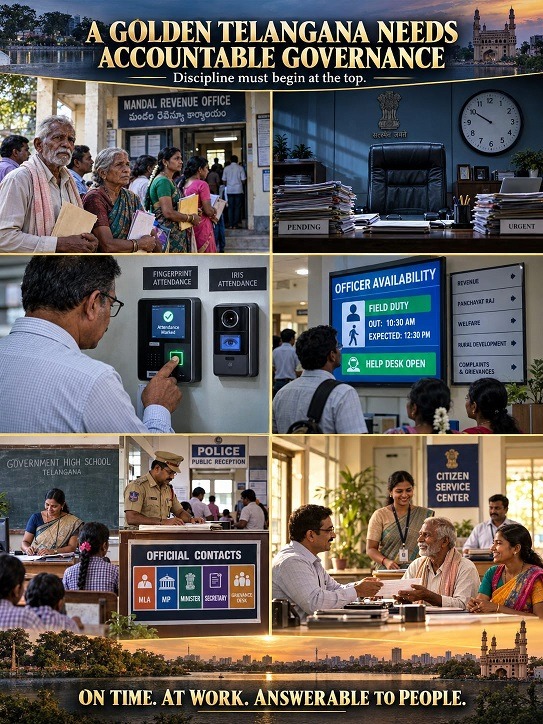
Administrative discipline must begin at the top
KARIMNAGAR, OCTOBER 18, 2026: The promise of a “Praja Palana” must be measured by the experience of the citizen standing outside a government office. Does an officer arrive on time? Is an application processed within a reasonable period? Does anyone explain a delay? Grand announcements lose their meaning when ordinary people must repeatedly sacrifice wages, travel and dignity to secure a routine public service.
Telangana’s expansion from 10 districts to 33 was intended to bring administration closer to the people. Yet geographical proximity alone cannot guarantee administrative responsiveness. More districts must mean faster decisions, accessible officers and effective supervision. The government should publish comparable service-delivery data to establish whether decentralisation has actually reduced delays. Administrative expansion deserves scrutiny through outcomes, rather than office buildings and signboards.
Discipline cannot remain a demand directed mainly at subordinate employees and students. It must begin with those who supervise, sanction and decide. When senior officers disregard punctuality, postpone decisions or remain unavailable without explanation, instructions to junior staff lose credibility. Subordinates remain responsible for their conduct, but accountability must also follow the chain of authority. Responsibility cannot stop at the lowest desk.
A practical reform should begin with verifiable attendance across government offices, government schools and police stations. Fingerprint or Iris-based systems could record attendance for officers and staff alike, with secure handling of biometric information and reliable alternatives when authentication fails. Field assignments, emergencies and authorised duties must be properly recorded. Seniority should never become an exemption from basic administrative discipline.
Attendance, however, is only the beginning. Every institution should maintain a digital public information board showing whether the responsible officer is available, attending an official meeting or undertaking field duty. It should display departure time, expected return and the designated alternative officer. Sensitive policing operations require appropriate protection, but routine public availability should never be concealed behind the vague explanation that an officer is “out”.
Citizens also need a clear route to seek intervention. Offices and schools and colleges should prominently display verified official contact numbers for the relevant MLA, MP, Departmental Minister, Secretary and grievance authority. Official helplines and designated public-contact mobile numbers should ensure access without exposing private numbers. Every complaint should receive an acknowledgement, a tracking number and a stated response deadline.
The decisive test is whether work gets done. Attendance records must therefore be linked to service standards: applications received, files disposed of, cases pending beyond deadlines and reasons for delay. District-level reviews should identify staffing shortages, procedural bottlenecks and unjustified inaction separately. Honest officers need institutional support; repeated negligence requires fair, documented corrective action. Technology should strengthen administration, not merely produce another dashboard.
The government should pilot these measures across selected rural and urban institutions, publish the results and expand what works. Citizens should not need influence to obtain services already owed to them. A golden State cannot be built on citizens waiting outside closed doors. It requires officers who are present, decisions that are timely and authority that answers to the public. Reform must begin where power sits, and reach every village.
About the Author