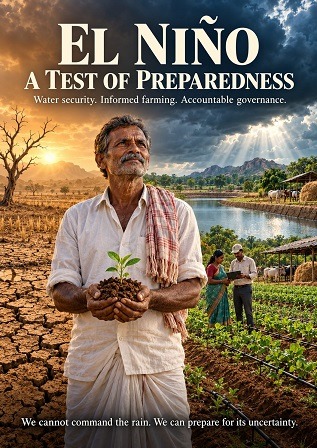
Climate uncertainty must be met with water security, informed farming and accountable governance
KARIMNAGAR, OCTOBER 17, 2026: For a farmer watching the skies, rain represents far more than a change in the weather. It carries the promise of a harvest, a child’s education, repayment of a loan and the means to sustain a household. When rainfall becomes uncertain, an entire rural economy faces uncertainty. El Niño must, therefore, be understood as more than a meteorological phenomenon. It is a reminder that agricultural security depends as much on public preparedness as on individual effort.
El Niño, associated with unusually warm surface waters in the central and eastern equatorial Pacific, can alter rainfall patterns across different regions. Its effects, however, are not uniform. The term should neither become a blanket prediction of drought nor be dismissed as a distant oceanic event. The appropriate response is to assess local risks, communicate them clearly and prepare before shortages emerge. [1]
The central question is not whether human intervention can prevent El Niño. It is whether institutions can reduce the hardship associated with its effects.
Beyond appeals to resilience
Farmers are frequently praised for their resilience. Such recognition becomes inadequate when it is offered without practical support. A cultivator cannot overcome inadequate rainfall through determination alone. Timely advice, suitable seeds, dependable water management and responsive institutions must give substance to public assurances.
Climate-related crop losses should never be treated as evidence of a farmer’s lack of effort. The responsibility for preparedness extends across government departments, local bodies, agricultural institutions and the wider community.
Early identification of local risks can help farmers adjust planting schedules, select drought-tolerant crops and secure water and fodder before shortages become severe. An early warning has value only when it enables an early decision. [2]

Make every rainfall count
Water conservation must begin before scarcity becomes an emergency. Restoring channels that carry rainwater into tanks, maintaining field bunds and preparing locally suitable storage structures should form part of routine planning.
The objective is not merely to create additional storage capacity. It is to ensure that rainfall is captured, retained and used effectively.
At the farm level, conserving soil moisture is equally important. Retaining suitable crop residues as ground cover, reducing evaporation and matching cultivation practices to soil conditions can help crops withstand dry periods. Such measures require local adaptation; no single technique can serve every field or farming system. [3, 4]
Public programmes should consequently be assessed by their practical results: whether water reaches storage structures, whether those structures remain functional and whether farmers can use the conserved water when it is needed.
Let water availability guide crop choices
Crop planning must respond to expected water availability, soil characteristics and local weather advice. Where conditions warrant, short-duration or drought-tolerant varieties may offer a more suitable option. These decisions should be guided by agricultural specialists familiar with the region. [5]
Yet advising farmers to change crops is only the beginning of institutional responsibility.
Are suitable seeds available on time? Do farmers understand the cultivation requirements? Is there a credible market for the produce? Without answers, crop diversification may transfer uncertainty from water availability to income.
A workable alternative must connect agronomic suitability with access to inputs, technical support and market opportunities. Farmers need a complete proposition, not an isolated recommendation.
Livestock must also be included in preparedness plans. Water and fodder reserves are essential to protecting animals and the households that depend on them. [2]
Turn forecasts into field-level decisions
Weather information should not remain confined to technical bulletins or departmental meetings. It must reach cultivators in clear language and early enough to influence their work.
The India Meteorological Department’s agricultural advisory services provide a framework for linking weather forecasts with farm operations. These services should inform local decisions on sowing, irrigation and other agricultural activities. [6]
The last mile deserves particular attention. A farmer needs to know what an advisory means for a specific crop and location. Agricultural extension workers, local institutions and cooperative societies can help translate technical information into usable guidance.
Communication should also acknowledge uncertainty. A seasonal outlook is a basis for preparedness, not a guarantee of what will happen in every village. Credibility depends on explaining both the risk and the limits of prediction.
Preparedness requires accountability
District and local administrations should maintain coordinated assessments of water resources, proposed cultivation, drinking-water needs and fodder availability. Each assessment should lead to clearly assigned responsibilities and time-bound action.
Agriculture departments, local bodies, cooperative institutions and banks should coordinate within their respective mandates. Their contribution should be measured by the assistance that reaches farmers, not merely by the number of meetings held or instructions issued.
A review becomes meaningful when it establishes what has been completed, what remains pending and who must act next.
This is also a question of fairness. Farmers with limited access to irrigation, storage or timely advice have fewer options when conditions deteriorate. Preparedness must account for these differences instead of assuming that every cultivator has the same capacity to adapt.
A shared responsibility
El Niño may arise beyond the reach of local control. The quality of the response does not.
Its consequences should not be left to a farmer’s endurance or addressed only after losses become visible. The stronger approach is to conserve water in advance, align crops with local conditions, communicate risks honestly and ensure that institutions act together.
We cannot command the rain. We can conserve what falls, plan for what may not and stand beside those whose livelihoods depend on it. The answer to nature’s uncertainty must lie not only in the farmer’s courage, but also in the foresight and accountability of public institutions.
Sources
- FAO — El Niño
https://www.fao.org/el-nino/en - FAO — El Niño is coming. Here is where the risks to agriculture are highest
https://www.fao.org/newsroom/detail/el-nino-is-coming-here-is-where-the-risks-to-agriculture-are-highest/en - FAO — Rainwater, land productivity and drought
https://www.fao.org/4/y4690e/y4690e08.htm - FAO — Drought-resistant soils
https://www.fao.org/4/a0072e/a0072e07.htm - FAO — Minimizing water stress and improving water resources
https://www.fao.org/4/y4690e/y4690e09.htm - IMD — Agricultural Meteorology Division background
https://imdagrimet.gov.in/AGBackground.php
About the Author