
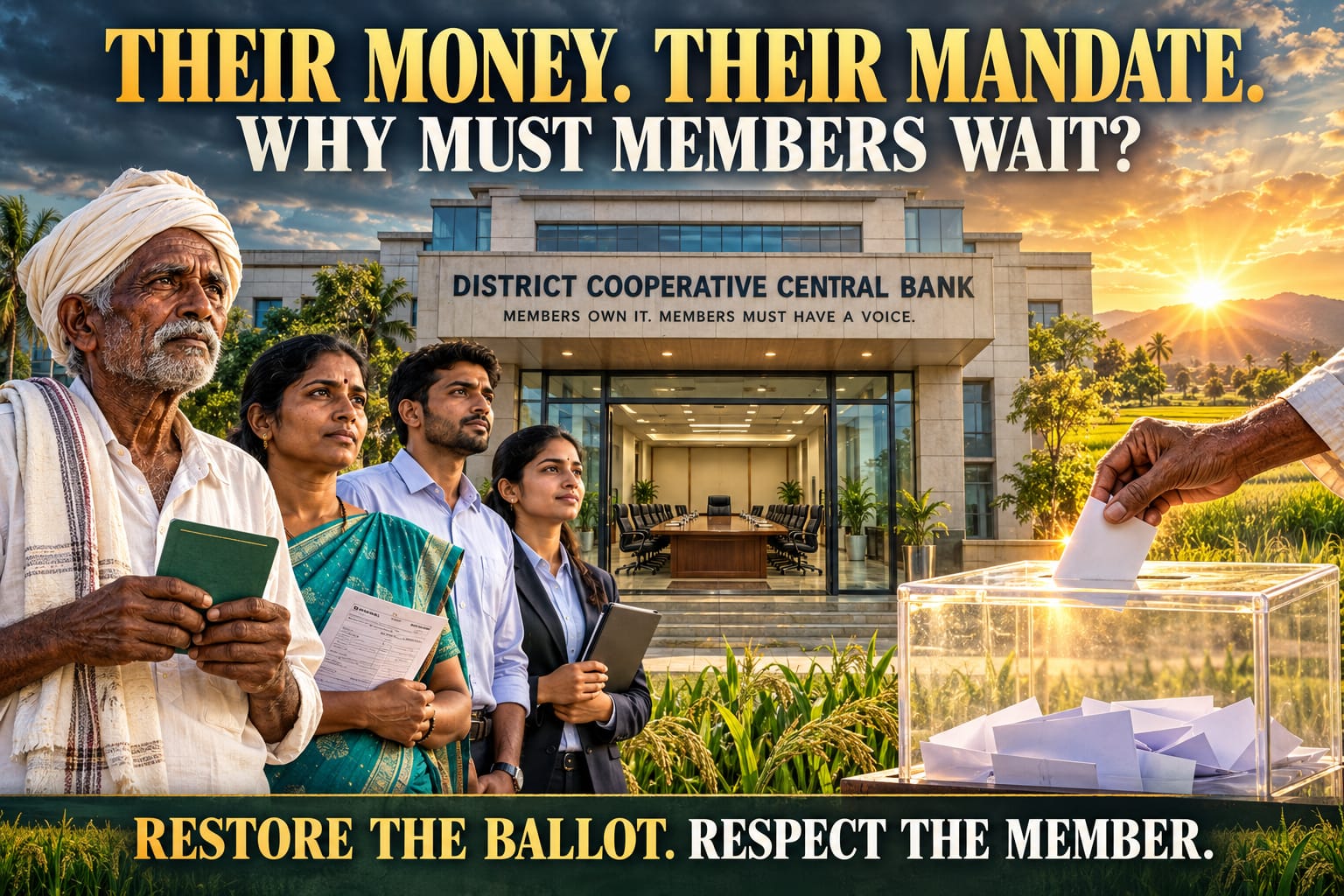
Elections offer the opportunity to question performance, choose representatives and demand a different course when expectations have not been met
The ballot alone cannot guarantee sound banking. But its absence weakens an important means of holding leadership to account
The Vaidyanathan Task Force’s central insight remains relevant: financial assistance cannot secure lasting revival without better governance
KARIMNAGAR, SEPTEMBER 26, 2026: A farmer cannot ask the monsoon to wait for an administrative decision. A rural household cannot put its needs on hold until a governance question is settled. Yet, whenever cooperative institutions remain uncertain about the renewal of their elected leadership, the people who depend on them are left asking a fundamental question: when will their voice return to the Centre of decision-making?
For Telangana’s cooperative credit system, timely elections are more than a procedural obligation. They connect ownership with authority, and authority with accountability. A cooperative may continue to transact business without an elected board. What it cannot indefinitely take for granted is the confidence of members who expect a meaningful say in its direction.
The case for democratic renewal is strongest when expressed with precision: explain the delay, remove the obstacle, protect essential services and publish a credible election timetable.
The society pays. The member deserves an answer.
The election rules place the expenditure of conducting cooperative elections on the societies concerned. This makes it necessary to examine, rather than merely assume, any suggestion that elections must wait for a general allocation from the State treasury. Where the society bears the bill, the status of that funding should be transparent: has the expense been assessed, has payment been requested, and has the society deposited the amount?
Public administration still has an indispensable role. Electoral rolls must be prepared, staff deployed and polling conducted fairly. Society funding does not remove these responsibilities. It does, however, make a vague explanation about financial constraints inadequate. Members deserve to know the particular obstacle and the authority responsible for resolving it.
The statutory framework envisages elections before the outgoing board’s term expires, allowing its successor to assume office without a break. Preparations are intended to begin in advance. An approaching expiry date should trigger action, not become the starting point for another period of uncertainty.
A mandate belongs to the members
Cooperative elections concern the governance of member institutions. They have a purpose distinct from a contest for legislative power. Candidates may have political affiliations, and election procedures provide for candidate symbols. It would therefore be simplistic to suggest that these contests exist entirely outside politics. The principle that matters is that political preference must not displace the rights and interests of members.
A cooperative draws its legitimacy from participation. The farmer, the rural woman and the younger member seeking a place in the local economy should see an institution they can influence, not merely an office they must approach. Elections offer the opportunity to question performance, choose representatives and demand a different course when expectations have not been met.
The ballot alone cannot guarantee sound banking. But its absence weakens an important means of holding leadership to account. Professional management and representative governance should reinforce each other.
The unfinished promise of revival
The Vaidyanathan Task Force’s central insight remains relevant: financial assistance cannot secure lasting revival without better governance. Its concern extended beyond depleted capital to delayed elections, repeated displacement of elected management, inadequate accountability and intrusive control.
The revival framework linked financial support to legal and institutional reform through agreements involving the Union Government, participating States and NABARD. The purpose was to build institutions capable of standing on their own, governed responsibly and answerable to their members. Restoring the balance sheet was part of that promise. Restoring the character of cooperation was equally important.
A committee recommendation, an agreement and an enacted law have different legal roles. Present election arrangements must follow the law in force. But the reform philosophy poses an enduring public-policy question: how faithfully is the promise of democratic, autonomous and accountable cooperation being honoured?
Temporary arrangements need a visible destination
Interim management may be lawful and necessary when an elected committee is unavailable. Such arrangements can preserve continuity and protect an institution from an administrative vacuum. Their existence should not automatically be treated as evidence of wrongdoing.
Yet continuity requires more than an appointment order. Members need to know why elections could not be completed, what preparations remain and when the position will be reviewed. A temporary arrangement should have a visible destination: the restoration of representative governance through the applicable process.
The distinction between an individual director’s eligibility and the tenure of an elected board is also essential. The banking-law change allowing the relevant category of cooperative-bank directors up to ten years of continuous service does not give a board a ten-year electoral mandate. It cannot, by itself, justify postponing elections.
Banking regulation, State cooperative law and institutional bye-laws must be read together. The objective should be clear authority, effective supervision and timely decisions. Ambiguity serves neither depositors nor members.
The price of waiting
The consequences of uncertainty may extend well beyond a vacant chair. Decisions outside an officer’s delegated powers can await a competent authority. Business proposals may lose momentum. Recovery initiatives and development plans may receive less attention than they require. A member who cannot obtain a timely decision may eventually look elsewhere.
These possibilities must be investigated through records, not converted into unverified claims that every bank has suffered losses or that all lending has stopped. Many employees continue to provide essential services with diligence. Their work should be recognised, and the limits of their lawful authority should be understood.
Each affected institution should examine pending proposals, the duration and reasons for delay, and the authority required to decide them. Any assessment of financial loss must distinguish a loan’s face value from earnings actually forgone. It must also consider other influences, including seasonal demand, interest rates and borrower eligibility.
Reputation requires equal attention. Complaints, member participation, service feedback and documented reasons for moving business can reveal damage that a balance sheet does not immediately capture. A cooperative cannot afford a growing impression that it is unable to respond to its own members. Trust is built over years; repeated uncertainty can weaken it quietly.
Responsibility must have a name and a deadline
Accountability should follow the allocation of duties. The election authority must explain progress within its remit. The Registrar and Government must account for the decisions and administrative support within their remit. Committees and interim managers must complete the preparatory work assigned to them. Bank management must document obstacles, use valid delegations and seek timely decisions from the competent authority.
This is a demand for an institutional account, not a presumption of personal guilt. Fixing financial liability on an individual requires an established legal basis, proof of breach and a demonstrated connection to loss. Public scrutiny becomes stronger when it insists on those distinctions.
What cannot be acceptable as a governing habit is responsibility dispersed so widely that no one can explain the outcome. Members should be able to see what remains undone, who must do it and by what date.
Give cooperation its voice back
The immediate agenda is practical: publish a society-wise election timetable; explain exceptional postponements through reasoned decisions; review obstacles at fixed intervals; and give affected banks written clarity on the powers needed to maintain lawful, uninterrupted service. Pending decisions should receive focused attention while the election process advances.
The farmer supplies the institution’s purpose, participates in its ownership and bears the consequences when an essential decision comes too late. That relationship deserves more than an assurance that the matter is under consideration. It deserves a functioning system of representation and response.
Cooperative democracy must be visible in an election notice, in an accountable boardroom and in a member who knows that a question will receive an answer. Their money sustains the institution. Their mandate must sustain its leadership.
About the Author