Officers trapped in uncertainty. Farmers waiting for decisions. Telangana’s cooperative banks need functioning governance before administrative delay becomes economic damage
When governing bodies are absent or decision-making authority is unclear, responsibility does not disappear. The Government, Cooperation Department, RBI, NABARD and the State Cooperative Apex Bank must work together to protect rural credit, institutional stability and public confidence
A vacant boardroom does not stop the crop calendar. An unsigned file does not suspend interest costs. An unresolved question of authority does not postpone a family’s need
A pending file is not always a harmless delay. It may be an approaching deadline, a lost crop opportunity, a weakening business relationship or an early warning of avoidable financial stress
KARIMNAGAR, SEPTEMBER 25, 2026: A bank can open its doors every morning and still leave an essential part of its purpose unfulfilled.
Employees attend work. Counters remain busy. Deposits are accepted, withdrawals processed and accounts maintained. Yet an eligible loan application may remain unresolved because the authority required to decide it is unavailable or unclear.
For the institution, this may appear as a pending file.
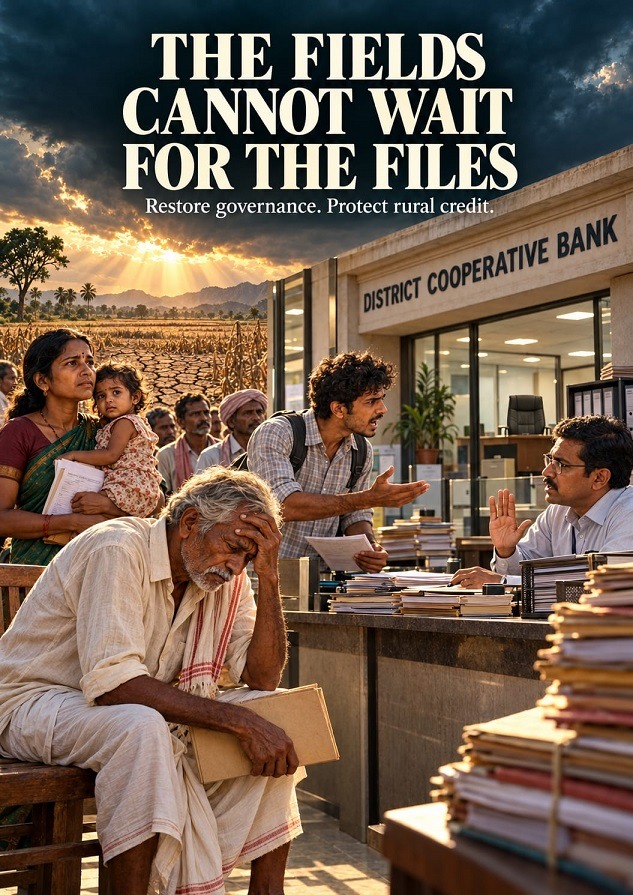
For a farmer, it may mean a missed sowing opportunity. For a student, an admission slipping away. For a woman’s self-help group, an enterprise unable to purchase its next batch of materials. For a small trader, an interrupted business cycle. For a family building a home, another month of mounting costs.
The concerns raised over recent months about governance uncertainty in Telangana’s District Cooperative Central Banks (DCCBs) must therefore be understood in their full significance. They concern the ability of institutions to fulfil their purpose, not merely the occupancy of administrative positions.
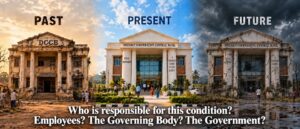
The governance position may differ from one bank to another and may change through valid appointments or orders. It would be inaccurate to assume that every DCCB faces the same interruption or that all lending has stopped. What is required is a current, bank-wise statement of facts.
Where decisions are moving, that should be recognised. Where they are blocked, the obstacle should be identified and resolved.
A functioning counter cannot substitute for a functioning decision-making system.
A Governance Vacancy Must Not Become a Vacancy of Responsibility
The absence of an effective governing body creates more than an organisational inconvenience.
It can interrupt policy decisions, approvals beyond delegated limits, business planning, audit follow-up and oversight of financial risks. If these interruptions persist, they may gradually weaken the institution even while routine transactions continue.
This is why the issue cannot be left to individual officers to manage through personal discretion.
The State Government must address the governance questions within its authority. The Cooperation Department must establish the legal and administrative position. NABARD must assess relevant supervisory risks. RBI must consider the regulatory implications. The State Cooperative Apex Bank must help consolidate the financial evidence and coordinate with the district banks.
Their mandates are different. Their actions must connect.
The central question is straightforward: when a bank cannot obtain a necessary decision through its normal governance structure, what lawful alternative or clarification allows its legitimate work to continue?
If that question remains unanswered, responsibility becomes dispersed while the consequences accumulate in one place—the institution and the community it serves.
A vacant boardroom may explain an interruption. It cannot justify an indefinite interruption.
Files in Their Hands, Decisions Beyond Their Reach
Bank officers occupy the most exposed position in this uncertainty.
An officer may have the experience to assess a borrower, examine security, evaluate repayment capacity and recommend a commercially sound proposal. But professional competence does not automatically confer sanctioning authority.
That authority must arise from the applicable law, registered bye-laws, valid delegations and regulatory requirements.
Where the required authority is absent, the officer faces competing pressures.
The borrower asks why the application has not moved. The business review asks why targets have not been achieved. A subsequent audit may ask under what authority the officer acted.
The same employee may be criticised for delay and questioned for attempting to overcome it.
This creates a damaging incentive. Deferring a decision can begin to appear safer than taking one, even where the proposal deserves timely consideration.
Such a situation cannot be repaired by asking employees to show greater courage. Nor should officers be encouraged to rely on oral assurances that approval will follow later.
Authority must precede its exercise. Accountability must correspond to the authority actually available.
A sound institution protects both principles.

What the Governance Framework Actually Requires
The cooperative governance framework assigns policy, oversight and strategic responsibilities to the governing body, while executive management carries out operational functions within authorised limits.
The bye-law provisions examined for this discussion illustrate that distinction. They address delegation of powers to the CEO and other functionaries, day-to-day management responsibilities and limits on the exercise of financial authority.
For Telangana’s DCCBs, the practical application must be checked against each bank’s registered bye-laws and current delegation resolutions. Common governance principles should not be mistaken for proof that every clause, amendment or financial limit is identical across all banks.
Bye-Laws Should Protect the Institution—and Be Supported by Functioning Governance
Bye-laws are necessary safeguards. They protect members, depositors and institutional funds by defining powers and responsibilities.
The problem arises when the body expected to exercise a particular power is unavailable and no clear lawful route exists for resolving the resulting difficulty.
The answer is not to disregard the rules. It is to make the governance arrangements work within them.
The institution needs a lawful path through the difficulty. Its employees should not be left to find that path by taking personal risks.
Cooperative Autonomy Requires the Capacity to Act
Section 115-D(2) of the Telangana Cooperative Societies Act, 1964 recognises autonomy for cooperative credit societies in specified financial and internal administrative matters, subject to RBI and NABARD guidelines.
The areas include interest rates, borrowings, investments, lending policies, individual loan decisions and aspects of personnel and internal control.
This autonomy belongs to the institution. It is exercised through its lawful organs and authorised functionaries.
It does not confer unlimited powers on an individual officer. Equally, it does not provide a reason for public authorities to remain disengaged when the institutional arrangements necessary to exercise that autonomy are impaired.
The reform principles associated with the Vaidyanathan initiative are relevant here: member ownership, democratic governance, professional management and freedom from excessive interference.
Those principles must operate through the applicable law. A reform recommendation or explanatory summary is not, by itself, a statutory power.
Their broader lesson, however, is clear. Cooperative institutions need both independence and functioning governance.
Autonomy loses practical meaning when an institution cannot take the decisions necessary to serve its members.
The State Cooperation Department Must Present a Solution, Not Merely Record a Vacancy
The State Cooperation Department has a central role in resolving the cooperative-law and administrative dimensions of the problem.
The State Act contains provisions for managing societies when a committee is unavailable, subject to the applicable conditions. The appropriate course for a particular bank must be determined in light of relevant special provisions and operative orders.
The Department’s immediate task should be to establish the position bank by bank and place a legally workable proposal before the competent authority.
A note stating that a governing body is absent does not adequately explain the urgency.
District Cooperation Authorities Must Bring the Ground Reality Into the Record
State-level action depends on reliable information from the districts.
District cooperation authorities should act within the powers assigned to them. They cannot be presumed to possess every statutory power of the Registrar merely by virtue of their designation.
Within their lawful remit, however, they can help establish the facts, coordinate with bank management and escalate unresolved issues.
The State Act provides mechanisms relating to inquiry into a society’s functioning and financial condition, inspection of its books and rectification of identified defects. These mechanisms should be used where their legal conditions and the circumstances justify them; every administrative delay need not become a formal inquiry.
The immediate questions are practical.
Has the district bank’s management submitted a written account of the problem? Have pending matters been classified by cause? Has the effect on affiliated PACS been examined? Has the district administration conveyed the seriousness of time-sensitive cases to the appropriate State authority?
Most importantly, has the matter been followed after the initial report?
Forwarding a letter is an action. Obtaining a decision requires sustained follow-up.
The distance between the district office and the State Secretariat should not become an indefinite waiting period for a village borrower.

NABARD Must Examine the Risk Before It Becomes a Loss
NABARD’s role extends beyond refinance.
Its inspection and supervisory functions cover State Cooperative Banks and DCCBs, including financial soundness, legal compliance, management and operational risks. Its official supervisory framework also includes off-site analysis, early warning signals, follow-up measures and recommendations to RBI.
A prolonged inability to take necessary governance decisions is therefore relevant to supervisory assessment.
Are significant audit observations awaiting action? Are essential policies due for renewal? Is management able to obtain approval for risk mitigation? Are lending opportunities being lost because proposals exceed existing delegated limits? Are important financial decisions accumulating without a competent forum?
These questions do not establish that a bank is already distressed. They identify conditions that may weaken it if left unresolved.
NABARD can assess the evidence, engage with the institution and communicate the need for appropriate remedial action to the relevant authorities.
Its assessment should look beyond whether a bank was profitable at the last reporting date. It should examine whether the present governance arrangements are adequate to preserve that performance.
Effective supervision should help prevent tomorrow’s weakness, not merely explain yesterday’s deterioration.
RBI’s Regulatory Perspective Must Include Management Continuity
Banking regulation of State Cooperative Banks and DCCBs rests with RBI, while NABARD performs a central supervisory role.
The Banking Regulation Act provides RBI with powers, in specified circumstances, to issue directions concerning public interest, banking policy, depositor protection and proper management, as applicable to cooperative banks.
That does not make RBI the sanctioning authority for individual loan applications. Nor does it make RBI a substitute for State cooperative election machinery.
It would also be inappropriate to insist on a particular regulatory intervention without examining the facts and the legal conditions for its use.
Nevertheless, a sustained impairment of a bank’s ability to manage its affairs deserves regulatory attention where it affects sound banking.
The relevant questions are whether the situation has been reported, whether its implications have been assessed and whether regulatory clarification or coordinated remedial action is required.
RBI’s response, where necessary, should be proportionate to the identified risk and consistent with its mandate.
The objective is to preserve proper management, depositor interests and the continuity of legitimate banking services.
The Apex Bank Must Explain the Financial Cost of Delay
The State Cooperative Apex Bank has a direct interest in the health of Telangana’s district cooperative banking network.
Its financing relationships connect its own interests with the lending, recoveries and financial strength of DCCBs.
Section 53 of the State Cooperative Societies Act provides a financing bank or federal society with inspection rights in relation to a society indebted to it, subject to the applicable conditions and authorisation. This includes obtaining information relevant to financial condition and the safety of funds lent.
The Apex Bank cannot assume all the powers of a district bank’s governing body. But it can help convert scattered institutional concerns into a consolidated financial assessment.
That assessment should identify the affected banks, the decisions awaiting approval, changes in disbursements and recoveries, the use of available funds and the implications for PACS.
It should also distinguish between problems of liquidity and problems of authority.
Providing additional funds will not necessarily resolve a proposal that cannot be sanctioned. Clarifying authority will not, by itself, resolve a genuine shortage of lendable resources.
The remedy must match the obstacle.
The Apex Bank should help Government understand what is happening, what may happen next and which decision can prevent avoidable damage.
The Question Is What Institutional Coordination Has Achieved
It would be unfair to claim, without the relevant records, that no institution has acted.
The Cooperation Department, RBI, NABARD or the Apex Bank may already have exchanged correspondence, held consultations or undertaken internal assessments. Some supervisory information may properly remain confidential.
The legitimate public question is what those efforts have achieved.
When was the difficulty identified? What impact was reported? What solution was proposed? Which authority must decide it? What is the implementation timetable?
The public need not see every confidential document. Members and borrowers should nevertheless be able to understand whether their institution has a functioning route to resolution.
A meeting does not automatically restore sanctioning authority. A representation does not automatically clear a pending proposal.
Coordination becomes meaningful when the obstacle is removed and lawful decisions resume.
A Loan Application Is Also a Calendar
The human cost of delay is easiest to understand through time.
A farmer requires credit at a particular stage of the agricultural cycle. A student must meet an admission deadline. A trader must replenish stock before demand passes. A women’s collective may need working capital to complete an order.
For these borrowers, the date of the decision can matter almost as much as the decision itself.
Credit standards must remain intact. Documentation, eligibility, repayment capacity and security requirements should not be diluted merely because a case is urgent.
But once a proposal is ready for consideration, uncertainty about the competent authority should not create an open-ended wait.
Some borrowers may seek more expensive alternatives. Others may reduce investment. Some may abandon the activity altogether.
A delayed sanction may eventually release money. It may not recover the opportunity that has already passed.
The bank records the date of disposal. The borrower lives with the cost of the interval.
Yesterday’s Profits Do Not Remove Today’s Risks
A bank’s earlier profitability is an achievement, not a permanent guarantee.
Deposit interest and operating expenses continue even when new lending slows. Salaries, security, technology services and maintenance costs do not stop because a proposal is awaiting approval.
If eligible lending is delayed, expected interest income may be lower than planned. Good borrowers may move to other institutions. Their departure may take associated deposits and future business with them.
Available funds may earn income through alternative permitted deployment, but that income must be compared with the risk-adjusted return the bank could reasonably have earned from the intended business.
Financial discipline requires measuring the consequences of delay accurately. It does not permit either exaggeration or complacency.
El Niño: A Climate Risk That Demands Institutional Preparedness
Weather uncertainty adds another dimension to the problem.
El Niño is associated with changes in ocean and atmospheric conditions that can influence rainfall and temperatures across regions. Its implications for a particular agricultural area depend on several factors, including the wider weather pattern, local rainfall, irrigation access and the stage of the crop.
It would therefore be inaccurate to predict identical drought conditions or inevitable crop losses across every district in Telangana merely because an El Niño risk is being discussed.
Local observations and official meteorological assessments must guide action.
Yet the absence of certainty is not a reason to avoid preparation. It is precisely why banks should assess different possible outcomes.
For agricultural lenders, climate preparedness involves understanding how weather can affect production costs, crop income, repayment schedules and future borrowing needs.
A bank cannot change the weather. It can improve the speed and quality of its response to weather-related financial stress.
How Weather Stress Can Travel From the Field to the Bank
The possible economic sequence deserves careful attention.
If rainfall is delayed or uneven, farmers may have to postpone sowing, repeat cultivation operations or purchase additional seed after an unsuccessful first sowing. These costs arise before there is any crop income.
If a dry spell occurs during crop growth, farmers may face higher expenditure on irrigation, pumping, hired equipment or other measures to protect the crop. Whether these options are available will vary by location.
A weather shock may begin in the field. Its financial consequences can reach the household, the PACS, the DCCB and the wider cooperative credit structure.
Delayed Credit Can Make a Weather Shock Harder to Absorb
The most troubling possibility is the interaction between climate stress and administrative delay.
A farmer facing uncertain rainfall may need timely, carefully assessed finance for revised cultivation plans or protective measures. If an otherwise eligible proposal remains pending solely because decision-making authority is unclear, the farmer may lose the opportunity to respond effectively.
This does not mean that every additional loan will save a crop or that lending should be expanded indiscriminately.
It means that the ability to consider a proposal promptly matters more when conditions are changing.
After verified agricultural damage, eligible borrowers may require consideration under applicable relief, conversion, rescheduling or other permitted arrangements. Such measures depend on the relevant conditions and approvals; they are not automatic loan waivers.
The bank must be capable of collecting information, identifying eligible cases, assessing the consequences and obtaining the required decision.
If the necessary approval structure is unavailable at that point, a manageable difficulty can become more prolonged.
Weather preparedness requires an operational decision-making system, not merely an intention to help when trouble arrives.
Climate Stress Also Affects the Next Season
The consequences of a poor crop do not necessarily end with the current repayment cycle.
A household that uses savings to meet cultivation expenses may have fewer resources for the next season. A borrower who repays one lender by taking expensive short-term debt elsewhere may enter the next cycle with a heavier burden.
Reduced farm expenditure can affect agricultural input dealers, transport providers, labourers and local shops.
PACS may face pressure on their own recoveries and their ability to support members. District banks must then assess the combined implications for agricultural lending, repayment flows and future credit demand.
This is why climate-related planning should cover more than immediate overdue accounts.
It should consider the sustainability of the next production cycle and the borrower’s capacity to continue earning.
The appropriate response is evidence-based credit assessment, permitted relief where applicable and close coordination with relevant agricultural and administrative authorities.
A District Bank’s Delay Can Become a Village Economy’s Slowdown
The influence of a DCCB extends beyond its branch premises.
Through PACS and direct relationships, it supports farming households, rural enterprises, women’s groups and other local economic activity.
If investment is postponed, the effect can move through the community. A farmer buys fewer inputs. A supplier sells less. A worker receives fewer days of employment. A household reduces spending.
No single delayed proposal will necessarily create a district-wide problem. But repeated delays across many eligible cases can have a cumulative effect.
That effect is often less visible than a closed road or interrupted power supply.
Credit disruption leaves no obvious barricade. It appears later in reduced activity, abandoned plans and weakened household cash flows.
Rural finance is part of the infrastructure of opportunity. Its interruptions deserve the same seriousness as other disruptions to essential economic services.
The Government’s Interest Goes Beyond Direct Financial Liability
A cooperative bank’s financial loss does not automatically become an equal loss to the State exchequer.
Direct fiscal exposure depends on factors such as government equity, guarantees and subsequent support decisions. Those distinctions must be maintained.
The wider public consequences, however, remain significant.
Weaker rural credit can affect agricultural investment, employment and local enterprise. It may reduce the effectiveness of development programmes that depend on functioning financial institutions.
If banks or affiliated societies deteriorate substantially, demands for rehabilitation or public assistance may increase.
The Government therefore has a strong preventive interest in resolving avoidable governance difficulties before they become deeper financial problems.
An administrative solution delivered in time may prevent an economic problem that later requires far more effort and resources to address.
The Hidden Backlog Behind the Loan Backlog
Governance uncertainty can affect more than advances.
Audit observations may require policy or disciplinary decisions. Technology and cybersecurity measures may need expenditure approval. Investment policies may require review. Asset-liability management may identify issues needing higher-level action. Staffing gaps may affect critical functions.
Routine services can continue while these less visible matters remain unresolved.
A proper review must therefore examine the full backlog of governance-dependent decisions, not only the number of loan applications.
The aim is not to assume that controls have failed. It is to verify that controls remain effective and that issues requiring approval have a competent forum.
Restoring governance means restoring oversight, decisions and follow-through—not merely filling a designation.
Management Must Document the Risk and Continue Lawful Work
Executive management also has clear responsibilities.
Officers should exercise valid existing powers, maintain essential operations and avoid treating every matter as automatically suspended.
Where authority is insufficient or uncertain, the file should state the precise issue. Management should record the decision required, the competent level, the time sensitivity and the potential consequence of further delay.
Material risks and unresolved matters should be reported through the appropriate channels.
This is not merely defensive paperwork. It is the evidence necessary for higher authorities to act.
At the same time, officials should not exceed their powers on the assumption that urgency will excuse an irregular decision.
The institution is best protected by lawful action, accurate records and timely escalation.
A Joint Programme Must Turn Review Into Resolution
An immediate coordinated review should involve the State Cooperation Department, relevant RBI and NABARD representatives, the Apex Bank and DCCB management, each within its mandate.
The review should produce a concrete programme.
First, establish the current governance position of each bank and the legal basis for its present arrangements.
Second, verify existing delegations and identify decisions that can proceed without additional approval.
Third, separate cases requiring fresh sanction, policy approval or a competent governance arrangement.
Fourth, prepare a consolidated financial and operational impact assessment. It should distinguish confirmed effects from estimates and explain the assumptions behind projections.
Fifth, identify climate-sensitive areas and time-bound borrower needs using available official and field information.
Sixth, assign every unresolved issue to a responsible institution with an implementation timetable.
A fortnightly progress review would be a useful administrative measure. It should track obstacles removed, decisions completed and services restored.
It should not measure progress merely by the number of letters issued or meetings held.
What the Government Should Receive in the Impact Report
A decision-ready report should contain:
- The current governance and delegation position of each affected DCCB.
- The number, value and age of proposals delayed specifically by authority-related issues.
- Separate identification of applications delayed by documentation, eligibility, appraisal or funding constraints.
- Comparative information on disbursements, recoveries, income, expenditure and relevant financial risks.
- Significant audit, technology, staffing and policy matters awaiting approval.
- The actual and potential effects on PACS and their members.
- Weather-related vulnerabilities and the institution’s preparedness to respond.
- A legally grounded remedy for each obstacle, with a responsible authority and target date.
Such a report would allow the Government and associated institutions to distinguish a manageable local issue from a wider structural problem.
It would also make follow-up more precise.
Democratic Governance and Professional Management Must Advance Together
The durable objective should be timely, lawful democratic governance supported by professional management.
Members need representation. Banks need competence. Both require accountability.
An elected board should provide policy direction, oversight and strategic judgment. Executive management should carry out operations within clear delegations. Individual directors should not improperly influence specific credit decisions or interfere in routine professional functions.
Where interim arrangements are legally necessary, they should preserve continuity while the longer-term governance position is resolved.
A temporary mechanism should not become an excuse for indefinite uncertainty.
Equally, the return of a governing body should not be treated as the end of reform. Delegations, committees, risk oversight and performance review must work in practice.
The quality of governance is measured by how responsibly an institution serves its members and protects its funds.
Before the Next Balance Sheet Records the Warning
The strength of cooperative banking lies in relationships built over time.
A farmer returns because the bank understands the agricultural cycle. A depositor stays because the institution has earned trust. An employee works with commitment because the bank’s success is connected to the community’s progress.
These relationships should not be weakened by unresolved questions of authority.
The Government and associated institutions may have different legal responsibilities. But those differences should produce a coordinated response, not a gap through which essential decisions disappear.
The immediate task is to establish the facts, clarify powers, resolve blocked approvals and restore effective oversight.
The longer-term task is to ensure that similar interruptions do not repeatedly immobilise institutions that rural communities depend upon.
The institutions capable of identifying financial weakness must also help prevent it. The authorities capable of resolving governance difficulties must act before those difficulties become embedded in financial performance.
Officers need clear authority to discharge their responsibilities. Borrowers need timely, reasoned decisions. Banks need functioning governance. The Government needs an honest assessment of the consequences of delay.
About the Author