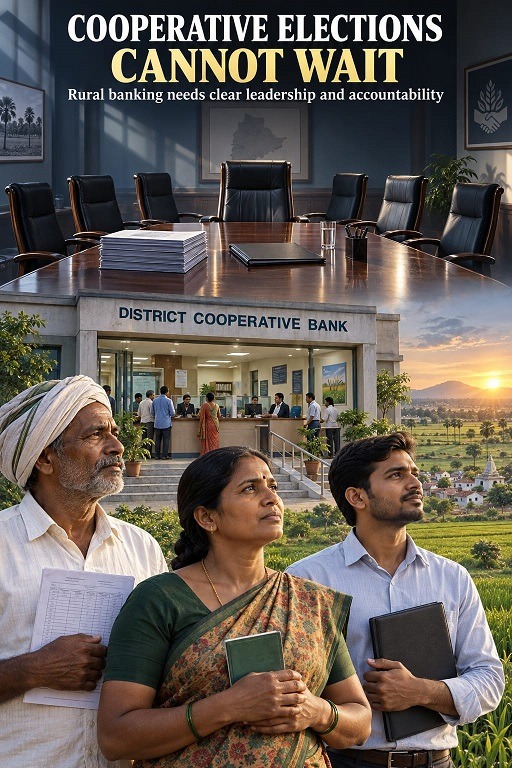
The government must end governance uncertainty through timely elections and clear interim authority while protecting financial transparency and accountability to members
KARIMNAGAR, SEPTEMBER 23, 2026: A farmer cannot postpone sowing until a bank’s leadership is settled. A small trader cannot keep a business waiting for an administrative decision. A family that places its savings in a cooperative bank deserves clear information about the institution it trusts.
This is why timely elections to cooperative institutions matter. They are not merely contests for positions. They provide a lawful way for members to choose representatives, question decisions and hold their institutions accountable.
When the government does not complete the election process on time, and elected boards are not replaced through a clear and lawful arrangement, uncertainty can follow. Who will take major decisions? Who will review the bank’s performance? Who will answer the questions of member societies? How long will temporary arrangements continue?
These questions concern the daily financial needs of rural communities.
Delayed Elections Can Weaken Rural Decision-Making
District Central Cooperative Banks connect village cooperative societies with the wider banking system. Their decisions support agricultural lending, rural businesses and local savings.
Bank employees and officers may continue deposits, withdrawals, repayments and other services within their existing powers even when an elected board is absent. Their work deserves recognition. But routine banking services alone cannot meet every requirement of an institution.
Long-term planning, policy decisions, financial oversight and accountability to members require a properly authorised governing arrangement. If responsibility is unclear, important files may remain pending because officials are uncertain about who can approve them.
The concern is therefore not that every bank without an elected board has stopped functioning. The concern is that prolonged uncertainty can weaken decision-making and slow development.
Where this uncertainty arises from elections not being held on time, the government must address that failure promptly, subject to applicable law and court orders. It should explain the reasons for the delay, clarify the interim arrangements and publish a realistic election timetable.
Members Deserve Answers About Their Bank
The financial year 2025–2026 ended on March 31, 2026. Members naturally want to know how their bank performed during that year.
Did deposits grow? Were loans recovered on time? Did the bank earn a profit? How much money was set aside against doubtful loans? Did the auditors identify any concerns?
These are ordinary questions about an institution built on public trust.
An annual financial statement should help answer them. A general body meeting gives member representatives an opportunity to examine the results, seek explanations and discuss future needs. These processes should not become casualties of uncertainty over the governing board.
At the same time, public discussion must distinguish between different legal requirements. Submission of financial statements to regulators, consideration by the general body and newspaper publication are separate obligations. It would be inaccurate to describe June 30 as one common deadline for completing all three.
Similarly, the absence of a newspaper announcement does not, by itself, establish that a bank has failed to submit its accounts to the authorities. Before alleging a violation, the relevant records and any valid extension must be checked.
The public needs facts that explain the situation clearly.
A Vacant Board Cannot Suspend Accountability
The absence of an elected board does not remove a bank’s legal responsibilities. It makes a clear allocation of authority even more necessary.
The competent authorities should identify who is legally empowered to consider pending matters, complete financial reporting requirements and arrange member meetings. Officers should receive written clarity about their responsibilities and limits.
Where court proceedings affect the available options, the authorities should seek the necessary clarification through lawful channels. Temporary arrangements must respect those orders while protecting the continuity of banking services.
An unresolved question of authority should not be allowed to become an indefinite delay.
Compliance Failures Have Consequences
RBI regulates the banking functions of cooperative banks, while NABARD undertakes statutory supervision of District Central Cooperative Banks. If a bank fails to meet applicable requirements, the authorities may seek an explanation, require corrective action or take enforcement measures where legally justified.
A monetary penalty may follow an established violation. More serious measures require their own legal grounds and an assessment of the bank’s circumstances.
A delay in an annual report does not automatically mean that the bank will close, lose its licence or become unable to repay depositors. Such claims can create unnecessary fear.
Nevertheless, compliance failures should not be treated casually. They can bring additional scrutiny, financial costs and damage to an institution’s reputation. Prompt correction and honest communication serve both the bank and its customers.
The Government Must Set a Clear Election Timetable
The immediate need is a practical response: clarify lawful decision-making authority, resolve pending compliance matters and keep members informed. Alongside this, the government and the responsible election authorities should complete the steps necessary for elections within a transparent timetable, consistent with the law and binding court orders.
Elected representatives must also understand that a board position carries responsibility. Once elected, they must attend meetings, examine accounts, support sound lending and answer to members.
Cooperative democracy works when timely elections are followed by responsible governance.
For a farmer, the test is simple: will the institution respond when support is needed? For a depositor, it is equally clear: will the bank provide reliable service and truthful information?
When elections are delayed, uncertainty must not be passed on to the farmer, the employee or the depositor. The government’s responsibility is to restore clear, lawful and accountable governance—before an administrative delay becomes a lasting obstacle to rural progress.
About the Author