An editorial article on cooperative elections as rural political schools for educated youth
KARIMNAGAR, SEPTEMBER 15, 2026:A cooperative election is not a small village contest. It is not merely a fight for a society post or a bank committee seat. It can be the first step in public life. It can be the beginning of rural transformation. It can be the platform from which educated youth enter politics with knowledge, discipline and responsibility.
In Telangana’s public debate, elections to PACS, DCCBs and cooperative marketing bodies are often treated as minor institutional events. That view is deeply mistaken. Cooperative elections are among the most important democratic training grounds available to rural society.
A Primary Agricultural Cooperative Society is where a young leader first learns how public trust works. It is where he faces members, listens to farmers, understands crop loans, learns credit discipline, deals with recoveries, respects audit, and realises that leadership is not a slogan but responsibility. A District Cooperative Central Bank boardroom teaches what rural finance really means: deposits, refinance, governance, compliance, risk, accountability and institutional trust.
History proves this point.
Former Chief Minister K Chandrashekar Rao’s public profile records that he served as Chairman of the Raghavapur Primary Agriculture Cooperative Society, Siddipet, in 1982 before rising through the legislature, Parliament, Union Minister for Labour and ultimately becoming the first Chief Minister of Telangana. Amit Shah, now Union Minister for Home and India’s first Union Minister of Cooperation, has long been associated with the cooperative banking sector. Public records show that he was elected President of the Ahmedabad District Cooperative Bank in 1999 and later served as its chairman. Singireddy Niranjan Reddy’s profile records that he served as PACS President from 1995 to 2000 before becoming Telangana’s Agriculture and Marketing Minister. Public reports and profiles also connect leaders such as Pocharam Srinivas Reddy, Botsa Satyanarayana, Ganni Veeranjaneyulu, Makkena Mallikarjuna Rao and Nettem Raghuram with PACS, DCCB, APCOB or related cooperative leadership before or alongside their wider political careers.
These examples carry a powerful message: the cooperative sector has long functioned as a nursery of rural leadership. Many leaders did not begin their public life in television studios or social media campaigns. They began in village societies, member meetings, loan committees, procurement centres, cooperative banks and district cooperative institutions.
If PACS could shape a future Chief Minister, and a district cooperative bank could form part of the journey of a national strategist, then cooperative elections cannot be dismissed as small elections. They are leadership laboratories. They are rural political schools. They are democratic entry points for those who may one day lead districts, States and the nation.
That history should not end with the older generation
Today’s educated youth have something earlier generations did not have: technology, digital payments, online platforms, logistics networks, data skills, market access, accounting knowledge and exposure to modern management. If such youth enter cooperative leadership, PACS and DCCBs need not remain only crop-loan institutions. They can become engines of rural enterprise, farmer prosperity and modern local democracy.
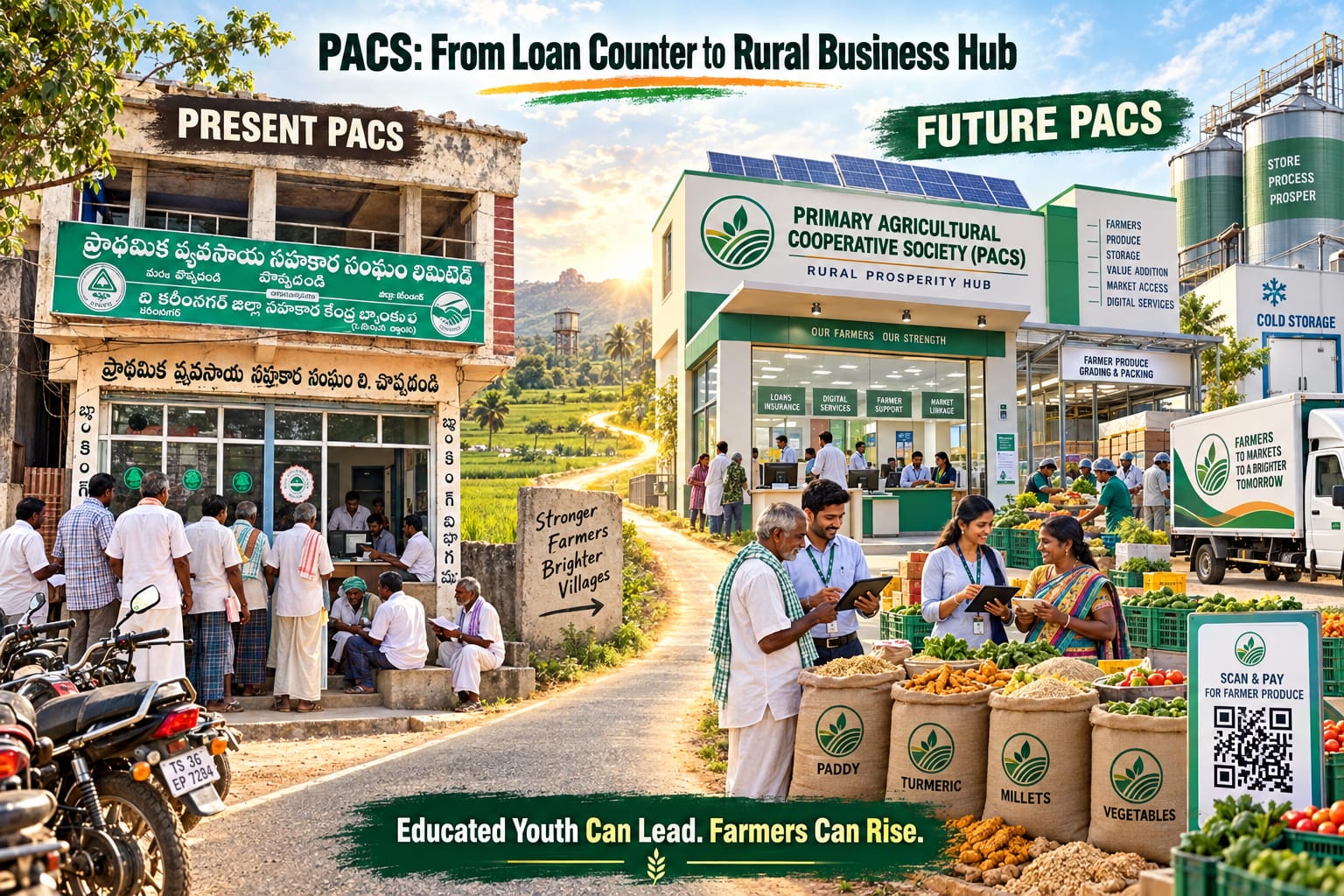
A farmer today should not stop at production. He must be supported in grading, storage, transport, processing, branding, online marketing and direct sale. A PACS under young leadership can help farmers move from merely growing paddy, maize, cotton, turmeric, chilli, vegetables, pulses or millets to selling them with value. The difference between distress sale and dignified income lies in organisation. That organisation can be provided by the cooperative system.
A modern PACS can arrange transport from farm gate to market yard. It can create shared logistics for small farmers who cannot individually afford vehicles. It can tie up with cold storage units, warehouses and processing centres. It can connect farmers with e-NAM, online buyers, local retailers, food processors, hotels, supermarkets and farmer-producer organisations. It can introduce digital weighing, transparent billing, online payment and real-time price information.
This is not imagination. This is the natural next step of cooperation.
If educated youth contest and win cooperative elections, they can bring reforms that make societies financially stronger. They can computerise records, reduce leakages, improve recovery monitoring, identify genuine borrowers, prevent misuse of credit and ensure that crop loans reach farmers on time. They can introduce member databases, SMS alerts, online loan tracking, digital receipts and transparent meeting records.
Financial discipline is the foundation of a strong cooperative. When loans are properly sanctioned, monitored and recovered, PACS become stronger. When PACS become stronger, DCCBs become stronger. When DCCBs become stronger, the entire rural credit chain becomes healthier. Good governance at village level directly improves the balance sheet at district level.
A young cooperative leader can also identify new income sources for PACS. Societies can provide farm machinery on rent, operate input centres, supply quality seeds and fertilisers, run custom hiring centres, provide insurance facilitation, support soil testing, assist in crop planning and help farmers adopt modern irrigation methods. PACS can become rural service hubs rather than passive loan counters.
The future PACS can even become a digital business platform. A society can help farmers sell turmeric powder, rice, pulses, millets, pickles, jaggery, dairy products and vegetables under a local cooperative brand. With proper packaging, quality control and online promotion, village produce can reach urban consumers directly. Why should the farmer sell only raw produce at a low price when the value-added product earns several times more?
This is where educated youth can make history
The youth who understand mobile apps, digital marketing, accounting, English communication, GST, packaging, transport networks and online marketplaces can take the cooperative movement into a new age. They can build buyer groups, online catalogues, local delivery systems, farmer-brand pages and cooperative e-commerce models. A PACS can become a village-level business incubator.
If one educated young leader can transform one PACS, imagine what hundreds can do across Telangana. Imagine 900 PACS led by youth who understand both farming and technology. Imagine DCCBs guided by directors who understand finance, law, audit, risk and digital governance. That is not just administrative reform. That is rural economic transformation.
This is why delaying cooperative elections is not a small procedural matter. It weakens one of the few democratic ladders available to educated rural youth. When PACS and DCCB elections are held regularly, young graduates, farmers’ children, women, professionals and socially conscious citizens get a lawful platform to enter public life. When these elections are postponed or replaced by temporary arrangements, that ladder is removed.
India needs educated youth in politics. But youth cannot enter politics only through expensive Assembly or Parliament elections. Cooperative elections can be the first practical school. A young candidate contesting a PACS election learns how to speak to members, prepare a programme, manage a campaign, maintain accounts, answer questions, and accept democratic verdicts. If elected, that person learns governance from the ground.
This is precisely the kind of political training democracy needs. Politics without institutional experience becomes noise. Leadership without financial discipline becomes risk. Public life without accountability becomes performance. Cooperative institutions teach the opposite: responsibility, patience, record-based decision-making and service to members.
Political parties too must open their eyes. If they truly want new leadership, they must encourage educated young candidates in cooperative elections. Instead of treating PACS and DCCB posts as rewards for existing factions, parties should see them as training grounds for future MLAs, MPs, Ministers and public administrators. The leaders of tomorrow will not be created by nomination alone. They will be shaped by local accountability.
The cooperative movement belongs to members. Its elections must therefore belong to members, not to temporary administrators. Regular elections are necessary not only for institutional legality but also for democratic renewal. Every postponed cooperative election postpones the political future of a young rural leader.
The next KCR, the next Amit Shah, the next agriculture minister, the next Speaker, the next district leader may be sitting today in a village, holding a degree, watching politics from a distance and waiting for a meaningful entry point.
That entry point can be the cooperative election
The youth of Telangana must understand this moment. Do not wait for Assembly tickets. Do not wait for someone to invite you into politics. Do not think public life begins only with MLA or MP elections. Public life begins where people trust you with their money, their crop, their credit and their future.
Contest PACS elections. Contest cooperative elections. Enter DCCB leadership. Bring new thinking. Bring clean accounts. Bring digital systems. Bring transport links. Bring online business. Bring farmer branding. Bring recovery discipline. Bring women and youth members into decision-making. Bring transparency into every meeting.
Let the farmer not remain only a producer. Let him become a shareholder in value. Let the PACS not remain only a loan counter. Let it become a rural business centre. Let the DCCB not remain only a refinancing institution. Let it become the financial nerve centre of rural transformation.
A cooperative society led by sincere youth can change a village. A network of such societies can change a district. A strong DCCB can change rural credit. A reformed cooperative movement can change Telangana’s political future.
The next great rural leader may not emerge from a television debate. He may emerge from a PACS election. She may emerge from a village cooperative society. The next generation of MLAs, Ministers and public leaders may first learn governance through crop loans, transport planning, digital marketing and farmer service.
This is the call of the hour.
Educated youth must step forward. Cooperative democracy is waiting. Rural Telangana is waiting. Farmers are waiting. The future is waiting.
Do not stand outside and complain that politics is bad. Enter the institution that can make politics better.
Contest. Lead. Reform. Build.
The cooperative movement once gave life to leaders. Now educated youth must give new life to the cooperative movement.
About the Author