Centre-States partnership advances reforms for sustainable rural water supply delivery for accountable and community-driven water governance
NEW DELHI, MARCH 24, 2026: Continuing the nationwide rollout of reform-linked implementation under Jal Jeevan Mission 2.0, the States of Andhra Pradesh and Odisha on Tuesday signed MoUs with the Union Government, committing to a structured reform framework for sustainable, transparent and community-led rural drinking water service delivery.
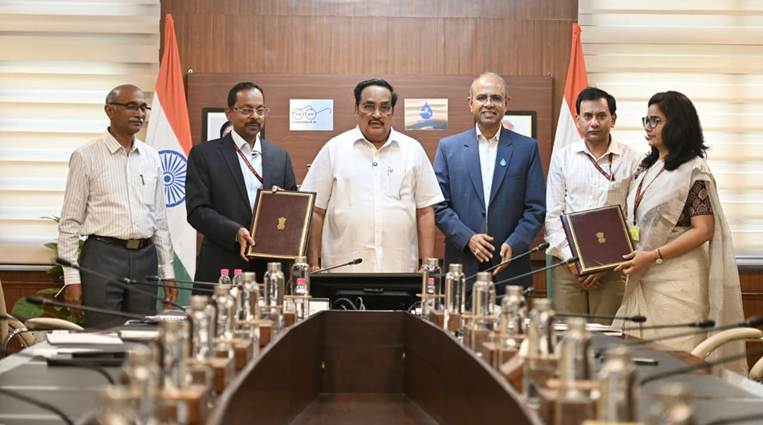
In the presence of the Union Minister of Jal Shakti, C.R. Paatil, who attended the meeting physically at the Department of Drinking Water and Sanitation (DDWS), Ministry of Jal Shakti, along with other senior officials, the MoU with Andhra Pradesh was signed. The Chief Minister of Andhra Pradesh, Nara Chandrababu Naidu, K. Pawan Kalyan, Deputy Chief Minister of Andhra Pradesh and Minister for Panchayat Raj, Rural Development, Environment, Forest, and Science & Technology, joined the event virtually along with senior officials from the state.
For Andhra Pradesh, the MoUs were signed and exchanged between Swati Meena Naik, Joint Secretary (Water), DDWS, and Shashi Bhushan Kumar, Special Chief Secretary to the Government of Andhra Pradesh.
Marking a key step in Centre-State collaboration, the MoU with the State of Odisha was formally signed at 12.30 p.m. in the virtual presence of Chief Minister of Odisha, Mohan Charan Majhi, Minister of Rural Development, Panchayati Raj, Drinking Water, Govt. of Odisha, Rabi Narayan Naik, Chief Secretary, Odisha, Anu Garg, Development Commissioner cum Addl. Chief Secretary, Deoranjan Kumar Singh, Sanjeeb Kumar Mishra, Finance Secretary and other senior officials from the State.
The MoU was signed between Swati Meena Naik, Joint Secretary (Water), DDWS, and Girish S.N, Commissioner cum Secretary, PR&DW Dept, and exchanged by Visal Gagan, Principal Residence Commissioner, Government of Odisha.
Addressing the gathering, Union Minister of Jal Shakti, C. R. Patil highlighted that while crores of rural households have already been provided tap water connections under the Jal Jeevan Mission, the focus under JJM 2.0 is on addressing gaps in existing infrastructure, covering the remaining households, and ensuring sustainable and reliable water supply systems. He emphasised the importance of formal handover of completed schemes to communities through proper documentation and strengthening community-led water management systems to ensure effective operation and maintenance. He further stressed the need to empower women through training in water quality testing using Field Test Kits, noting that the mission has already freed nearly 9 crore women from the burden of fetching water, marking a significant social transformation. Expressing confidence in the leadership of the State, he stated that Andhra Pradesh is well-positioned to achieve the vision of Har Ghar Jal and contribute to Viksit Bharat 2047. He also highlighted the Prime Minister’s emphasis on water use efficiency, including pilot initiatives for agriculture through pipeline-based supply and promotion of drip irrigation. He emphasised source sustainability through Jal Sanchay se Jan Bhagidari, promoting water conservation and community participation. He further urged the State to convene regular review meetings with district collectors and officials to accelerate implementation and ensure timely utilisation of funds, while assuring full support from the Government of India for the successful implementation of the mission.
Chief Minister of Andhra Pradesh, Nara Chandrababu Naidu, along with the Deputy Chief Minister, reaffirmed the State Government’s strong commitment to effective implementation of Jal Jeevan Mission 2.0. Expressing gratitude to the Prime Minister for extending the Mission timeline, they stated that this decision has enabled the State to move decisively towards universal household tap water coverage. Describing the Mission as a holistic initiative to ensure safe and protected drinking water for every household, the State leadership highlighted its transformative impact on public health and quality of life. They assured that Andhra Pradesh is now fully prepared to accelerate implementation and complete the mission within stipulated timelines. Reiterating the State’s focus on reliable, sustainable and assured drinking water services, with emphasis on service delivery, sustainability and community participation, they sought continued support from the Government of India to address remaining gaps. The Chief Minister further emphasised that providing tap water to every household remains a top development priority of the State, and invited the Union leadership to visit Andhra Pradesh to witness progress and inaugurate upcoming drinking water and irrigation projects, including those planned ahead of the Godavari Pushkaralu.
Chief Minister of Odisha, Mohan Charan Majhi, said that the MoU signing between the Government of India and the Government of Odisha is a significant step towards achieving the goal of Har Ghar Jal and building a Viksit Bharat, and appreciated the continued support of the Government of India in extending the mission under Jal Jeevan Mission 2.0 with a focus on universal coverage and sustainable service delivery and stated that the State is implementing JJM 2.0 with emphasis on community participation, financial sustainability, operation and maintenance and effective monitoring, supported by a comprehensive O&M policy and coordinated implementation efforts.
He further highlighted that steps are being taken for asset strengthening and digital integration, with the registration of water supply assets on the Sujal Bharat platform and assigned unique Sujal Gram IDs to enhance monitoring, transparency and accountability. He mentioned that the State is ensuring strengthening citizen-centric services through the Basudha helpline and WhatsApp interface, and promoting Jan Bhagidari through Village Water and Sanitation Committees.
The Union Minister Shri C.R. Patil appreciated Odisha for strengthening digital systems to improve monitoring and accountability of water supply schemes, the significant progress achieved under the Jal Shakti Abhiyan, particularly in water conservation and rejuvenation of water structures and the State’s citizen‑centric initiatives such as helplines, grievance redressal mechanisms and strengthened Village Water and Sanitation Committees that promote Jan Bhagidari.
The reform-linked MoU seeks to ensure that every rural household has access to drinking water supply in adequate quantity and of prescribed quality on a regular basis, through strengthened community participation (Jan Bhagidari) and bringing in structural reforms for sustainable operation and maintenance of rural water supply systems, thereby enhancing the living standards of rural communities contributing to long-term water security aligned with the national vision of Viksit Bharat @2047.
About the Author